
Why Cultural Awareness Matters
Picture this: you've just landed in China, ready to explore ancient temples, futuristic skylines, and everything in between. You're excited, maybe a little overwhelmed, and wondering how to navigate this fascinating country without accidentally offending anyone. The good news? Chinese people are incredibly warm and forgiving to foreign visitors. A genuine smile and sincere effort go a remarkably long way. Still, understanding a few cultural fundamentals will transform your trip from merely smooth to truly enriching.
At the heart of Chinese social interaction lies a concept you'll encounter everywhere:面子 (Miànzi), or "face." While the English word "face" might conjure images of, well, a face,miànzi is far more nuanced. It represents a person's reputation, dignity, and social standing—both in their own eyes and in the eyes of others. As the Chinese saying goes, "Men live for face as trees grow for bark." In practice, this means Chinese people generally go out of their way to avoid public embarrassment, whether for themselves or for others. You'll notice this in subtle ways: people rarely deliver a blunt "no" in public, and direct criticism—even if constructive—is typically softened or delivered privately to avoid causing a loss of face.
PRO TIP FOR SOCIAL SITUATIONS
If a local friend or business contact enthusiastically invites you to dinner and insists on paying the bill despite your polite protests,let them have that honor . In Chinese culture, hosting a guest and covering the expense is not just hospitality—it's a tangible way of "gaining face" (giving them social prestige). Fighting too hard for the check can actually rob them of this joy. A warm, sincere "Xièxie" (Thank you) and a promise to host them in your home country someday is the perfect, graceful response.
What about modern China? Is it all ancient traditions and formal rituals? Not at all. China in 2026 is a fascinating blend of deep-rooted tradition and hyper-modern living. You'll see grandmothers practicing tai chi in the park at dawn, then pulling out smartphones to scan QR codes for their breakfast buns an hour later. You'll encounter formal tea ceremonies in historic tea houses and, minutes away, friends clinking milk tea cups while live-streaming on social media. Handshakes have largely replaced bows in daily life, and the ancient art of gift-wrapping has been streamlined by the convenience of digital red envelopes. This guide is designed to help you navigate exactly this modern-traditional fusion—so you can focus less on worrying about etiquette and more on soaking up the incredible experiences China has to offer.
Social Interactions & Greetings
Greetings: Handshake, Nod, or Bow?
Let's clear this up immediately: you do not need to bow in China. While bowing is deeply ingrained in Japanese and Korean culture, in modern China, the handshake is the standard greeting for nearly all situations—whether you're meeting a business partner, a tour guide, or a new friend. In cities especially, handshakes are the safest and most common way to greet someone.

That said, a few nuances are worth knowing. First, keep the handshake relatively gentle; an overly firm grip can feel aggressive or uncomfortable. Second, when meeting a group, it's respectful to greet the eldest or most senior person first. Third, if you're the guest meeting a host, the host will usually extend their hand first. When saying goodbye, however, the guest should offer the handshake first.
What about physical contact? Hugging and cheek-kissing—common in many Western and Latin cultures—are not the norm in China, even among friends. Unless you're already very close with someone, stick to a handshake and a warm smile. A slight nod or smile makes the interaction even friendlier.
Q: What if someone asks "Nǐ chī le ma?" (Have you eaten?)
Don't panic—nobody is actually inviting you to lunch. It's simply a folksy way of saying "How are you?" A simple "Chī le"(I've eaten) or "Hái méi"(Not yet) is the expected, friendly reply.
Addressing People: Surnames First, Titles Matter
In China, the family name comes first , followed by the given name. For example, in "Wáng Wěi" (王伟), "Wáng" is the family name and "Wěi" is the given name. When addressing someone you're not close with, especially in formal or professional settings, using their title + surname is the gold standard of politeness. If someone is a manager, teacher, or doctor, you can say "Wáng Jīnglǐ" (Manager Wang) or "Lǐ Lǎoshī" (Teacher Li). If you're unsure of their professional title, "Xiānsheng" (Mr.) and "Nǚshì" (Ms.) are perfectly safe defaults.
Avoid jumping straight to first names, and steer clear of casual slang like "Hey bro!" unless you've built genuine closeness.
Personal Space: A Different Calculus
If you're from a culture that values a generous personal bubble, prepare for a gentle adjustment. China is home to over 1.4 billion people, and in bustling cities like Shanghai, Beijing, or Guangzhou, personal space operates on a different scale. People will stand closer to you in queues, on subways, and in crowded markets. This isn't rudeness—it's simply a practical adaptation to population density. That said, physical contact like back-slapping or hugging between acquaintances remains uncommon in public. The best approach? Take a breath, go with the flow, and remember that no one is trying to invade your space intentionally.
The Concept of "Face": Giving It and Keeping It
We touched on miànzi earlier, but how does it play out in real interactions?
- Accept compliments with humility using "Nǎlǐ nǎlǐ" or "Guòjiǎng le."
- Refuse offers or gifts gently once or twice before accepting to show grace.
- Point out mistakes discreetly to save the other person's dignity.
- Avoid public criticism or making someone feel embarrassed in front of others.
- Don't be too direct or blunt with a "No" in formal social settings.
- Don't feel pressured by "pushy" hospitality; it's just a ritual.
Dining Etiquette: The Heart of Chinese Culture
If there's one thing that unites Chinese people across all regions and generations, it's a deep, abiding love for food. Meals in China are not just about sustenance; they're social events, bonding opportunities, and expressions of care. Understanding dining etiquette is arguably the most impactful way to show respect and connect with locals.
Table Seating: Where You Sit Matters
At formal dinners or banquets, seating is not random—it reflects hierarchy and respect. The most prestigious seat is typically the one facing the entrance . This seat is reserved for the most senior person or the guest of honor. The host usually sits opposite the guest of honor, making it easier to serve dishes and keep conversation flowing. Other guests are seated based on their relationship to the host and their relative seniority.
As a foreign visitor, your Chinese hosts will likely guide you to your seat—just follow their lead. A simple rule of thumb: wait to be seated and don't sit down before the host or the most senior person does.
Chopstick Essentials: What NOT to Do
THE ULTIMATE CHOPSTICK TABOO
Never stick chopsticks vertically into a bowl of rice.This arrangement resembles incense sticks burned at funerals and is deeply associated with death and mourning.
Chopsticks are more than utensils; they're cultural symbols with a set of clear taboos. Beyond the "vertical sticks" rule, keep these in mind:
- Don't point your chopsticks at others.Pointing is considered rude, and chopsticks are seen as an extension of your fingers.
- Avoid tapping your bowl with chopsticks.This is what beggars historically did, so it comes across as impatient or insulting.
- Don't use chopsticks to rummage through shared dishes.Take what you touch, and use serving chopsticks if provided.
If you're struggling with chopsticks,don't be embarrassed to ask for a fork and spoon . Most restaurants in tourist-friendly areas will have them, and your hosts would much rather you eat comfortably than struggle nobly.
The Round Table & Lazy Susan: Sharing Is Caring
Chinese meals are typically served family-style : a spread of dishes is placed in the center of a round table, and everyone shares. This is where the Lazy Susan (rotating tray) comes in—it's your best friend for reaching dishes without awkward stretching.
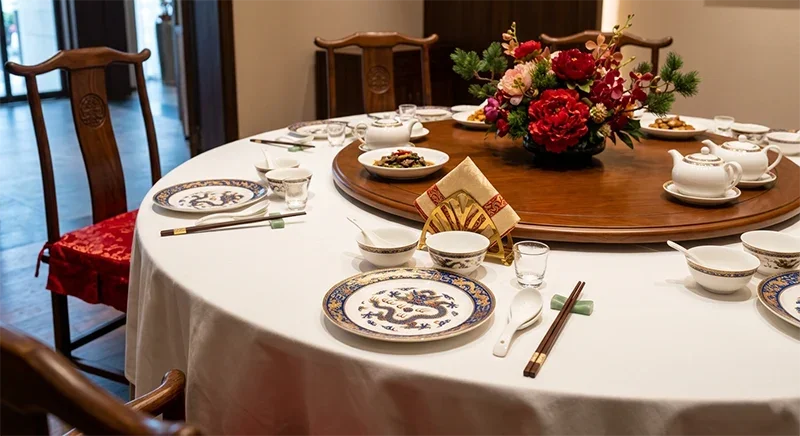
Table Manners Summary
- Look before you spin:Ensure no one is reaching for a dish before rotating the Lazy Susan.
- Finger tapping (叩指礼, Kòu zhǐ lǐ):This subtle gesture is a silent, universally recognized way to say "Thank you" when someone refills your cup. However,the specific number of fingers and how they are used depends entirely on the relative social standing (hierarchy) of the two people involved.
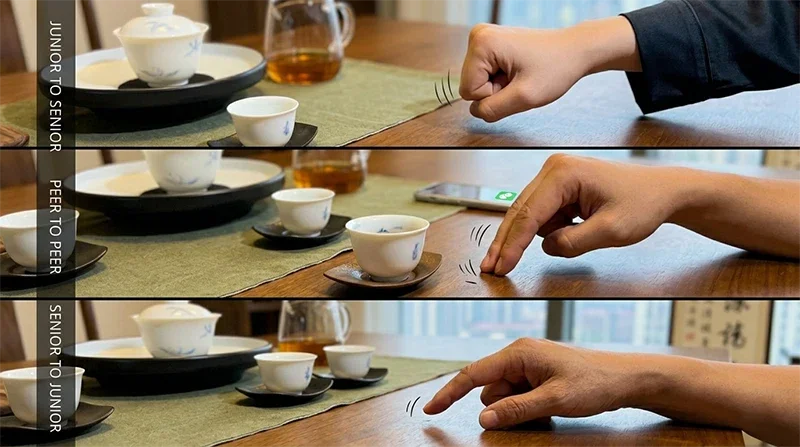
Kou Zhi Li (The Finger Tap) at a glance: Use five knuckles to show extreme respect, two knuckles for friends, and a single tap for juniors. - Toast with humility:When clinking glasses, hold yours slightly lower than the senior person's.
- Pour for others first:Always refill your neighbor's tea or drink before your own.
- Don't start too early:Wait for the host to pick up chopsticks or say "Chī ba" (Let's eat).
- Avoid the teapot "aim":Never point the teapot's spout directly at anyone at the table.
- Don't feel forced to "Ganbei":If you can't finish the drink, say "Suíyì" (drink at your own pace).
- Don't take huge portions:It's better to take small amounts and go back for seconds later.
Tea is the lifeblood of Chinese hospitality. Keeping each other's cups filled is a small but meaningful gesture of care. Similarly, if alcohol is served—especially the potent Chinese liquor báijiǔ(白酒)—toasting is a ritual unto itself. It's all in good fun and a sign of warmth.
Gift Giving Customs
Gift giving in China is steeped in symbolism. The thought counts, but so do the colors, numbers, and even the pronunciation of the gift's name. A little knowledge here can prevent a well-intentioned gesture from accidentally sending the wrong message.
Lucky Colors and Unlucky Ones
- Red:The ultimate lucky color symbolizing happiness and prosperity.
- Gold/Yellow:Often associated with royalty and wealth.
- Red Envelopes (hóngbāo):The standard for weddings and festivals.
- White & Black:Traditional funeral colors representing mourning or grief.
- White Flowers:Specifically chrysanthemums, which are for funerals.
- Plain Wrapping:Avoid overly somber or colorless gift bags.
Lucky and Unlucky Numbers
THE NUMBER 4 TABOO
Avoid the number 4 at all costs.The pronunciation (sì) sounds like "death" (sǐ). In some traditional buildings or older hotels, you might notice the 4th floor is skipped or relabeled, though this is less strict in modern skyscrapers.
Conversely,8 is the luckiest number because it sounds like "prosperity" (fā). Also, remember the saying "Hǎo shì chéng shuāng" (Good things come in pairs)—even numbers are generally preferred for gifts, except for the number four!
Taboo Gifts: What Never to Give
Some gifts carry such strong negative connotations that they should be avoided entirely:
| Gift | Why It's Taboo |
|---|---|
| Clocks or watches | "Giving a clock" (sòng zhōng) sounds like "attending a funeral." |
| Pears | "Pear" (lí) is a homophone for "separation" or "parting." |
| Green hats | In Chinese culture, this implies a man's wife has been unfaithful. |
| Umbrellas | "Umbrella" (sǎn) sounds like "to break up" or "scatter." |
| Sharp objects | These symbolize cutting ties or severing a relationship. |
Safe, universally appreciated gifts include high-quality tea, fresh fruit, local specialties from your home country, or fine alcohol.
Receiving Gifts: Etiquette
HANDLING THE GIFT
Use both hands when giving or receiving—it's a fundamental sign of respect. Don't be surprised if the recipient declines once or twice before accepting; it's a ritual of modesty. Also, avoid opening the gift immediately in front of the giver unless invited to do so.
Public Behavior & Social Norms
Noise Levels: A Different Baseline
If you're from a country where public spaces are quiet zones, Chinese public spaces might feel lively—sometimes startlingly so. Restaurants hum with conversation and laughter; families chat animatedly on trains; street vendors call out their wares. This isn't rudeness; it's simply a cultural norm where sociability and expressiveness are valued. What sounds like shouting to you might just be an enthusiastic discussion to the people involved. Try to adjust your expectations and embrace the vibrancy rather than resist it.
That said, in more formal or quiet settings—museums, temples, libraries—the expectation for quiet behavior is universal. Use your judgment and observe what locals are doing.
Queuing: Patience and Perspective
Queuing in China has improved dramatically over the past two decades, especially in major cities. You'll find orderly lines at train stations, airport security, and bank counters. However, in high-density, high-pressure situations—think subway boarding during rush hour in Shanghai or securing a popular street food stall—the concept of a neat, single-file line can fray at the edges. People may crowd forward, and personal space will shrink to near zero.
HANDLING CROWDS
This isn't about disrespect; it's often about efficiency in a country with enormous population density. As a visitor, the best strategy is to be firm but polite , maintain your position without aggression, and go with the flow when necessary. Getting visibly angry or confrontational in public is frowned upon and can cause a loss of face for everyone involved.
Tipping Policy: Save Your Cash
Here's a piece of good news that often surprises Western travelers:tipping is not practiced in China . Not in restaurants, not in taxis, not in hotels. In fact, offering a tip can create an awkward situation where the recipient may feel uncomfortable or even embarrassed.
Standard Tipping Amount:¥0.00
The one exception: tour guides and private drivers who serve international clients may be accustomed to receiving tips. For everyday dining and services, however, simply pay the bill and go—no extra math required.
Photography & Public Etiquette
- Ask before close-ups:A smile and a gesture toward your camera is usually enough to get permission from locals.
- Check for signs:Look for "No Photography" signs in temples and museums.
- Observe the vibe:Mirror the behavior of locals in quiet zones like libraries.
- No Military/Gov photos:Avoid snapping pictures of military installations or personnel.
- No flash in museums:Protect ancient artifacts by keeping your flash turned off.
- Don't lose your temper:Public outbursts cause a major loss of face for you and others.
Business Etiquette (Quick Overview)
While this guide is primarily for tourists, you might find yourself in a business-adjacent situation—perhaps meeting a local partner for a meal or attending a conference. Here's a rapid-fire primer:
Business Cards: The Two-Handed Ritual
THE BUSINESS CARD RITUAL
Always present and receive cards with both hands . Take a moment to look at it carefully —don't just shove it into your pocket. Putting a business card directly into your back pocket is considered especially disrespectful, as it symbolically means you're sitting on the person's face.
Punctuality: Arrive Early or On Time
In Chinese business culture, punctuality is non-negotiable. Arriving on time—or ideally, a few minutes early—demonstrates respect for the other party's time and professionalism. Tardiness can be interpreted as a lack of seriousness.
Small Talk & Conversation
- Food:Discussing regional cuisines is always a winner.
- Travel:Share what you've enjoyed about China so far.
- Home Culture:Talk about your home country's scenery or traditions.
- Family:General positive topics about family are welcomed.
- Politics:Avoid sensitive political discussions.
- Sensitive Regions:Steer clear of topics like Taiwan or Tibet.
- Money:Don't ask about personal income or costs.
- Criticism:Avoid anything that could be perceived as criticism of China.
Digital Etiquette: The Mobile-First Society
China is arguably the world's most cashless society. From luxury malls to humble street-food stalls, from subway gates to temple donation boxes,QR code payments dominate daily life. This digital ecosystem runs primarily on two super-apps:WeChat (微信) and Alipay (支付宝).
WeChat Culture: More Than Messaging
WeChat is not just a messaging app, it's the operating system of Chinese daily life. As a tourist, you'll likely use it primarily for communication and payments.
Q: Can I use Digital Red Envelopes (hóngbāo)?
Yes!While functionality was historically limited,recent updates in 2026 now allow many foreign users to receive and send small amounts. If a local friend sends you a tiny hóngbāo (like ¥0.66 or ¥8.88), it's a gesture of goodwill—enjoy this unique piece of digital culture!
Mobile Payments: Essential Setup
CRUCIAL: ENSURE YOU HAVE MOBILE DATA
These payment apps require a live internet connection to process transactions. Before you leave the airport, make sure you have an active eSIM, local SIM card, or international roaming plan enabled. Relying on spotty public Wi-Fi can lead to frustrating dead ends at the checkout counter.The ultimate guide to staying connected in China , check out our comprehensive China Internet 101 Guide .
As of 2026,both WeChat Pay and Alipay support direct linking of international Visa and Mastercard credit cards . Here is how to handle your digital wallet:
- Set up early:Link your international card 5-10 minutes after downloading the apps.
- Keep small change:Carry ¥10 and ¥20 bills for small vendors who might not have change for ¥100.
- Expect fees:Be aware of a ~3% surcharge for transactions over ¥200.
- Don't rely 100% on apps:Carry ¥100–200 in cash as a tactical backup.
- Don't wait until the counter:Have your QR code ready to scan while you're in the queue.
- Don't worry about bank accounts:Foreign cards are now widely accepted through these apps.
Bonus Travel Tip: High-Speed Train Travel in 2026
2026 SEAMLESS BOARDING
No more paper tickets!The vast majority of train stations now allow foreign passport holders to use automated gates. Once booked via Trip.com or 12306, simply scan your passport at the turnstile. Just ensure your booking name matches your passport exactly. Check out our China High-Speed Rail 101: The Ultimate Train Travel Guide
Traveling in China is an extraordinary experience—one that blends ancient history with breakneck modernity, serene landscapes with bustling megacities, and deep-rooted tradition with digital innovation. Cultural differences exist, and yes, you might occasionally stumble. You might accidentally point your chopsticks at someone or forget to hold your glass lower during a toast.That's okay.
THE GOLDEN RULE OF TRAVEL
The single most important piece of advice I can offer is this:maintain an open mind and a genuine smile . Chinese people are remarkably gracious hosts, and they appreciate any effort a foreigner makes to understand their culture. A sincere apology—"Duìbuqǐ" (Sorry)—delivered with humility and a smile, can smooth over almost any cultural misstep. No one expects perfection.
What they will notice, and what they will appreciate, is your willingness to try . Trying to use chopsticks, even if clumsily. Attempting a few words of Mandarin, even if mispronounced. Showing curiosity about the food, the history, the way of life. These small gestures signal respect and openness, and they're the foundation of the warm, memorable connections that make travel truly meaningful.
So go ahead—book that ticket, download WeChat, and pack your sense of adventure. With a little cultural awareness and a lot of curiosity, your time in China will be not just smooth, but unforgettable.
Zài zhōngguó lǚyóu yúkuài!在中国旅游愉快—Happy travels in China!