
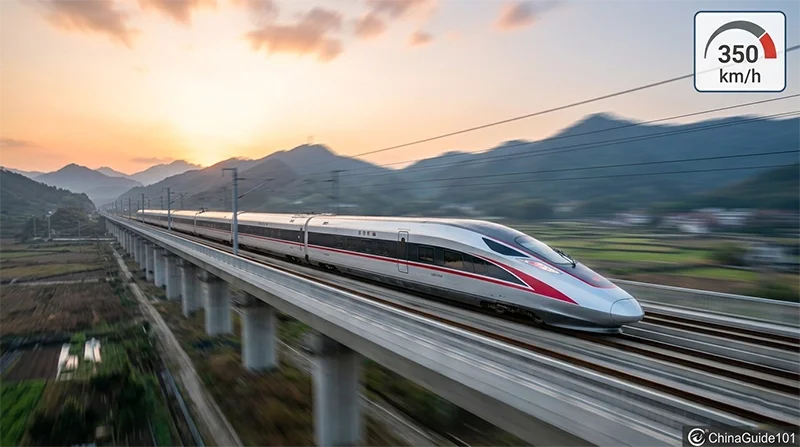
Forget delayed flights and stuffy long-distance buses—China's high-speed rail (HSR ) is hands down the best way to traverse this vast nation. With near-perfect punctuality, city-center stations, and speeds up to 350 km/h, it turns cross-country trips into smooth, scenic journeys. No airport security lines, no remote terminals, no traffic jams—just sit back, relax, and watch China glide by. This guide covers everything you need to ride like a local in 2026.
The High-Speed Network: A System Overview
China boasts the world's largest HSR network , spanning over 50,000 kilometers —enough to wrap around the Earth's equator. It connects nearly all major cities and countless smaller ones, making almost any destination accessible by bullet train.
Why Choose High-Speed Rail?
- Unbeatable Punctuality : Trains depart and arrive on time over 99% of the time , rain or shine. No more waiting for delayed flights.
- Cost-Effective : Often cheaper than flights for mid-range routes (500–1,500 km), with no hidden baggage fees.
- City-Center Convenience : Stations are downtown or easily metro-connected , saving hours of transit to/from airports.
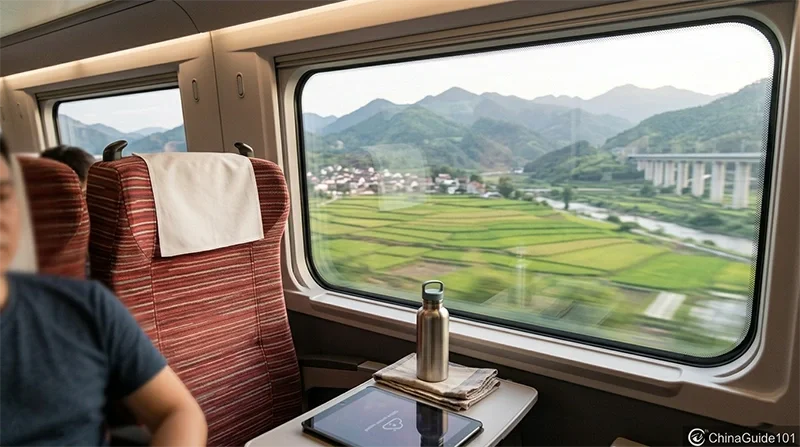
- Scenic Comfort : Large windows, spacious seats, and the ability to walk around—perfect for sightseeing or working.
- Eco-Friendly : Far lower carbon emissions per passenger than air or road travel.
Train Codes Decoded: G, D, C
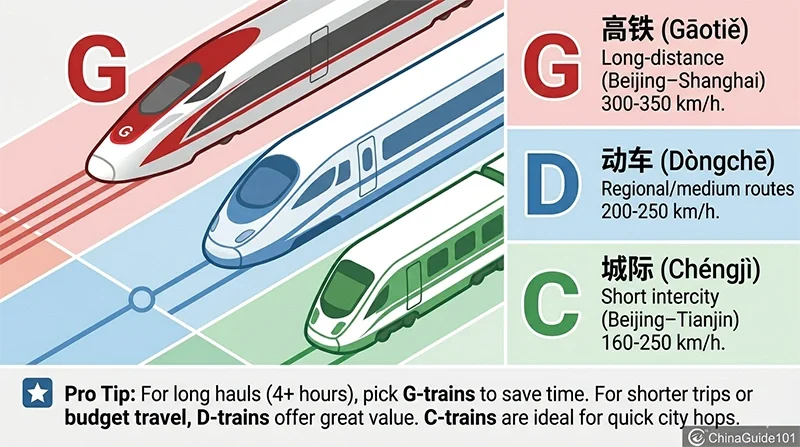
Not all bullet trains are the same. The letter prefix tells you speed, route, and stops:
| Code | Name | Top Speed | Best For | Key Traits |
|---|---|---|---|---|
| G | 高铁 (Gāotiě) | 300–350 km/h | Long-distance (Beijing–Shanghai) | Fastest, fewest stops, all seat classes |
| D | 动车 (Dòngchē) | 200–250 km/h | Regional/medium routes | Cheaper , more stops, some overnight sleepers |
| C | 城际 (Chéngjì) | 160–250 km/h | Short intercity (Beijing–Tianjin) | Budget , frequent departures, open seating |
PRO TIP: Choosing Your Train
For long hauls (4+ hours), pick G-trains to save time. For shorter trips or budget travel,D-trains offer great value.C-trains are ideal for quick city hops.
Planning Your Route: Essential Tools & Timing
Planning is half the battle—here's how to book smart and avoid stress.
Booking Channels: 12306 vs.Trip.com
Two main options for foreigners (2026 update):
12306 (Official App/Website)
- Pros :No service fees , real-time inventory, direct railway access.
- Cons : Clunky English interface; requires passport verification (1–3 days).
- Best for : Tech-savvy travelers who want the lowest price and no middleman.
Trip.com (Third-Party)
- Pros :Full English support , accepts Visa/Mastercard/PayPal, 24/7 help, auto-books when sales open.
- Cons : Small service fee (~3%discount for new users).
- Best for : Most foreign travelers—easiest, most hassle-free way to book.
PRO TIP: The 15-Day Rule
Tickets go on sale 15 days before departure (at 5 AM China time). Popular routes (e.g., Beijing–Shanghai, Xi'an–Chengdu)sell out within hours on day 1. Set a reminder for the 15-day mark and book immediately for peak dates.
Seat Selection Philosophy
Seats follow an aviation-style system (no "E" seat!):
- A/F :Window seats (best for views, privacy, light sleepers).
- C/D :Aisle seats (easy access, quick exits, ideal for short trips).
- B :Middle seat (second class only—avoid if possible!).
How to Select : On Trip.com , choose "Window" or "Aisle" during booking. On 12306, manually pick A/F or C/D.
PRO TIP: Couples Travel
For couples, book D+F (aisle + window) in second class—you'll sit together with no middle seat.
Holiday Survival Guide (Spring Festival/Golden Week)
Chinese holidays are the busiest time —tickets are gold dust:
- Book 15 days early—set an alarm for release.
- Be flexible with time (early morning/late evening).
- Check daily for returned tickets.
- Rely on last-minute G-train bookings.
- Ignore split-ticket options if direct routes are sold out.
The Digital Boarding Pass: Using Your Passport
No paper tickets needed—China is fully e-ticket (2026). Your passport is your ID and boarding pass.
Key Rules for Foreign Travelers
PRO TIP: Keep Your Passport Handy
Always carry your original passport —no copies, no photos. It's required for every step : entry, security, gates, and onboard checks. Save your digital confirmation (email/app) offline for easy reference.
Step-by-Step Boarding with a Passport
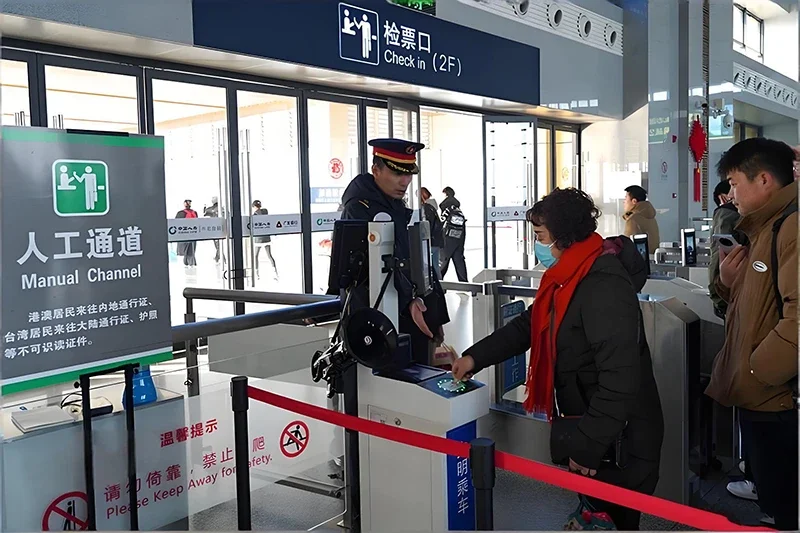
Head to the manual foreigner channel . Machines don't read foreign chips, so present your passport to the staff here.
Standard airport-style screening—laptops out, liquids under 100ml, remove jackets.
Locate your gate on the electronic departure boards . Proceed to the manual gate 15–20 minutes before departure.
Keep your passport ready; ticket inspectors perform spot checks throughout the journey.
Prohibited & Restricted Items: Security Check Guide
When passing through security at Chinese train stations, please note these common restrictions. Keeping your luggage compliant will save you time and prevent any items from being confiscated.
🚫 Items You Must NOT Carry
- Hazardous/Flammable:Explosives, gasoline, lighter fluid, strong chemicals.
- Sharp Objects:Large scissors, utility knives, or box cutters.
- Self-Defense:Pepper spray and tear gas.
- Pack sharp items in your checked luggage for flights.
- Ensure all personal care items meet the quantity limits below.
⚠️ Items with Quantity Limits
If you are carrying these personal care items, please ensure they meet these specific limits:
| Category | Limit per Item | Total Limit |
|---|---|---|
| Aerosols (Hairspray, Mousse, etc.) | Max 150ml | Max 600ml total |
| Perfume/Cologne (Non-pressurized) | Max 100ml | 1 bottle per type |
| Alcohol (24%–70% Vol) | N/A | Max 3,000ml (3L) |
| Nail Polish/Remover | N/A | Max 50ml total |
| Lighters/Matches | 2 Lighters / 2 Boxes | Keep in pockets only |
🔋 Electronics & Batteries
- Power Banks:Must be clearly marked with capacity. The capacity of a single power bank must not exceed 100Wh .
- Loose Lithium Batteries:Should be properly protected to avoid short-circuiting.
PRO TIP: Smooth Security Experience
Security at Chinese train stations is much faster and more relaxed than at airports. Here is how to speed through:
- Keep Electronics Packed:You do not need to take your laptop, tablet, or camera out of your bag.
- Liquids Are Fine:Keep them inside your luggage.
- Empty Your Pockets:Place your phone, keys, coins, and lighter into your bag before you reach the machine.
- If You're Concerned:Ask the station staff at the entrance before putting your bag on the conveyor belt.
Station Mastery: Surviving the "Airport-Style" Hubs
Major HSR stations are massive (like Shanghai Hongqiao—bigger than many airports). Avoid getting lost with these hacks.
The #1 Station Trap: Same City, Different Stations
PRO TIP: Double-Check Your Station Name
Never mix up stations —they can be 1+ hour apart! Always match the Chinese characters on your ticket exactly to the station signs. For example, in Shanghai, the Hongqiao hub handles the majority of G/D trains, while Shanghai Station and South Station serve different routes.
Station Flow Checklist
Arrive 45–60 mins before departure for major hubs like Hongqiao or Beijing South.
Follow signs for Departures (Fāchē). Security is quick and efficient—keep electronics packed.
Check the boards for Train No. and Gate . Note: Gates shut strictly 5 minutes before departure —no exceptions!
Proceed to your assigned platform. Note that gates often have A and B sides , which lead to different car sections on the same platform.
Navigating the Waiting Area
- Arrive early to secure a seat near your specific gate.
- Use the free station Wi-Fi if available.
- Wait at the wrong A/B side gate number.
- Wander too far from your gate if your status says "Check-in Soon."
Onboard Experience: Comfort & Etiquette
Your chariot awaits—here's what to expect onboard.
Seat Classes: Second vs. First vs. Business
| Class | Layout | Price | Comfort |
|---|---|---|---|
| Second Class | 3+2 | Base (¥) | Spacious, reclines 15°, clean |
| First Class | 2+2 | ×1.6–1.8 | Wider seats, more recline (30°) |
| Business Class | 1+2 / 1+1 | ×3–4 | Lie-flat (180°), leather, free meals |
Power & Connectivity
- Power Outlets : Every seat has USB ports and standard AC sockets (bring a 2-pin adapter if needed).
- Wi-Fi : Free onboard Wi-Fi is available, but download movies/maps offline as streaming can be slow.
- Mobile Signal : Strong in cities, but expect drops in tunnels—cache content ahead.
Food & Drinks
PRO TIP: The "Hot Water" Culture
There is free unlimited hot water at the end of every car. Bring a reusable bottle to stay hydrated—it's very common practice here.
- Dining Car : Sells meals (¥30–60); it is perfectly allowed and common to bring your own snacks and food.
Luggage Rules
- Carry-on Limit : 20kg (44lbs) per adult; max size 130×60×35cm.
- Power Banks : Must be clearly marked and ≤100Wh (approx. 27,000mAh).
Basic Etiquette
- Keep your voice down during calls.
- Use provided bins for your trash.
- Stay strictly in your assigned seat.
- Smoke or use e-cigarettes anywhere.
- Take your shoes off (unless in Business Class).
- Play music or media without headphones.
Pro Tips for Advanced Travelers (The Secret Sauce)
Level up your HSR game with these expert hacks.
Ticket Changes & Refunds (2026 Rules)
PRO TIP: Manage Changes Online
Changes and refunds can be handled via the 12306 app or Trip.com , or at any station counter with your passport. Be mindful that fees increase as departure time approaches (ranging from 5% to 20%).
Same-Station Transfer
For connecting trains, don't exit the station:
Look for "Transfer (Huànchē)"signs immediately after exiting your first train.
This allows you to bypass the main security check—save 20–30 mins for tight connections.
Have your next e-ticket and passport ready for staff inspection.
Must-Have Apps
- 12306 /Trip.com : Essential for booking and refunds.
- Baidu / Apple Maps : Best for finding specific station entrances and metro connections.
- Google Translate : Download offline language packs for Chinese signs and communication.
Safety & Health
- Carry a small first-aid kit.
- Keep a digital + printed copy of your passport.
- Save emergency numbers:12306 (Railway) and 110 (Police).
- Leaving valuables unattended.
- Waiting until the last minute for station navigation.
Frequently Asked Questions
Booking & Verification
Q: Do I have to use 12306 to buy tickets?
Not necessarily. While 12306 (the official platform) offers the most comprehensive schedules, platforms like Trip.com are reliable alternatives if you find the official site difficult to navigate.
Q: How long does identity verification take?
Usually, it is processed instantly. However, in rare cases, it may take up to 48 hours . We strongly recommend completing your identity verification online well in advance of your travel date.
Q: Can I buy tickets at the station?
While some stations have ticket counters, they are not recommended . Tickets for popular routes sell out quickly, especially during holidays. Always secure your tickets online as early as possible.
Boarding & Travel
Q: Can I really not use the self-service gates with my passport?
The success rate is very low and unstable. To avoid missing your train or causing delays,always use the Manual Channel . It is the safest and most efficient choice.
Q: Can I bring a power bank?
Yes, provided the capacity is ≤100Wh (roughly 27,000mAh) and clearly marked. Power banks exceeding 100Wh are prohibited.
Q: What if I miss my train or overshot my station?
- Missed Departure:Change to the next available train at the service counter (fee applies, usually 20%).
- Overshot Station:Alert staff immediately. They will arrange for your return at no extra charge.
PRO TIP: Prohibited Onboard Items
While snacks are encouraged,self-heating meals (hot pot/rice)are strictly prohibited due to fire safety regulations. Please stick to standard ready-to-eat food.
China's high-speed rail is more than just transport—it's a travel experience in itself. Efficient, comfortable, and reliable, it lets you explore China's incredible diversity with ease. By following this guide, you'll avoid common pitfalls and ride like a seasoned local.
Now—book your ticket, pack your bags, and get ready to discover the real China at 350 km/h.All aboard!