
The "New Normal" of Chinese Tourism
For international travelers planning a trip to China in 2026, one fundamental reality reshapes every part of sightseeing planning:spontaneous walk-up ticket purchases at major museums, imperial landmarks, and world-famous natural sites are almost entirely a thing of the past . Long gone are the days when visitors could arrive at the gate of the Forbidden City, Terracotta Warriors, or National Museum of China, queue briefly, and buy a physical ticket for same-day entry.
- Pre-book all "Must-See" landmarks via digital platforms to guarantee entry.
- Expect to find traditional on-site ticket booths at top-tier attractions.
China's tourism infrastructure has undergone a permanent systemic shift, driven by crowd management, cultural relic protection, public safety regulations, and nationwide real-name governance, forming a brand-new operational norm for inbound tourism in 2026.
PRO TIP: STAY UPDATED
Policies and release times are subject to seasonal adjustments. Always double-check the "Latest Notice" section within the official mini-program 24 hours before your target booking date.
The single most transformative shift across China's major tourist attractions is the wide-scale implementation of the Real-name Registration System (实名制). For high-demand landmarks, entry tickets are now strictly bound to an individual's travel document. Anonymous tickets and transferable passes have been phased out at most top-tier sites, and traditional on-site ticket booths are increasingly being replaced by digital-only reservation platforms. This policy has become a long-term national standard for tourism management, intended to regulate crowd flow and ensure site security.
Q: Can I still buy tickets on-site at any locations?
While many secondary or less-crowded sites still offer on-site ticket purchasing, pre-booking remains the only guaranteed way to secure entry at China's "Must-See" landmarks.
2026 brings unprecedentedly favorable conditions for foreign tourists navigating this system. China has extended its large-scale unilateral visa-free policy until December 31, 2026 , granting 50 eligible countries 30-day visa-free entry. Parallel to expanded visa access, official platforms have rolled out upgraded English-language support and international payment compatibility that did not exist in prior years.
This guide delivers actionable, error-proof advice to help you secure entry to China's most iconic destinations, avoid scalper scams, and comply with all local entry requirements without misinformation.
The Golden Rule: Real-Name Booking Explained
The Real-name Registration System is the standardized foundation of modern Chinese tourism. Every foreign traveler must understand its logic to ensure a smooth entry experience.
What the Real-Name System Means for You
In essence,your travel document is your digital key.Most high-demand sites do not issue physical, anonymous tickets. Instead, your booking is tied to the identification provided during the reservation. While strict data matching is the rule, the system is designed to accommodate international visitors through various channels.
Supported Documents:While the Passport is the primary document for most, other valid IDs include the Foreign Permanent Resident ID Card (which often allows direct swiping at turnstiles like a local ID), and regional permits for travelers from Hong Kong, Macau, and Taiwan.
The Matching Rule:While names and document numbers should ideally match 100%, small errors aren't always a "dead end." Most major attractions now provide dedicated Manual Verification Channels to resolve minor discrepancies or scanning issues.
Essential Pre-Trip Preparation
Before booking, ensure you have organized the following details for everyone in your group:
PRO TIP: DATA ACCURACY
Prepare a digital note or printout with these details to avoid typos during the short booking windows:
- Full Legal Name:Exact spelling and order as shown on ID.
- Identification Number:Double-check every digit.
- Document Expiry Date:Must be valid for 3+ months.
- Nationality:As listed on your travel document.
Entry Validation: Scanning, QR Codes, and Vouchers
In 2026, most landmarks prioritize physical document scanning at automated gates. However, the process can vary by site:
You insert your original passport or swipe your Permanent Resident ID at the turnstile for instant validation.
Some sites like Mogao Caves require exchanging digital codes for a Paper Entry Voucher (购票信息单)at a kiosk.
THE "MANUAL LANE" (RELIABLE BACKUP)
Many turnstiles are optimized for Chinese IDs. If the gate doesn't open, look for the Manual Channel (人工通道)where staff verify your ID manually.
Emergency: If the System Fails to Recognize Your ID
China's Ministry of Culture and Tourism has mandated that all major attractions maintain offline service options for international tourists.
Q: What if the system fails to recognize my ID or booking?
Head to the Service Window (综合服务窗口). Every top-tier site (5A/4A) reserves this as a "safe zone" for technical glitches or special cases. Bring your original document and reservation confirmation ; staff are trained to resolve "off-system" cases manually.
Top 3 Ways to Book
Foreign travelers have three reliable, official channels for securing attraction tickets in 2026. Below is a detailed comparison to help you choose the best option for your needs.
| Booking Method | Service Fee | Language Support | Ticket Inventory Access | Ticket Grab Success Rate | Key Pros | Key Cons |
|---|---|---|---|---|---|---|
| Official WeChat Mini-Programs | $0.00 | Default Chinese; built-in translation available | Full inventory (largest allocation) | High (80–90% for peak dates with quick booking) | 100% official, no hidden fees, instant updates | Chinese interface, requires WeChat installation |
| Official English Websites | $0.00 | Full English (optimized for foreigners) | Partial inventory (smaller than WeChat) | Medium (60–70% for peak dates) | No app downloads, intuitive global navigation | Slower during peak hours, occasional server lag |
| Third-Party OTAs (Trip.com, Klook, Viator) | 5–15% above base price | Full English + multilingual support | Partial inventory (authorized quota) | Medium-High (70–80% with pre-booking) | No language barriers, 24/7 customer support | Extra service fees, limited rare ticket access |
Official WeChat Mini-Programs
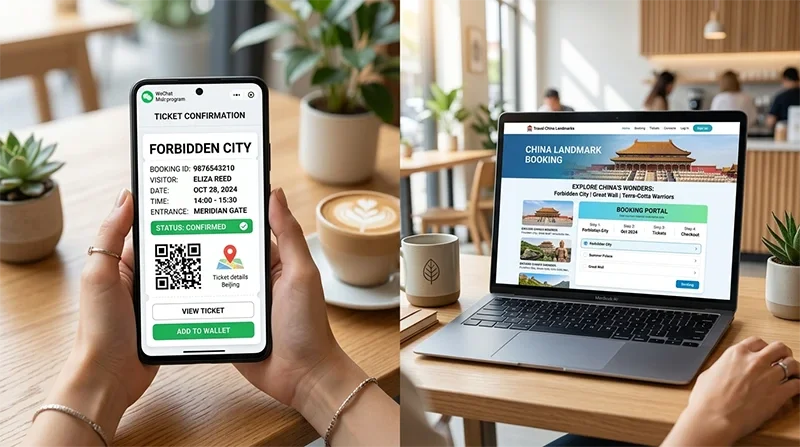
WeChat Mini-Programs are the exclusive primary booking channel for most state-owned heritage sites, including the Forbidden City and National Museum of China. They reserve the largest daily ticket inventory, with zero scalper interference.
Step-by-Step Operation
Download WeChat and register with your international mobile number.
Tap the search icon and input the exact official Chinese name of the attraction.
Enter the verified mini-program, select visiting date, time slot, and ticket type.
Input full passport details into the foreign national registration module.
Complete payment via linked international cards and receive confirmation.
PRO TIP: WECHAT TRANSLATION
For non-Chinese speakers: Long-press Chinese text to trigger WeChat's real-time in-app translation for menus and prompts. Pre-fill passport info in your WeChat profile to save time during ticket releases.
Official English Websites
In 2026, iconic Beijing landmarks (Forbidden City, Summer Palace, National Museum) have launched stable, permanent English booking websites—no Chinese apps or local accounts required. Reservations follow a simple web form flow: create an account with your email, add traveler profiles, pay, and store confirmation emails.
Third-Party OTAs
These platforms (Trip.com , Klook, Viator...) offer fully English end-to-end booking, pre-filled passport processing, and bundled transport + ticket options. You pay a small service fee for eliminated language barriers and 24/7 overseas support.
- Only use the three official/authorized channels listed above for bookings.
- Avoid unofficial scalper sites, social media sellers, or unlicensed private resellers.
CRITICAL WARNING
All unlicensed resellers are illegal—fake reservations, stolen passport data, and denied entry are common risks. Only the three channels above are legitimate.
Deep Dive: Booking Top Landmarks
Below is detailed 2026 booking guidance for China's most visited landmarks. For full in-depth guides, check our Coming Soon cluster posts dedicated to each site.
The Forbidden City (Beijing)
The Palace Museum remains China's most competitive attraction. In 2026, same-day tickets and walk-ins are generally not permitted, and on-site ticket counters are permanently closed. Real-name passport registration is mandatory for all international visitors.For more details, see our Forbidden City Guide .
PRO TIP: THE ALARM CLOCK GUIDE
Ticket Release Time:7 days prior to visiting date at 20:00 Beijing Time (GMT+8). With a strict limit of 40,000 visitors per day, tickets often vanish within minutes. Pre-fill your passport details in your booking profile to shave seconds off your "8:00 PM Battle."
Hours: 08:30 - 17:00 |¥60
Last Entry: 16:00
Hours: 08:30 - 16:30 |¥40
Last Entry: 15:30
Separate ¥10 tickets are required for the Treasure Gallery and Clock Gallery (highly recommended for their unique imperial collections).
- Enter via Meridian Gate only (Wu Men).
- Bring your physical passport ; digital copies are not accepted for scanning.
- Check holidays : Open on Mondays during National Traditional Holidays.
- Don't arrive late ; morning slots expire at 12:00.
- Don't visit on Mondays ; the museum is closed (except holidays/special events).
- Don't visit on Chinese New Year's Eve ; the museum is closed.
Q: Does the 40,000 daily limit include tour groups?
Yes. The 40,000 visitor cap applies to the total daily volume, including both individual travelers and tourist groups. This is why advance online booking is essential for everyone.
The National Museum of China (Beijing)
Widely recognized as the hardest ticket to obtain in China —free entry, but mandatory real-name pre-booking with fierce competition.
PRO TIP: TIMING IS EVERYTHING
Ticket Release Time:7 days prior to visiting date at 17:00 Beijing Time (GMT+8)(3 hours earlier than the Forbidden City—don't mix up the times!).
Doors open for the first morning slot. Passport scanning required.
Final admission allowed for the day. Late entry beyond your slot is not permitted.
Museum galleries close to the public.
Terracotta Warriors (Xi'an)
More flexible than Beijing landmarks, with integrated transport + entry packages available.For more details, see our Terracotta Warriors Guide .
Booking Window : 7 days in advance via official channels; limited same-day on-site tickets available during non-peak periods (still requires passport verification).
Shanghai Disney Resort & Universal Beijing Resort
Both operate closed app-based ecosystems—all reservations, ticket purchases, and entry checks happen via their official mobile apps.Real-name passport binding is mandatory , and no third-party scalper tickets are valid.
Natural Wonders: Zhangjiajie & Jiuzhaigou Valley
Strict time-slot entry and multi-day real-name passes with biometric binding:
- Zhangjiajie : 4-day valid pass (¥227 peak,¥147 off-season) with included eco-bus; cable cars/elevators require separate booking.
- Jiuzhaigou : Segmented time-slot reservations, no on-site tickets—arrive within your allocated window.
Q: What happens if I miss my reservation at the National Museum?
Cumulative no-shows result in 30-day booking bans . Always cancel at least 24 hours in advance if you cannot make it.
Payment Methods
2026 marks the most seamless year for international tourists completing ticket payments in China, with full foreign credit card integration into Alipay and WeChat Pay. For a complete setup guide, see our [China payment 101 Guide ].

Alipay & WeChat Pay: Foreign Credit Card Integration
2026 upgrades enable direct linking of Visa, Mastercard, American Express, JCB, and Discover to both platforms—no Chinese bank account or local phone number required for basic tourist use.
Alipay : English onboarding, simple passport verification, automatic currency conversion.
WeChat Pay : Identical card compatibility; less intuitive English interface but fully functional for ticket payments.
PRO TIP: TRANSACTION LIMITS
Foreign card-linked accounts only support merchant payments (e.g., attraction tickets)—no peer-to-peer transfers or red envelopes. For a step-by-step guide, see our China payment 101 guide
Apple Pay & Cash: Remaining Usability
- Carry ¥500–1000 in cash for small local purchases or emergencies.
- Link your credit card to Alipay/WeChat before arriving in China.
- Don't rely on Apple Pay for mini-program bookings or small vendors.
- Don't expect cash to be accepted for major landmark ticket bookings.
Q: Is cash still relevant for tourist attractions?
Cash (CNY)is increasingly obsolete for attraction tickets. While it works for small local purchases, it will not help with landmark ticket booking which is now almost entirely digital.
Insider Tips for "Sold Out" Scenarios
Even with pre-planning, top attractions often show "sold out" immediately after ticket release. Below are verified strategies to secure entry.
The Midnight Refresh Strategy
The "First Wave" of tickets often sells out in minutes for major sites.
Cancelled or unclaimed tickets are returned to the system in incremental drops. Refresh official platforms now for last-minute inventory.
Guided Tour Packages
When standalone tickets are sold out, official licensed tour packages are the only legitimate alternative. Authorized operators hold pre-allocated quotas—packages include guaranteed entry, commentary, and transport.
- Use authorized tour operators for guaranteed entry when individual tickets are gone.
- Avoid unlicensed private guides promising "guaranteed entry" without official credentials.
Shoulder Seasons: Avoid Booking Frenzy
Travel during mid-March to late April or mid-October to late November —outside summer vacation, Golden Week, and winter peaks. Tickets are widely available, crowds are smaller, and time-slot flexibility is unlimited.
PRO TIP: LAST-MINUTE SAVVY
The largest wave of cancelled tickets returns to the system midnight to 02:00 Beijing Time prior to the visiting date. This is your best chance for a first-come, first-served "second life" booking.
Q: What if I absolutely cannot find a ticket online?
Check for authorized licensed tour packages . While they cost more than base entry, they are the only legitimate alternative once official individual quotas are exhausted.
Essential Checklist for Travelers
To ensure a frictionless journey through China's digital-first tourism landscape in 2026, verify every item on this list before you depart.
- Pre-saved Traveler Profiles : Upload passport details to platforms in advance to speed up booking.
- Time Zone Management : All ticket times operate on Beijing Standard Time (GMT+8)—set all devices to GMT+8.
- Passport Name Matching : Use your exact full legal name (as on passport)—no abbreviations or typos.
- Leave Passport at Hotel : Digital copies or photos are invalid for entry. Carry your Original Passport .
- Forget Data : Never rely on public Wi-Fi for entry gates; ensure Reliable Mobile Data via eSIM or roaming.
Pre-install a China eSIM and upload traveler profiles to Alipay/WeChat to bypass the "typing race" during ticket drops.
Know your Cancellation Deadlines . Most reservations require cancellation 24 hours in advance to avoid penalties or booking bans.
Present your original passport at the designated manual or automated lane. Staff will verify the real-name data against your document.
PRO TIP: CONNECTIVITY IS KEY
All booking and verification systems in 2026 require a constant internet connection. Ensure your roaming or eSIM is active before reaching the attraction gate.
FAQ
Q: Can I use a photo of my passport if I'm afraid of losing the original?
No.Digital copies or photos are strictly invalid for entry at major landmarks. You must carry the original physical passport for scanning at the turnstiles or manual check-in counters.
Q: Can I use my child's passport to book a ticket?
Yes. Children of all ages require their own real-name reservation linked to their passport. Children under 6 typically enter free with an accompanying adult's reservation, but pre-registration is still required for most attractions.
Q: What if I lose my physical passport while in China?
Immediately contact your embassy for an emergency travel document . Then, visit the attraction's Service Window with that document and your booking confirmation for manual verification.
Q: Are tickets refundable?
Most allow full refunds if cancelled 24 hours or more before the date. Cancellations within 24 hours often result in partial or no refunds. For free sites, no-shows may lead to booking bans .
Q: Can I change the visiting date after booking?
No. Most attractions do not allow date changes . You must cancel your original reservation (if eligible) and book a new ticket for your desired date—subject to availability.
PRO TIP: INFANT REGISTRATION
Even for infants without passports, use their birth certificate details to secure the mandatory real-name reservation before arrival.
China's 2026 tourism landscape is defined by accessible visa entry, upgraded digital infrastructure, and strict but fair real-name governance. By following this guide's official channels, timing rules, and protocols, you will navigate landmark entry seamlessly, avoid common pitfalls, and enjoy a smooth cultural journey across China's iconic sites.