
The Gateway to the Floating Mountains
If you have seen the gravity-defying floating peaks in James Cameron's Avatar , you have probably already added Zhangjiajie to your travel bucket list. But here is something most first-time visitors do not realize: there are actually two Zhangjiajies . Understanding the difference between them will save you from confusion—and potentially a wasted day of your trip.
PRO TIP: THE "TWO ZHANGJIAJIES" CLARIFIED
When locals talk about "Zhangjiajie" they could mean either of two places. The first is Zhangjiajie City —officially Yongding District—a bustling urban center of about 1.5 million people with an international airport, a high-speed rail station, hotels, restaurants, and the launch point for Tianmen Mountain. The second is Wulingyuan District , roughly 40 kilometers (about 25 miles) northeast of the city center, which is where you will find the Zhangjiajie National Forest Park —the UNESCO-listed site that actually inspired those Avatar landscapes. Wulingyuan is not a sleepy village, it is a fully developed tourist town in its own right, packed with hotels, restaurants, and souvenir shops. But staying there means you are far from the city's cultural heartbeat. Many travelers make the mistake of heading straight to Wulingyuan without ever experiencing the city itself, missing out on world-class attractions that are literally steps from their hotel.
Why Visit the City?
The city center is far more than a logistical transit point. It is the launching pad for Tianmen Mountain , whose cable car departs directly from downtown—something no traveler should skip. It is the heartland of the Tujia ethnic minority , one of China's 56 recognized ethnic groups, whose stilted wooden architecture and fiery cuisine give Western Hunan its unmistakable character. And it is where you will find the authentic Xiangxi food scene, from bustling night markets to hole-in-the-wall restaurants that have been perfecting their recipes for generations.
The Travel Trend.
- Plan for at least 1-2 nights in the city center to experience Tujia culture.
- Look for immersive workshops to dive into folk traditions.
- Don't treat the city center as just a quick transit stop.
- Avoid sticking only to the "Avatar" peaks; the local vibe is equally rewarding.
Over the past two years, Zhangjiajie has undergone a noticeable shift. The era of flag-following tour groups is giving way to a hunger for immersive, self-guided local experiences . During the 2026 Spring Festival, the city received nearly 500,000 visitors across its three main scenic areas, with inbound tourists from 97 countries. The emphasis is no longer just on "seeing the mountains" but on diving into Tujia folk traditions, tasting regional cuisine, and participating in cultural workshops rather than observing from a distance. A growing number of foreign visitors are choosing to spend at least one or two nights in the city center before moving on to the forest park, turning what used to be a quick stop into a core part of the Hunan travel experience.
Visa & Entry: Do I Need a Visa for Zhangjiajie?
Before you pack your hiking boots, let us address the single most important piece of travel planning: getting into China. The good news is that entering China in 2026 is dramatically easier than it was just a few years ago.
Q&A: Your Top Entry Questions Answered
Q: Do I need a visa for Zhangjiajie in 2026?
For passport holders from more than 50 countries , the answer is no. China's unilateral visa-free policy allows ordinary passport holders from the UK, Canada, Australia, New Zealand, and most EU nations to enter for up to 30 days without a visa. This policy is currently confirmed through December 31, 2026 . The full list of eligible countries includes: France, Germany, Italy, the Netherlands, Spain, Switzerland, Ireland, Hungary, Austria, Belgium, Luxembourg, Australia, New Zealand, the United Kingdom, Canada, and many more. A few countries have slightly different terms—Brunei's policy is permanent, and Russia's is valid through September 14, 2026.
Q: What if my country isn't on the visa-free list?
If your country is not on the visa-free list, or if you are planning a longer trip around Asia, you may still be able to take advantage of China's 240-hour (10-day) transit visa exemption . As of 2026, this policy has been expanded from the previous 144-hour version, giving you significantly more flexibility. It allows you to enter certain regions of China without a visa as long as you are transiting through to a third country. For Zhangjiajie, the smartest strategy is to fly into Changsha Huanghua International Airport , which qualifies for the transit policy. From Changsha, a high-speed train ride takes just about 1.5 hours to reach Zhangjiajie West Station. This gives you a comfortable window for a focused Zhangjiajie trip before continuing onward.
Q: How do I handle payments as a foreigner?
Perhaps the most practical improvement for 2026 is in payments. Foreign visitors can now link their international Visa or Mastercard credit cards directly to both Alipay and WeChat Pay . In Zhangjiajie specifically, the city government held a press conference in April 2026 to announce comprehensive upgrades to payment infrastructure—international card acceptance now covers core scenic areas, star-rated hotels, and major commercial districts across the city. Look for the "外卡受理" (international card accepted) signs at shops and restaurants. Meanwhile, China is rolling out e-visa pilot programs in select regions. As of 2026, Zhangjiajie has upgraded multilingual guided tour services and VIP customized routes specifically to welcome the growing influx of visa-free international visitors.
PRO TIP: 2026 HOT UPDATE
Hot tip:Despite what you might read on outdated forums, UK and Canadian passport holders only gained visa-free access in February 2026, so some older travel guides still incorrectly state you need a visa. You do not. This has been confirmed by multiple consular updates as of early 2026.To simplify your trip, you can check out our China visa 101 guide for more details.
- Ensure you have a confirmed onward flight to a third country if using the 240-hour transit rule.
- Set up Alipay/WeChat Pay before landing to ensure seamless travel.
- Don't rely solely on cash, digital payments are now extremely foreigner-friendly in 2026.
- Don't panic if you see "visa required" on old websites—follow the 2026 official updates.
What Are the Top Things to Do in Zhangjiajie City Center?
This is where Zhangjiajie City proves it is so much more than a stopover. The following attractions are all reachable from the city center—no need to stay in Wulingyuan to experience them.
Tianmen Mountain: The Crown Jewel
If Zhangjiajie National Forest Park is the main course,Tianmen Mountain is the show-stopping appetizer you will never forget. The entire experience begins in the heart of the city: the Tianmen Mountain Cable Car lower station sits right on Dayong Road in Yongding District. This is the world's longest passenger cable car ride, stretching 7,455 meters (about 4.6 miles) and taking roughly 30 minutes to climb from the urban streetscape into the clouds. As you ascend, the city falls away beneath you, replaced by sheer limestone cliffs and swirling mist.
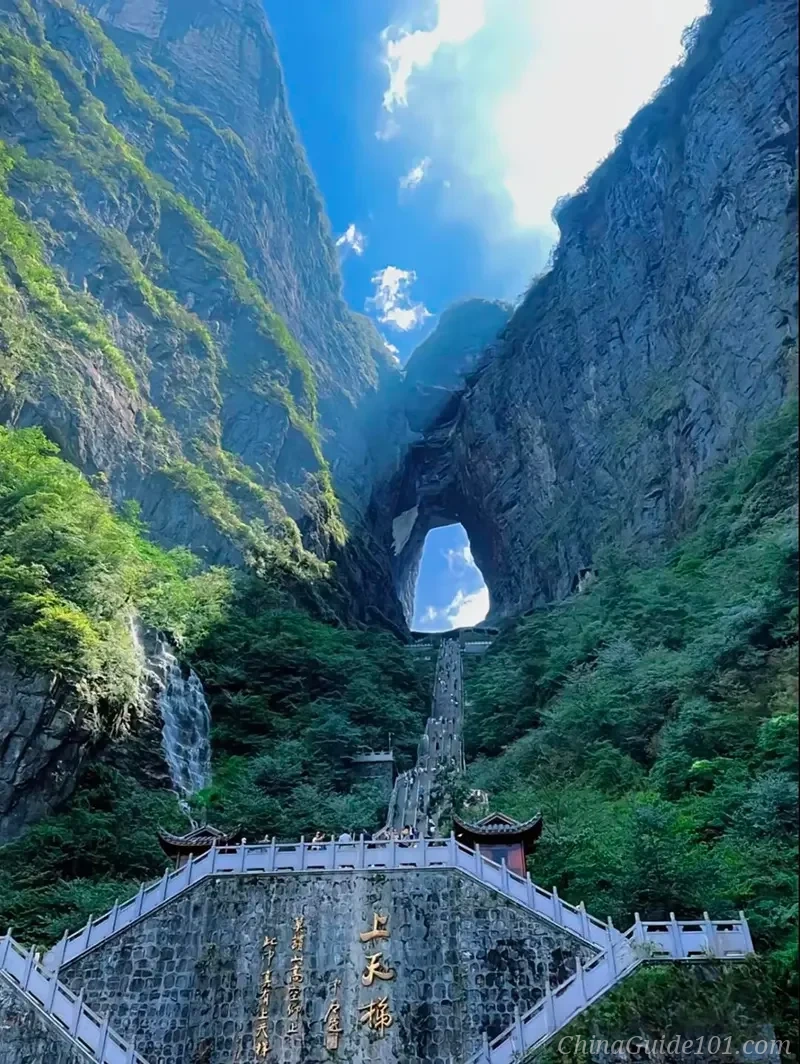
At the summit, you will walk along vertigo-inducing glass skywalks bolted to the side of vertical cliffs—three sections totaling about 60 meters, with glass floors offering a direct view of the abyss hundreds of meters below. The mountain's defining feature is Heaven's Gate (Tianmen Cave), a massive natural arch carved through the rock face. To reach it, you descend (or ascend) the 999 steps —a staircase so steep that it feels almost vertical. In Tujia folklore, the number 999 symbolizes the highest realm attainable by human effort, and climbing these steps is said to bring good fortune.
2026 TICKET INFO & PRACTICALITIES
2026 Tianmen Mountain Tickets Booking & Practicalities:The park operates from 8:00 AM in peak season (March 1–November 30) with admission gates closing at 4:00 PM. As of the latest update, a standard adult ticket costs around 278–288 RMB (approximately $38–40 USD), which includes the cable car ride, eco-friendly shuttle buses, and the escalator tunnel through the mountain.
Important:Prices may vary slightly by season; always check the official WeChat Mini-Program "Zhangjiajie Tourism" for the real-time rate before you go.
NEW FOR 2026: TIME-SLOT ENTRY
Tianmen Mountain now operates a strict time-slot entry system . When you book your ticket online, you must select a specific 2-hour arrival window for the cable car. Ensure you arrive within your designated window—gate staff are enforcing this rule, and if you miss your slot during peak periods, you may face significant delays or even be required to purchase a new ticket.
72 Strange Strata (72 Qi Lou): The 2026 Must-See Architectural Marvel
If your mental image of Zhangjiajie is purely natural landscapes, 72 Qi Lou will completely rewire your expectations. Standing 109.9 meters tall and certified by Guinness World Records as the tallest stilted building (Diaojiaolou) on the planet, this architectural wonder reimagines traditional Tujia construction on an audacious scale. The complex features layers upon layers of upward-sweeping eaves, warm lantern light, and intricate wooden detailing that transforms into something utterly magical after dark.
By night, 72 Qi Lou becomes the city's premier nighttime cultural hub. A 72-transformation themed light show uses holographic projection, naked-eye 3D technology, and animated mapping to turn the entire façade into a living canvas of swirling patterns and folkloric imagery. Beneath the lights, a sprawling night market unfolds—food stalls serving Xiangxi specialties, craft vendors, and impromptu performances create an atmosphere that feels like stepping into a Chinese fantasy film.
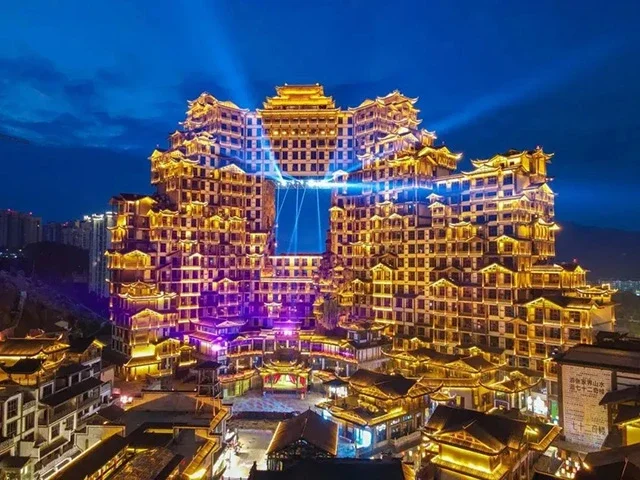
72-transformation themed light show
PHOTOGRAPHY TIP & LOCAL FLAVORS
Best Tujia food near 72 Qi Lou:Look for freshly grilled Ciba and Tujia bacon smoked over camphor wood.
Photography Tip:For the best panoramic shot, head to the viewing platform across the Lishui River . Arrive 20 minutes before sunset to secure your spot for the transition to full illumination.
Dress the Part:In 2026, renting traditional outfits has exploded in popularity among international visitors, and 72 Qi Lou is the perfect place to join the trend. You can rent elaborate Tujia ethnic costumes or flowing Hanfu robes from several shops near the main entrance, typically priced around 50–80 RMB per hour. Imagine yourself in embroidered Tujia attire with the glowing tower as your backdrop—it is a truly immersive photo session and one of the most memorable souvenirs you can take home. Give yourself at least two hours to eat, wander, and photograph.
Puguang Temple & Tujia Culture: Zen to Fire
Cultural Vibe:
⭐⭐⭐⭐
Not every moment in Zhangjiajie needs to be adrenaline-charged. The city hides pockets of stillness and tradition where you can slow down and soak in the local rhythm, far from the selfie-stick crowds.
Puguang Temple: A 600-Year-Old Sanctuary in the City
Right in the heart of Yongding District on Jiefang Road sits Puguang Temple , a genuine working Buddhist monastery that somehow remains a pool of silence amid the city's hum. Built in 1413 during the Ming Dynasty—a full seven years before Beijing's Forbidden City, four years before the Golden Temple of Wudang Mountain, and over a century before Sichuan's Xianfeng Temple—the temple has earned its title "Famous Monastery of Jiangnan".
What makes Puguang special is its rare architectural hybridity. Walk through the compound and you will find halls that blend Song, Yuan, Ming, and Qing dynasty styles within a single site—something few temples in China can claim . The complex is also unusually inclusive: it houses Buddhist halls alongside Taoist shrines and a Confucian temple, making it a multi-faith sanctuary rather than a purely Buddhist space .
The temple remains an active place of worship, home to 50 to 100 resident monks who oversee nearly a hundred affiliated temples across the region . Early mornings are the most atmospheric time to visit—if you arrive around 8:00 AM, you may hear chanting drifting from the main hall as the day's first rituals begin. There is no admission fee charged by the temple itself, though some online platforms list a nominal entry price; respectful dress (covered shoulders and knees) is expected.
Visitor info:Open 08:00–18:00 daily. Located on Jiefang Road, Yongding District—a short Didi ride from anywhere in the city center .
Tujia Folk Customs Park: From Quiet to Fire
Once you have had your fill of temple calm, walk ten minutes south toward Nan Zhuang Ping and step into a completely different world at the Tujia Folk Customs Park (also known as Tusi City, or 土司城). This is a 4A-rated national tourist attraction built on the foundations of the old Yongding Tusi chieftain's fortress, and it is the most efficient way to dive into Tujia culture without leaving the city .
The park's crown jewel is the Jiuchongtian (Nine-Story Heaven) stilted building —at 48 meters tall with twelve stacked layers of overlapping eaves, it held a Guinness World Record for the tallest Diaojiaolou structure . The craftsmanship is genuinely impressive; the entire structure uses traditional mortise-and-tenon joinery, not a single nail.
But the architecture is only half the draw. The park stages live performances of the Maogusi dance and the Baishou (hand-waving) dance , both recognized as part of China's intangible cultural heritage. The Maogusi is particularly striking—it is a primal, almost trance-like ritual dance performed in rough-hewn costumes made of straw and leaves, traditionally meant to drive away evil spirits. You can also participate in hands-on workshops: try Tujia brocade weaving on a traditional loom, or watch Miao silversmiths at work and make your own small piece. If you have time for only one cultural site in the city, make it this one.
Visitor info:Open 08:30–17:00. Admission 80 RMB (book online in advance for a slight discount). Located in Yongding District, about 10 minutes by taxi from the airport. Allow 2–3 hours .
Local Tip:Combine an early morning visit to Puguang Temple with a late-morning or afternoon session at the Tujia Folk Customs Park. The quiet stillness of the monastery, followed by the drums and fire of the Maogusi dance, is the perfect one-two cultural punch that most tourists miss entirely.
Beyond the City: Zhangjiajie Grand Canyon & Yellow Dragon Cave
If you have an extra day or two and want to see a different side of Zhangjiajie beyond the sandstone pillars, these two attractions deliver something entirely distinct. Both sit within an hour of the city or Wulingyuan, making them easy half-day or full-day additions to your itinerary.
Zhangjiajie Grand Canyon & Glass Bridge: Adrenaline Meets Scenery
Zhangjiajie Grand Canyon , located in Cili County about 60 kilometers from the city center, has earned worldwide fame for its record-breaking glass bridge—but the canyon itself is far more than a single photo op . Think rugged karst peaks, cascading waterfalls, turquoise streams, and lush forests woven together by wooden boardwalk trails .
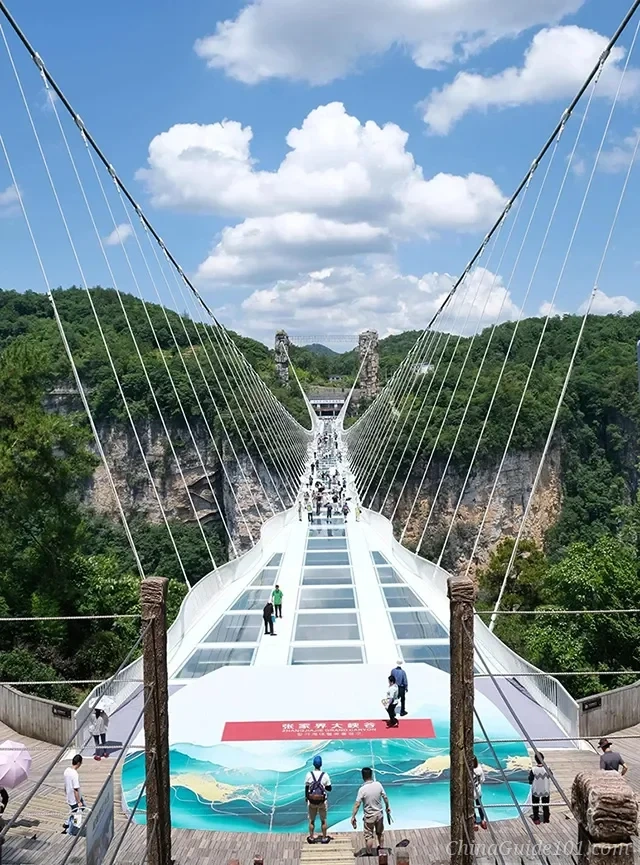
The star attraction is the Yuntiandu Glass Bridge (云天渡), the world's first cable-stayed high-altitude glass bridge. It stretches 430 meters across the canyon and hangs roughly 300 meters above the valley floor—every step on its transparent glass panels delivers a dizzying view straight down into the gorge . On misty days, walking across feels like floating on clouds, hence its name "Cloud Sky Crossing". If you are after more than the bridge, the canyon itself rewards with forested trails, the thundering Rainbow Waterfall, and a subterranean boat ride through Tianhe Karst Cave.
Ticket Options (2026):
Canyon Only:CNY 60. Best for budget travelers who want a peaceful hike without the bridge .
Canyon + Glass Bridge:CNY 178. The standard first-timer choice, including the bridge, canyon trails, and a free boat ride on Shenquan Lake .
7-in-5 Adventure Combo:CNY 298. Includes everything above plus five adventure activities chosen from seven options—zipline, slides, VR experience, and more. Recommended if you have 4+ hours and want a full day .
Important:There is no standalone glass bridge ticket. Even if you only want to walk the bridge and return, you will need the CNY 178 combo .
Practical Info:
Hours:08:00–16:00 (last entry and ticket sales stop at 16:00); April–December hours are 08:00–16:00, January–March are 08:30–16:00 .
Getting there:Direct shuttle buses run from both Zhangjiajie City and Wulingyuan, taking about 20–30 minutes . A taxi from the city center takes about 45 minutes and costs approximately 150 RMB . Budget travelers can take a bus from Zhangjiajie Bus Station for about 15 RMB .
Time needed:40 minutes for the bridge only, 2–4 hours for canyon hiking; 4+ hours with adventure activities .
Pro tip:Do not just snap a photo on the bridge and leave. The main canyon trail winds along waterfalls and crystal streams directly beneath the bridge—and if you start early, you will beat the tour bus crowds and have the sounds of nature almost to yourself . If you are visiting in autumn, the changing leaves and morning mist make it even more magical .
Yellow Dragon Cave: The Underground Palace
If the weather turns rainy, or if you simply want to witness a different kind of natural wonder,Yellow Dragon Cave (黄龙洞)is your answer. Located just outside Wulingyuan—about a 15-minute taxi ride from the landmark entrance—it is one of China's largest karst cave complexes and has been called "the wonder of the world's caves".
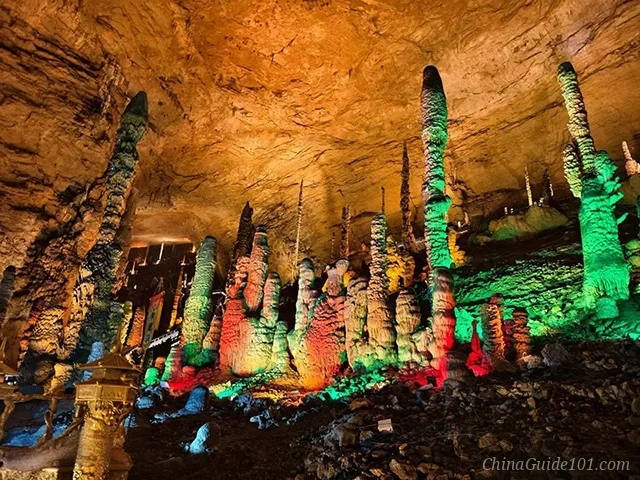
The scale here is staggering: the cave system stretches 7 kilometers in total length, though only a portion is open to visitors, with the highest chamber soaring 140 meters . Inside, you will find four distinct layers connected by stairs, two underground rivers, three waterfalls, and thirteen massive halls .
The visit follows a one-way route with no turning back, split into three clear stages :
Stage 1 — Descent through Stone Halls (30–40 minutes):You begin by descending stairs through massive chambers filled with stalagmites and stalactites, illuminated by colored lights that create dramatic shadows on formations named after Chinese legends—look for the "Dragon Dance Palace" and "Golden and Silver Ancient Weapons".
Stage 2 — Underground River Cruise (8–10 minutes):This is the highlight for many visitors. You will board a small boat and glide 800 meters along the Xiangshui River, 80 meters below the surface . The only sounds are lapping water and the occasional drip from stalactites overhead. Stalactite formations reflect in the clear, dark water, creating an atmosphere that feels lifted straight from a fantasy novel . The boat ride is included in your ticket.
Stage 3 — Dragon Palace & Sea-suppressing Needle (40–50 minutes):After disembarking, you enter the Dragon Palace—a hall the size of two football courts filled with over 1,700 stalagmites . Here stands the cave's icon: the Sea-suppressing Needle (定海神针), a slender stalagmite over 19 meters tall . It is thick in the middle and thin at both ends, resembling the magic weapon that Sun Wukong stole from the Dragon Palace in Journey to the West . This single formation has been growing for roughly 200,000 years—and the scenic area has insured it for 100 million RMB . Nearby, the Tianxian Waterfall thunders down from 30 meters above, its roar echoing through the enclosed chamber .
Practical Info:
Hours:08:00–17:30 (March–October); 08:00–17:00 (November–February).
Admission:CNY 118, including the underground boat ride . Discounts are available for visitors under 18 and over 60.
Getting there:From Wulingyuan, take Bus No. 1 (20 minutes, 2 RMB) or a taxi/Didi (15–20 RMB).
Important caveats before you go:
Stairs are unavoidable.The cave involves over 900 stairs and roughly 2 hours of walking on sometimes wet, slippery surfaces . If you have limited mobility or knee problems, this may not be the attraction for you.
Dress appropriately.The cave maintains a constant temperature of 15–17°C year-round. Bring a light jacket even in summer; in winter, it actually feels warmer inside than outside . Wear shoes with good grip—the paths are often damp.
It is guided.You must follow a guide through the cave, and the tour is conducted in Chinese. If you want detailed English commentary, consider booking a private guide in advance.
Beat the crowds.Summer sees the heaviest crowds, with queues potentially adding 30–60 minutes, especially at the underground river dock. Arrive when gates open (8:00 AM) for the thinnest crowds, or visit right after lunch (1:00–2:00 PM) as an alternative window .
A note on location:Yellow Dragon Cave sits within the Wulingyuan district, not the city center. If you are staying in Wulingyuan for the National Forest Park, it is an easy addition to your itinerary. If you are based in the city, combine it with a Wulingyuan day trip. And if the skies open up during your forest park visit, ducking into this underground palace is one of the best rainy-day strategies in Zhangjiajie .
Logistics: Getting There & Getting Around
Zhangjiajie Hehua International Airport (IATA:DYG ) is the gateway. A Didi or taxi ride takes just 10 to 15 minutes and costs approximately 10–20 RMB .
Zhangjiajie West Station is the high-speed rail hub (1.5h from Changsha). The older Zhangjiajie Railway Station serves conventional trains and is located right in the city center.
About 40 kilometers (25 miles) away. Options include public bus (12–15 RMB ) or Didi/Taxi (100–130 RMB ).
Arrival by Air.Zhangjiajie Hehua International Airport (IATA:DYG ) is the gateway for international arrivals. The airport is refreshingly close to the downtown core—a Didi or taxi ride takes just 10 to 15 minutes and costs approximately 10–20 RMB. The airport serves direct flights from major Chinese cities including Beijing, Shanghai, Guangzhou, and Chengdu, as well as a growing number of international routes from South Korea, Thailand, and Southeast Asia.
Arrival by High-Speed Rail.Zhangjiajie has two railway stations, and it is important to know which one you are heading to.Zhangjiajie West Station is the high-speed rail hub, connected to China's vast HSR network and located slightly west of the city center. If you are coming from Changsha (a common gateway city), high-speed trains run frequently and take approximately 1.5 hours. The older Zhangjiajie Railway Station serves conventional trains and is located right in the city center—convenient but slower.
Getting from the City Center to Wulingyuan.The distance is about 40 kilometers (25 miles), and you have several solid options. The most budget-friendly is the public bus from Zhangjiajie Central Bus Station, which costs 12–15 RMB , departs frequently throughout the day, and takes roughly 40 minutes to reach Wulingyuan's landmark entrance, with the last bus typically departing around 6:30 PM. If you prefer door-to-door convenience, a Didi or taxi ride costs approximately 100–130 RMB and takes about 40 minutes. For those arriving directly at the airport, an airport bus runs to Wulingyuan Bus Station (20 RMB, every 30 minutes, last bus at 6:30 PM).
PRO TIP: SMART TRAVEL APPS IN 2026
Smart Travel with Apps.In 2026, the most practical tools for getting around are Didi (which now includes an English interface), Baidu Maps, and Amap (Gaode). Google Maps does not work reliably in mainland China without a VPN.
- Download your navigation apps before arriving in China.
- Ask your hotel concierge to write down key addresses in Chinese characters.
- Don't rely on Google Maps for local data; it's often outdated.
- Avoid unlicensed "black taxis"; always use Didi or metered official taxis.
Download the apps you need before arriving, and consider having your hotel concierge write down key addresses in Chinese characters—this helps enormously when showing destinations to taxi drivers. For public bus route information within the city, the "Zhangjiajie Bus" mini-program on WeChat provides real-time arrival estimates and route maps, though it requires some Chinese reading ability.
Culture & Cuisine: The Flavors of Xiangxi
Western Hunan cuisine is not for the faint of palate. It is smoky, sour, spicy, and deeply savory—a reflection of the mountain environment where preservation techniques like smoking, pickling, and fermenting have been refined over centuries. Skip the bland hotel breakfast buffet and dive into the real thing.
Signature Dish: Sanxiaguo (Three-Staked Pot)
If you eat only one meal in Zhangjiajie, make it Sanxiaguo . The name translates to "three-staked pot" and the dish is exactly that: three main ingredients—traditionally smoked pork belly, pork intestine, and shredded pork—cooked together in a shallow iron wok over a flame. Unlike the broth-heavy hot pot you may know from Sichuan, authentic Zhangjiajie Sanxiaguo is a dry pot; the ingredients sizzle in their own rendered fat with heaps of dried chili, garlic, and Sichuan peppercorn. As the meal progresses, the bottom layer caramelizes into intensely flavorful, slightly crispy bits that locals fight over with their chopsticks. This is widely considered the best Tujia food you can find in the city.
Where to find it, according to local regulars:
- Hu Shifu Sanxiaguo (胡师傅三下锅) on Ziwu Road in Yongding District. A local institution for over 20 years, widely regarded by city residents as the benchmark. Expect to pay around 45 RMB per person for a generous portion.
- Impressions Old Stove Sanxiaguo (印象老灶台三下锅), with locations near both the Tianmen Mountain cable car station and the Wulingyuan landmark entrance. Recommended by both tourists and locals for a slightly more polished setting.
- Fuzhengyi Sanxiaguo , a well-established chain with more than 26 branches throughout the city. The branch near the Charming Xiangxi theater is especially convenient if you are heading to a show afterward.
Street Food Crawl
PRO TIP: JIEFANG ROAD NIGHT MARKET
The best street food hunting ground in the city center is along Jiefang Road and the surrounding alleys near Nankoumen. As evening falls, this area transforms into a raucous open-air food scene.
- Rice Tofu (米豆腐):Small cubes of jellied rice paste, served cold with chili oil, vinegar, crushed peanuts, and pickled vegetables. The texture is bouncy, the flavor is explosive, and it costs just a few yuan per bowl.
- Haozi Baba (蒿子粑粑):Glutinous rice cakes made with wild mugwort, giving them an earthy, herbal fragrance. They are stuffed with sweet bean paste or savory fillings, pressed flat, and pan-fried until the outside turns golden and crisp.
- Rice Noodles (米粉):Zhangjiajie's breakfast staple—silky, freshly made rice noodles served in a rich bone broth and topped with braised beef, pickled long beans, and a drizzle of chili oil. Locals recommend Zhangjiajie Rice Noodle King on Huilong Road in Yongding District, which opens at 6:00 AM with a broth simmered for eight hours.
- Ciba (糍粑):Glutinous rice pounded into a sticky paste, shaped into rounds, and grilled over charcoal until the outside chars slightly. They are served with brown sugar syrup and crushed sesame seeds.
Cultural Immersion: Which Show Is Worth Your Time?
A large-scale outdoor musical staged at the foot of Tianmen Mountain. Cinematic, unique, and set against actual canyons.
An indoor theater show in Wulingyuan. Polished and entertaining, but feels more like a staged spectacle.
Zhangjiajie has two major evening performances, and choosing between them depends on what kind of experience you are after.Tianmen Fox Fairy (天门狐仙) is a large-scale outdoor musical staged at the foot of Tianmen Mountain, using the actual canyon and mountain as its backdrop. The show tells a Tujia folk tale of a fox spirit who falls in love with a human woodcutter, weaving together Sangzhi folk songs, Xiangxi dance traditions, and high-altitude acrobatics. The 2026 season opened on March 13, with an impressive 70% of that first audience being international visitors from Russia, Korea, Thailand, and beyond. The setting alone—watch a love story unfold against a real mountain under the stars—makes it a memorable night.
Charming Xiangxi (魅力湘西), by contrast, is an indoor theater show located in Wulingyuan. It focuses more on variety-style ethnic performances, including Tujia wedding rituals, Miao drumming, and acrobatics. The production is polished and entertaining, but it feels more like a staged spectacle than an organic cultural experience. If you have time for only one,Tianmen Fox Fairy delivers the more unique and cinematic evening.
Where to Stay: City vs. Wulingyuan
One of the most frequent travel dilemmas for Zhangjiajie visitors is whether to base themselves in the city center or in Wulingyuan. Both have strong arguments, and the right answer depends on your itinerary. Below is a quick-reference comparison to help you decide at a glance.
| Feature | Zhangjiajie City (Yongding) | Wulingyuan District |
|---|---|---|
| Main Attraction | Tianmen Mountain, 72 Qi Lou | National Forest Park (Avatar) |
| Transport Hub | Airport & HSR Station nearby | 40 mins drive from hub |
| Vibe | Authentic urban, night markets | Tourist town, nature-focused |
| Food Scene | Local, diverse, late-night street food | Tourist-oriented restaurants |
| Hotel Prices | Generally 30–40% lower | Higher, especially near park entrance |
| Best for... | Arrival/Departure & Cultural fans | Multi-day hikers & Nature lovers |
| Evening Activity | Night markets, riverside walks, 72 Qi Lou light show | Xibu Street bars, Charming Xiangxi show |
- Proximity:Walk to the Tianmen Mountain cable car in under five minutes.
- Logistics:Airport and train stations are within a 10- to 20-minute taxi radius.
- Authenticity:Access the diverse dining scene and Jiefang Road street food.
- Nature Access:Maximize time inside the National Forest Park by staying near the gate.
- Early Starts:Beat the tour bus crowds and return for a midday break easily.
- Atmosphere:Enjoy the nature-focused vibe and Xibu Street's evening energy.
Why Stay in the City Center?
Proximity is the biggest draw. Staying near the Tianmen Mountain cable car station means you can walk to your morning ascent in under five minutes. The airport and both train stations are within a 10- to 20-minute taxi radius. And when you stumble back from a late-night street food crawl along Jiefang Road, your hotel is minutes away rather than a 40-minute drive through dark mountain roads. The city also offers better value, and the dining scene is far more diverse—you will find far more authentic local spots where you are the only foreign face in the room.
Why Stay in Wulingyuan?
If your primary goal is maximizing time inside Zhangjiajie National Forest Park itself, staying near the park entrance makes strategic sense. You can enter the park as soon as gates open, beat the tour bus crowds, and return to your hotel for a midday break without wasting time on transport. Wulingyuan also has its own dining and nightlife scene—Xibu Street (溪布街) is a lively pedestrian strip packed with restaurants, bars, and craft stalls.
PRO TIP: THE SPLIT-STAY STRATEGY
Many experienced travelers split their stay:one or two nights in the city center to tackle Tianmen Mountain, 72 Qi Lou, and the food scene, then two or three nights in Wulingyuan to explore the forest park at a relaxed pace. This is a Hunan travel tip that seasoned visitors swear by—it gives you the best of both worlds without feeling rushed.
Recommended City Center Neighborhoods.The area around the Tianmen Mountain Cable Car lower station is the most convenient base, with major hotels like the Pullman-adjacent options and numerous boutique guesthouses within walking distance. For a quieter, more scenic experience, consider accommodations along the Lishui River —several new boutique hotels here offer river-view rooms and easy access to riverside walking paths, with the city center still less than a 10-minute taxi ride away. In Wulingyuan, the Pullman and Noble Hotel both sit within a 10-minute walk of the forest park entrance, while mountain-side guesthouses like Zishan Manju offer stunning cloud-sea views for those willing to venture deeper into the hills.
Seasonal Guide & Events
April–May:Mild temperatures, blooming wildflowers, and iconic "floating peak" mist.
September–November:Clearest skies and vibrant crimson foliage by late October.
Peak domestic season. High humidity (25°C–35°C). Expect intense crowds but dramatic cloud formations and mist-shrouded landscapes after thunderstorms.
The "Sleeper Season." Monochromatic snow-covered peaks and rime ice.Hotel prices fall 30%–40%. Perfect for solitude, but paths can be slick.
Best Time to Visit.
Zhangjiajie has four distinct seasons, each with its own character.April–May and September–November are the ideal windows. Spring brings mild temperatures, blooming wildflowers, and frequent morning mists that create the iconic "floating peak" effect. Autumn delivers the clearest skies of the year, crisp air, and foliage that shifts from green to gold to crimson by late October—photographers should target mid-to-late October for the best visibility and color.
Summer (June–August)is peak domestic tourism season. Temperatures hover between 25°C and 35°C (77°F–95°F) with high humidity, and the crowds at major viewpoints can be intense. On the plus side, summer brings the most dramatic cloud formations, and sudden afternoon thunderstorms create spectacular mist-shrouded landscapes.
Winter (December–February)is the sleeper season. Temperatures drop to 0°C–10°C (32°F–50°F), and the peaks occasionally receive snow, transforming the park into a monochromatic wonderland of frosted rock and ice-glazed branches. The visitor count drops dramatically—hotel prices fall by 30%–40%, and you will often have trails nearly to yourself. January through February is the peak window for rime ice and snow scenery. Just pack thermal layers and shoes with aggressive tread; the stone paths can become treacherously slick.
China has two "Golden Week" national holidays—Chinese New Year (typically Jan/Feb) and National Day (Oct 1–7). Domestic tourism surges to overwhelming levels. The 2026 May Day holiday alone saw nearly 195,000 visitors in the forest park—a 19.16% year-on-year increase.
Festival Calendar.
2026 HIGHLIGHT: LANTERN FESTIVAL (MARCH 3)
One of Zhangjiajie's biggest annual events—50-plus parade troupes and 380,000 people gathered along the Lishui River. The 2026 edition featured a striking fusion of tradition and technology, with Tujia folk performers sharing the stage with costumed robots.
If you can time your visit to coincide with a local celebration, the experience becomes richer. The Lantern Festival (15th day of the lunar new year, falling on March 3 in 2026) is one of Zhangjiajie's biggest annual events—50-plus parade troupes, over 30 intangible cultural heritage showcases, 3,000 community performers, and a crowd of 380,000 people gathered along the Lishui River waterfront for lantern displays, dragon dances, and fireworks. During Spring Festival, the "World Heritage Wulingyuan Tujia Pre-New Year Celebration" invites foreign visitors to participate in traditional customs—dragon and lion dances, gate-blocking welcome wines, and a long-table community banquet where everyone eats together. On May Day, Tianmen Mountain offers a unique "robot welcome wine" experience alongside Tujia intangible heritage shows, with costumed Tujia women greeting visitors at Tianmen Cave plaza. The Lusheng Festival , a traditional Miao and Tujia celebration featuring reed-pipe dancing and courtship rituals, is typically held in autumn (dates vary by lunar calendar)—check with your hotel or a local tourism office for specific 2026 dates.
Practical Tips for International Travelers
Language: Survival Mandarin and Smart Tools.
English is not widely spoken in Zhangjiajie outside of major hotel front desks. This should not deter you, but it does require some preparation. Learn a few essential phrases:nǐ hǎo (hello),xiè xiè(thank you),duō shao qián (how much?), and bú yào (I do not want it—useful for politely declining persistent souvenir vendors). For everything else, download Baidu Translate or Microsoft Translator before arriving; both work reliably on Chinese networks and offer camera-based text translation for menus and signs.
2026 LANGUAGE UPDATE
The scenic area has achieved full trilingual Chinese-English-Korean signage coverage, and over 1,000 multilingual guides are now available throughout the park system.
Connectivity: 5G, eSIMs, and the VPN Question.
Zhangjiajie's urban areas and major scenic spots now enjoy robust 5G coverage through China Mobile, China Unicom, and China Telecom. For staying connected, you have two approaches.
International roaming or a travel eSIM (Holafly, Nomad, Airalo) allows access to Google, WhatsApp, and Instagram without a VPN, as data routes through international gateways.
As of 2026, VPN blocking has become significantly more aggressive. Connections are often unstable, and apps may flag your account for abnormal activity.
If you do plan to rely on local Wi-Fi and use a VPN, be prepared for a challenging experience. A travel eSIM or roaming plan is by far the more reliable strategy. The crucial tip: install and activate your eSIM before landing in China and screenshot the setup instructions.
Packing Essentials.
The most important item in your bag is your footwear. Zhangjiajie involves a lot of walking—much of it on stone steps and paths that can become wet, mossy, and extremely slippery. Leave the fashion sneakers, canvas shoes, and flat-soled trainers at home. You need hiking boots with ankle support and deep-tread Vibram-style soles .
QUICK PACKING LIST
- Rain Jacket:Light and packable (essential regardless of season).
- Synthetic/Merino Wool:Avoid cotton due to high humidity.
- Power Bank:Critical for a full day of navigation and photos.
- Travel Insurance:Must cover hiking and medical evacuation.
Mid-to-high-cut boots that protect your ankles on uneven terrain are strongly recommended, as a twisted ankle miles from the nearest exit can ruin a trip. A lightweight packable rain jacket is essential regardless of season—mountain weather changes rapidly, and sudden showers are common even on forecasted sunny days. Synthetic or merino wool clothing works far better than cotton here; high humidity means cotton stays damp for hours. A compact power bank is critical for a full day of photography, navigation, and translation app use. Finally,travel insurance that covers hiking activities and emergency medical evacuation is strongly advised—most standard policies exclude "high-altitude" or "adventure" activities, so read the fine print carefully.
Zhangjiajie in 2026 stands as a testament to China's high-tech travel revolution. Thanks to expanded visa-free entry and a fully modernized infrastructure—think seamless mobile payments and high-speed rail connectivity—independent travel here is now truly frictionless. You can marvel at Tianmen Mountain towering over the rooftops by day, and watch 72 Qi Lou illuminate the night like a vibrant beacon. But the true soul of the city lies in the alleyways off Jiefang Road, where the aroma of a sizzling Sanxiaguo pot awaits. The legendary peaks are calling, and the city has never been better prepared to welcome the world.