
Planning a trip to China—whether you're eager to wander the Great Wall, savor authentic dim sum in Guangzhou, or marvel at the pandas in Chengdu—starts with one essential step: sorting out your visa. Navigating China's entry requirements doesn't have to be stressful, though. This guide breaks down the latest policies, including newly updated visa-free options and the standard tourist visa process, to help you prepare smoothly and avoid common pitfalls. All information is current as of April 2026, so you can trust it to guide your travel plans.
Important Update 1: Unilateral Visa-Free Entry for 50 Countries
Before diving into the visa application process, check if you qualify for China's expanded unilateral visa-free policy—the most convenient way to enter for short trips. As of 2026, China has extended this privilege to 50 countries , allowing travelers to enter without a pre-arranged visa for up to 30 Days .
PRO TIP: POLICY VALIDITY
For 48 of these countries (including the UK, Sweden, Japan, and Canada), the policy is currently active through December 31, 2026 . Russia's current term lasts until September 14, 2026 , while Brunei remains permanent.
Eligible countries now span across several regions. If you hold a standard passport from these nations, you can enter for tourism, business, family visits, or transit:
- Europe (35 countries):France, Germany, Italy, Spain, UK, Sweden, Norway, Switzerland, Poland, Russia, and more.
- Americas (6 countries):Canada, Brazil, Argentina, Chile, Peru, and Uruguay.
- Asia & Oceania:Japan, South Korea, Australia, New Zealand, Saudi Arabia, and others.
- Ensure your standard passport is valid for your stay.
- Carry supporting documents like flight itineraries or hotel bookings.
- Count your stay starting from 00:00 the day after entry.
- Attempt to use a travel document or temporary ID (standard passports only).
- Overstay the 30-day limit without a proper visa extension.
- Use this for work, study, or news reporting.
Q: What about Mutual Visa-Free Agreements?
China also has comprehensive mutual visa-free agreements with 29 countries , including Singapore, Thailand, Malaysia, the UAE, and Qatar. If your country is on this list, you are also eligible for visa-free travel!
Important Update 2: 240-Hour Visa-Free Transit (10-Day Stay)
If you aren't eligible for the 30-day unilateral visa-free policy, the 240-hour (10-day) visa-free transit is your next best option. This policy currently applies to citizens of 57 countries who are transiting through China to a third country or region.
PRO TIP: THE 57 ELIGIBLE COUNTRIES
Europe (40):Austria, Belgium, Czech Republic, Denmark, Estonia, Finland, France, Germany, Greece, Hungary, Iceland, Italy, Latvia, Lithuania, Luxembourg, Malta, Netherlands, Poland, Portugal, Slovakia, Slovenia, Spain, Sweden, Switzerland, Monaco, Russia, UK, Ireland, Cyprus, Bulgaria, Romania, Ukraine, Serbia, Croatia, Bosnia and Herzegovina, Montenegro, North Macedonia, Albania, Belarus, and Norway.
Americas (6):United States, Canada, Brazil, Mexico, Argentina, and Chile.
Oceania (2):Australia and New Zealand.
Asia (9):South Korea, Japan, Singapore, Brunei, United Arab Emirates, Qatar, Indonesia (added as of June 12, 2025), Vietnam, Kyrgyzstan (both added on August 20, 2026).
You must hold a confirmed onward ticket to a third country or region (e.g., London → Shanghai → Tokyo). A simple round trip (London ↔ Shanghai) does not qualify for this specific transit policy.
This policy covers 60 ports across 24 provinces. You can stay for up to 10 Days (240 hours) within the designated stay area associated with your entry port.
- Inform your airline at check-in that you intend to use the 240-hour TWOV (Transit Without Visa).
- Apply for the stay permit at the dedicated "240-Hour Transit" counter upon arrival.
- Don't leave the designated stay area (e.g., if you enter via Shanghai, you can visit Jiangsu and Zhejiang, but cannot fly to Beijing).
PRO TIP: HAINAN ISLAND SPECIAL
Travelers from 59 countries can enjoy a separate 30-day visa-free stay specifically for Hainan Province , perfect for beach holidays without any transit requirements.
Always verify the latest regional stay boundaries and eligible ports at the National Immigration Administration (nia.gov.cn)before your flight, as transit rules can be province-specific.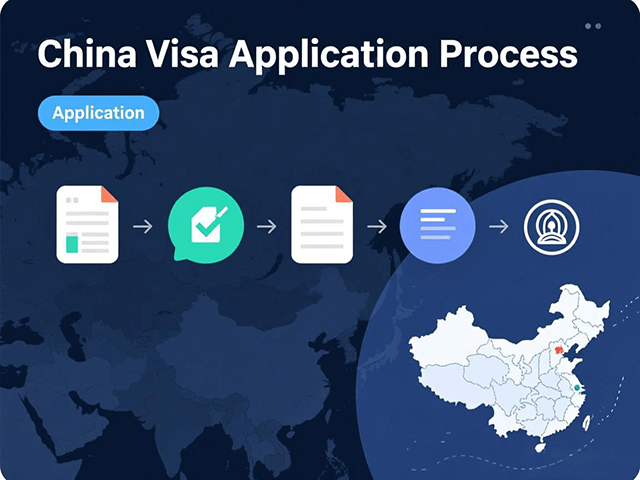
If You Don't Qualify for Visa-Free Options: The Standard Tourist (L) Visa Process
If you're not eligible for the 30-day visa-free entry or 240-hour transit policy, you'll need to apply for a Tourist (L) Visa—the standard visa for travelers visiting China for sightseeing, leisure, or casual visits to friends and family. Follow these steps carefully to ensure a smooth application process; attention to detail is key to avoiding delays or rejection.
1. Start Early (Plan Ahead)
Visa processing typically takes 4–5 business days, but it's wise to allow extra time for unexpected delays—such as missing documents or additional verification. We recommend starting your application at least one month before your planned departure date. This gives you enough time to gather all required materials, attend your appointment, and address any issues that may arise.
2. Find Your Local Application Center
You'll apply for your L Visa through the Chinese Visa Application Service Center (CVASC) in your country of residence. Most countries have a CVASC office, and their official website is your go-to resource for all application details. Start by visiting the CVASC website for your country to download the latest application form, check visa fees (which vary by nationality), and book a mandatory in-person appointment. Walk-in applications are not accepted, so booking an appointment in advance is essential.
3. Prepare Your Documents (The Most Critical Step)
Incomplete or inaccurate paperwork is the most common reason for visa delays or rejection. Make sure you have all the following documents ready before your appointment, and double-check that all information is consistent across every form (e.g., your name should match exactly on your passport, application form, and travel bookings).
Valid Passport Your passport must be valid for at least 6 months beyond your intended date of entry into China, and it must have at least two blank pages for the visa sticker and immigration stamps. A new requirement introduced in November 2025 also requires you to submit all your old or previous passports along with your current one—don't overlook this step!
Completed Application Form Fill out the China Online Visa Application (COVA) form on the CVASC portal. Be sure to answer all questions truthfully and completely, then print the form and sign it at the designated spot. Do not leave any fields blank—if a question doesn't apply to you, write "N/A" instead.
Passport Photo One recent (taken within the last 6 months), professional passport photo. The photo should be 48mm x 33mm, with a plain white background, and your face should be fully visible (no hats, sunglasses, or filters). Some CVASC offices offer photo services on-site, but it's cheaper and more convenient to bring a ready-made photo that meets the requirements.
Proof of Travel Copies of your round-trip flight bookings (both incoming and outgoing) and full hotel reservations for your entire stay in China. If you're staying with friends or family instead of a hotel, you'll need a letter of invitation from your host, including their contact information, address in China, and a copy of their Chinese ID or passport.
Travel Itinerary A clear, day-by-day plan of your activities in China. This doesn't need to be overly detailed, but it should include the cities you'll visit, the dates of your stay in each city, and key attractions you plan to see. For example: "Day 1: Arrive in Beijing, check into hotel; Day 2: Visit the Forbidden City and Tiananmen Square; Day 3: Travel to Xi'an, visit the Terracotta Army."
Financial Proof A recent (within the last 3 months) bank statement to demonstrate that you have sufficient funds to cover your trip. The exact amount varies by nationality, but a general guideline is at least $1,000 per person for a 7-day trip. If you're traveling with a family, you can provide a joint bank statement, but be sure to include proof of your relationship (e.g., a marriage certificate or birth certificate).
Additional Documents (If Applicable)If you're not applying in your home country, you'll need to provide proof of legal stay or residence in the country where you're applying (e.g., a work visa or student visa). If you've ever held Chinese nationality, you'll need to submit your old Chinese passport or a copy of your previous Chinese visa.
Helpful Tips for Document Preparation
Ensure your name, passport number, travel dates, and other key details are the same on every document. Even a small typo (e.g., "Smith" vs. "Smithe") can cause delays.
Visa requirements can vary slightly by country, so always check the latest checklist on your local CVASC website. Don't rely on outdated information or advice from friends—official sources are the most reliable.
PRO TIP: DEMONSTRATE STRONG TIES TO YOUR HOME COUNTRY
Providing proof of employment (a letter from your employer stating your position, salary, and approved leave), property ownership, or family ties (e.g., a marriage certificate or photos with family members) can help show that you intend to return home after your trip. This reduces the risk of your visa being rejected due to concerns about overstaying.
4. Submit Your Application In Person
Attend your scheduled appointment at the CVASC office with all your original documents and copies (some offices require two copies of certain documents, so check in advance). You'll need to pay the visa fee at this time—fees are non-refundable, even if your visa is rejected. During the appointment, your photo and fingerprints will be collected (this is a standard security measure for most nationalities). After submitting your documents, you'll receive a dated pickup slip—keep this safe, as you'll need it to collect your passport later.
5. Collect Your Visa and Verify Details
Return to the CVASC office on the date specified on your pickup slip to collect your passport. When you receive it, immediately check the visa sticker for accuracy: verify your name, passport number, visa validity dates, and number of entries (single, double, or multiple). If there are any mistakes, notify the CVASC staff right away—correcting errors after you leave will be much more difficult.
Final Recommendations for a Successful Application
Getting a Chinese tourist visa is straightforward if you prepare carefully. Here's a quick recap to ensure you don't miss anything:
- Check if you qualify for visa-free entry or 240-hour transit first (this will save you time and effort).
- Start your application early.
- Gather all required documents and double-check their accuracy.
- Follow the official guidelines from the CVASC and NIA.
PRO TIP: STAY UPDATED
Remember, policies can change, so always refer to the official website of the Chinese Visa Application Service Centre in your country or the National Immigration Administration (NIA) for the most up-to-date information before you travel.
With the right preparation, you'll be ready to embark on your Chinese adventure with peace of mind.