
| Item | Details |
|---|---|
| Location | Hangzhou, Zhejiang |
| Chinese Name | 灵隐寺 |
| Main Experience | Historic Buddhist temple + Feilai Feng grottoes |
| Recommended Time | 2.5–4 hours |
| Entry Rule | Free admission for all; mandatory real‑name reservation required for most visitors |
| Best For | History, Buddhist art, architecture, nature |
| Combine With | West Lake, Longjing Tea Village, Meijiawu |
What Is Lingyin Temple?
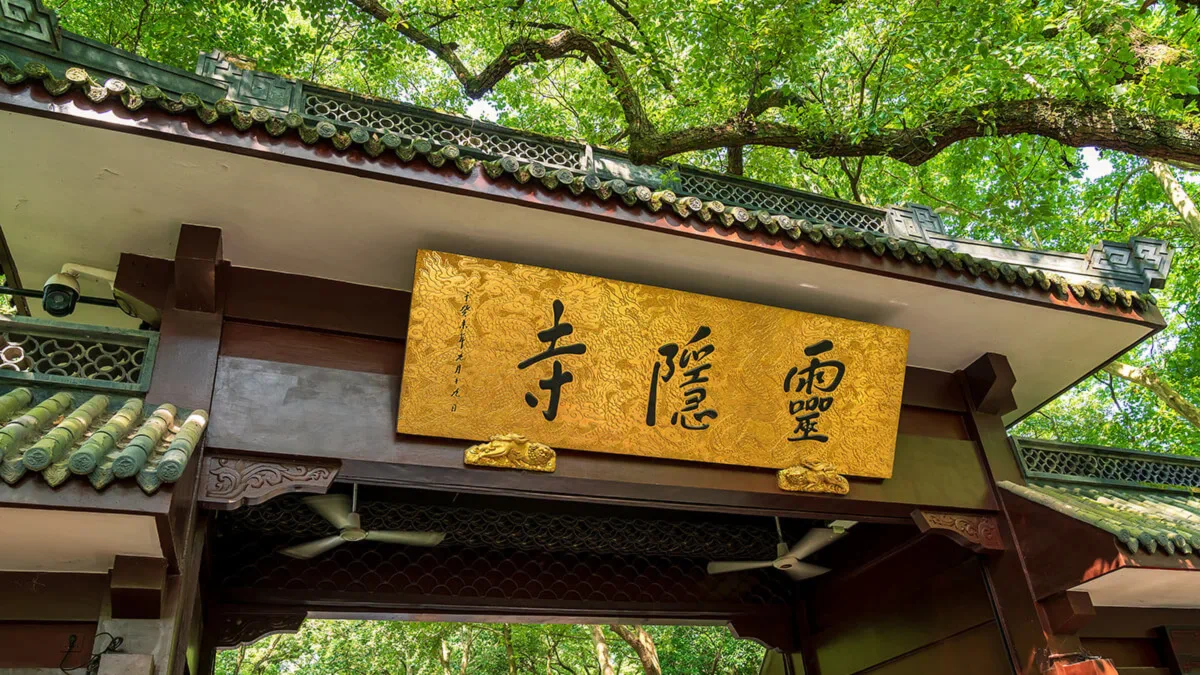
Nestled in a wood‑cut mountain valley just west of Hangzhou's West Lake, Lingyin Temple is one of China's best‑known active Buddhist monasteries. The larger scenic zone also includes the remarkable ancient stone grottoes of Feilai Feng, so your visit covers both temple buildings and cliff‑side religious sculpture.
When Was Lingyin Temple Built?
Lingyin Temple was founded in AD 326, during the Eastern Jin Dynasty. Local tradition credits an Indian monk named Huili with establishing the original temple in this quiet mountain valley west of West Lake.
Over more than 16 centuries, the monastery went through repeated cycles of destruction and rebuilding due to war and fire. Many of the standing halls you walk through today are later reconstructions, rather than surviving original buildings from the early dynastic period. That does not diminish the atmosphere; the forested mountain setting, ancient stone carvings and continuous living monastic life give the site its deep sense of history.
Why Is Lingyin Temple Famous?
It remains an active Buddhist monastery and is one of Hangzhou's best‑known historic religious sites. Tucked into a quiet wooded valley just outside central Hangzhou, it offers a peaceful contrast to the busy lakeside downtown area.
Much of its appeal stems from the adjacent Feilai Feng hillside, covered in centuries of cliffside Buddhist carvings. Together, the working temple and open‑air grotto museum create a layered cultural experience that blends architecture, religious heritage, and natural scenery within one protected scenic zone.
What Is Feilai Feng?
This point often creates confusion for first‑time international visitors.
PRO TIP: FEILAI FENG IS PART OF THE SAME SCENIC AREA
Feilai Feng is the scenic area containing the grottoes and rock carvings next to Lingyin Temple. It is not another distant attraction.
When you enter the main gate of the scenic zone, you first step into the Feilai Feng area. The limestone hill rises gently beside a running mountain stream, dotted with caves and hundreds of stone Buddhist statues carved into cliff faces from the Five Dynasties period through the Yuan Dynasty. Lingyin Temple itself sits further inside this same protected scenic area.
Virtually all visitors explore both sections on one single trip. You cannot reach Lingyin Temple's gates without first walking through the Feilai Feng grotto zone.
Lingyin Temple Admission and Opening Hours
Is Lingyin Temple Free?
Since December 1, 2025, Lingyin‑Feilai Feng Scenic Area has offered free admission for all visitors . This complimentary entry fully covers three core attractions within the scenic zone: Lingyin Temple, Yongfu Temple, and Taoguang Temple.
Most visitors must make a real‑name reservation in advance. Some visitors who qualify for specific preferential policies may be exempt from the reservation requirement. If you are an international visitor, plan to make a reservation in advance using your passport.
Do You Need a Separate Reservation for Lingyin Temple?
One reservation covers the Lingyin‑Feilai Feng Scenic Area, including Lingyin Temple, Yongfu Temple and Taoguang Temple. You do not need to make a separate reservation for Lingyin Temple itself.
How to Reserve Lingyin Temple (Official 2026 Rules)
The official way to reserve entry is through the "杭州灵隐飞来峰" mini‑program on WeChat or Alipay . For international visitors, this is more important than looking for a conventional "ticket" on a third‑party booking platform, because admission itself is free and the key requirement is the official reservation.
Follow this simple official booking process:
Open WeChat or Alipay and search the official mini‑program:杭州灵隐飞来峰
Select your intended visit date and time slot (morning or afternoon)
Fill in traveler information: foreign visitors can legally use a valid passport as their official identification document, per scenic area regulations
Complete the real‑name reservation submission
PRO TIP: RESERVATION LIMITS
One mobile account can reserve spots for up to 5 travelers, and every person in the group requires individual valid identification information. Each passport or ID is limited to one reservation per day .
How Far in Advance Can You Reserve?
Reservations open 7 days in advance at 08:00 AM daily . Reservations must be made in advance, and same‑day reservations are not available. Last‑minute walk‑in visits should therefore not be relied upon.
Booking slots are split into two fixed daily sessions:
- Morning session : 07:30 – 12:00 (last entry 13:00)
- Afternoon session : 12:00 – 17:00 (early entry available from 11:00)
You must arrive within your reserved time window to gain entry.
Official daily visitor caps control crowd flow: 35,000 on weekdays, 50,000 on weekends, and 65,000 during major Chinese public holidays.
What If My Preferred Date Is Full?
The scenic area launched an official online waitlist mechanism in February 2026, fully replacing the old on‑site registration system. No offline queue or walk‑in standby option exists anymore.
If your ideal date or time slot is fully booked:
- Submit a waitlist application via the official mini‑program for your target date and session
- Waitlist applications close at 20:00 on the day before your planned visit
- Spots are allocated automatically in chronological order of waitlist sign‑ups
- Successful reservations are pushed directly via the mini‑program notification system
What Should Foreign Visitors Bring?
Bring the original passport used for the reservation. The passport details must match the information entered during booking. International visitors use the same reservation system as other visitors, but should use their passport as the identification document when making the reservation and entering the scenic area.
Opening Hours
Current opening hours are 07:30 – 17:30, with last entry at 17:00 . Opening arrangements may change on major holidays, so check your reservation notice before visiting.
What to See at Lingyin Temple
Hall of the Heavenly Kings
The first major hall you reach after walking past the cold stream area is the Hall of the Heavenly Kings. Above the entrance hangs the well‑known plaque "Yunlin Chan Temple", an imperial name given to the monastery in the Qing era.
Inside this hall you will find the laughing Maitreya statue near the entry. At the back stands the famous ancient wooden Weituo guardian carving, a well‑preserved Southern‑Song‑period sculpture carved from one single camphor log. Many visitors pause here before moving deeper into the temple compound.
- Pause to view the ancient Weituo guardian carving, a well‑preserved Southern‑Song‑period sculpture carved from a single camphor log.
- Do not take photos inside worship halls, as photography is often restricted.
Mahavira Hall
This is the main ceremonial building of Lingyin Temple, the tallest hall on the central axis. Standing more than 33 metres high, it dominates the inner courtyard. The large seated Shakyamuni Buddha statue inside is gilded camphor wood. Even for travellers with limited background in Buddhist traditions, the scale of this hall creates a quiet, imposing feeling.
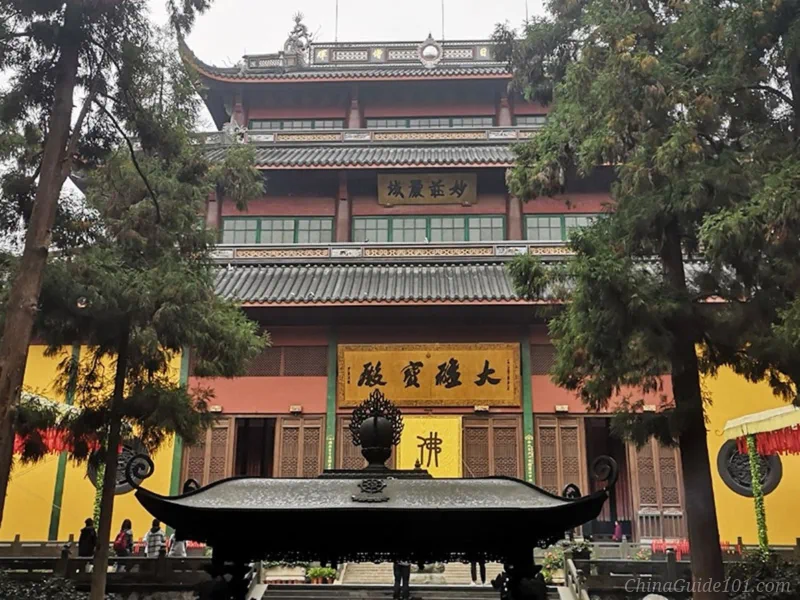
Along the side walls sit rows of guardian deity statues. You can walk slowly around the perimeter of the hall, observing the details without crowding other visitors or worshippers. Small free incense sticks are available near the temple entrance for visitors who wish to participate in traditional worship.
Hall of the Medicine Buddha
Further along the central pathway, past the Mahavira Hall, you arrive at the Hall of the Medicine Buddha. This smaller hall is dedicated to the Medicine Buddha, flanked by statues of the twelve guardian generals. It tends to feel less crowded than the main great hall. Many casual visitors only glance briefly here before continuing uphill toward the upper buildings of the monastery.
Other Important Buildings
Further up the slope you will come to the Huayan Hall and the Hall of Five Hundred Arhats. These upper buildings sit on higher ground, so expect a gentle flight of stairs to reach them. You do not need to visit every hall if your available time is limited.
PRO TIP: SHORT VISIT PRIORITY
For a shorter visit, focus your time on the Heavenly Kings Hall and Mahavira Hall, rather than rushing every upper chamber.
What to See at Feilai Feng
Buddhist Grottoes and Rock Carvings
Feilai Feng functions as an open‑air museum of Chinese Buddhist stone sculpture. Around 470 Buddhist sculptures and related carvings are found across the grottoes, caves and cliff faces, created from the Five Dynasties period through the Yuan Dynasty.
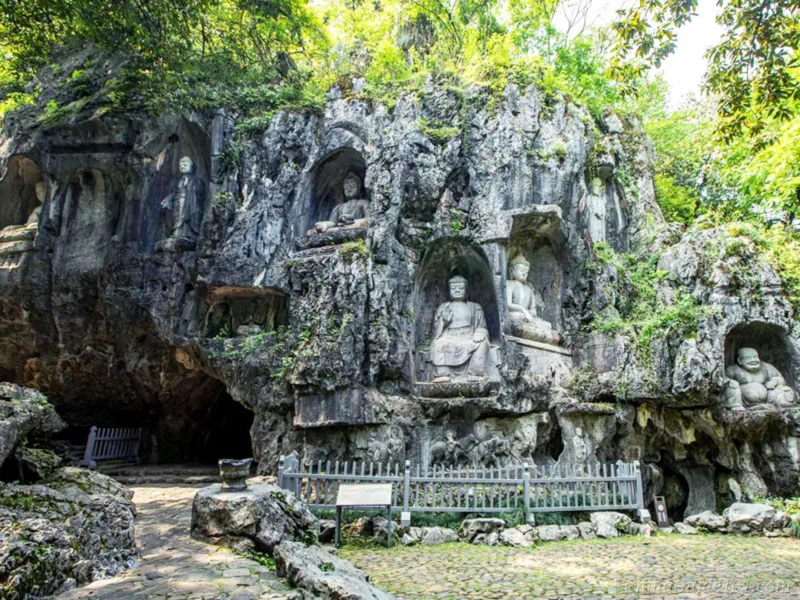
One interesting detail for visitors is the mix of artistic styles. Some of the later Yuan‑era carvings show visible influences from Tibetan Buddhist art, a feature that makes this grotto site different from many other Buddhist rock‑art locations across eastern China. You can wander the paved footpaths, stopping to peer inside shaded caves such as Qinglin Cave and Yuru Cave, where groups of smaller figures sit in the rock hollows.
The Laughing Buddha and Other Famous Sculptures
The most‑recognisable single carving on Feilai Feng is the large seated laughing Maitreya (the "big‑belly Buddha") carved during the Southern‑Song Dynasty. This iconic piece is one of the earliest large‑scale examples of this popular Buddha figure in Chinese stone artwork and serves as the visual symbol of the entire Feilai Feng site.
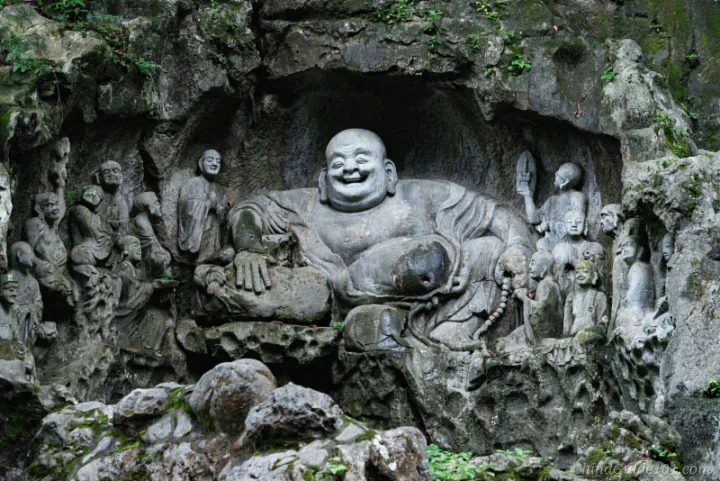
Nearby you can also seek out the slender Linggong Pagoda, a small ancient stone pagoda built to commemorate the founding monk Huili.
- Seek out the iconic laughing Maitreya carving and the slender Linggong Pagoda commemorating founding monk Huili.
- Do not touch the stone surfaces of the carvings, as these are protected cultural relics.
Feilai Feng's Forested Setting
Do not treat Feilai Feng purely as a collection of statues. The limestone hill itself sits in a lush valley, with a clear mountain stream winding along the base of the cliffs. Tall old trees create shade across most of the main footpaths. Even on warm summer days, the valley temperature often feels pleasantly cooler here.
PRO TIP: ROUTE SELECTION
If you have extra energy, there are steeper trails climbing higher up the hill, but casual sight‑seers can stick entirely to the flat or gently sloping main lower path and still see nearly all the important grotto art without heavy climbing.
How to Visit Lingyin Temple
Where Should You Start?
Your visit always begins at the main visitor entrance gate for the whole Feilai‑Feng‑Lingyin scenic zone. After your reservation is scanned and your passport checked, you walk inward. There is no separate entry checkpoint later for Lingyin Temple itself.
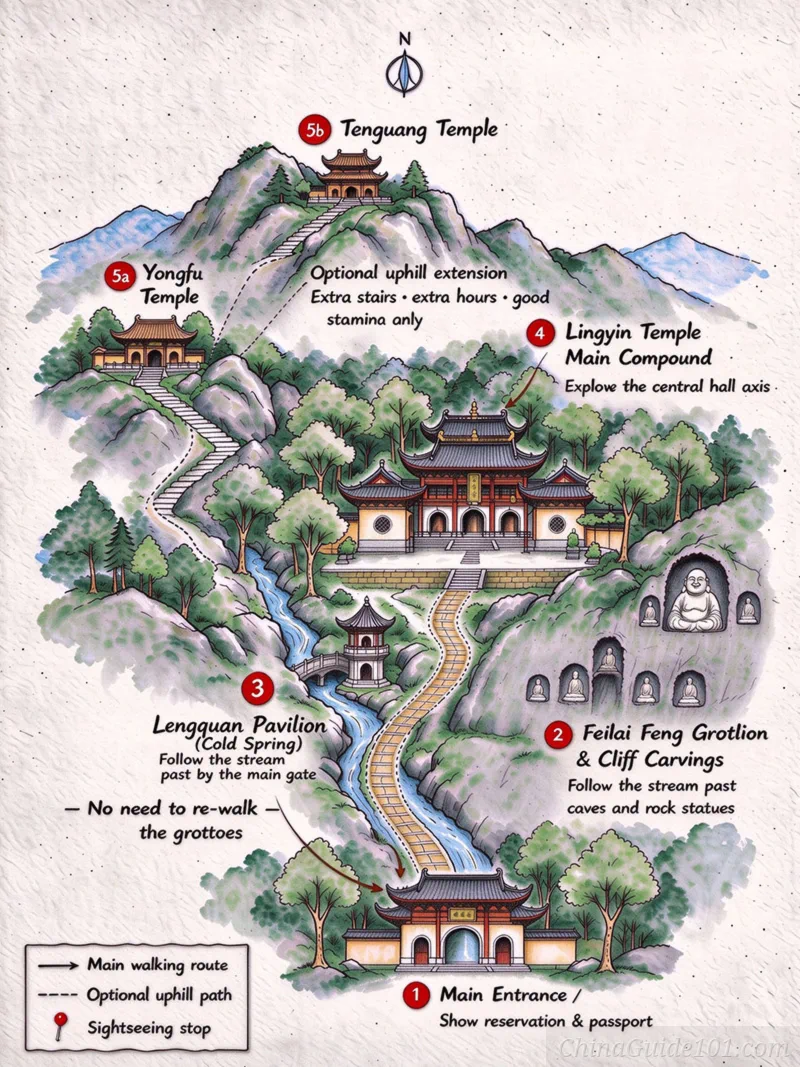
Lingyin Temple and Feilai Feng Walking Route
The logical, most widely‑used core visiting sequence focuses on the iconic sights for first‑time visitors:
Present your reservation code and passport / ID for verification
Follow the mountain stream past caves and ancient rock statues
Pause at this historic waterside pavilion right beside Lingyin Temple's main gate
Explore the central hall axis inside the monastery
Follow the exit path out of the scenic area (no need to re-walk the Feilai Feng grottoes)
PRO TIP: UPHILL EXTENSIONS
Yongfu Temple and Taoguang Temple are optional uphill extensions, not required for a complete core visit. Only travellers with extra time and good stamina should continue uphill from Lingyin Temple's side‑exit to explore these additional monasteries. This extension adds considerable stair‑climbing and extra hours to your itinerary.
How Long Does the Visit Take?
Times can shift depending on crowd levels and how slowly you choose to wander.
| Pace / Scope | Estimated Time |
|---|---|
| Quick, streamlined sightseeing | 1.5‑2 hours |
| Standard balanced visit covering key grottoes plus the main temple halls | 2.5‑3 hours |
| Relaxed pace, including optional uphill temple extensions | 3‑4 hours |
Weekends and holiday periods mean slower walking progress through crowded paths, so you should budget extra time on those dates.
Is Lingyin Temple Difficult to Walk?
Parts of this site involve stone steps, uneven paved trails and moderate uphill slopes, both within the Feilai‑Feng valley and especially inside the upper sections of Lingyin Temple.
The primary lower‑valley path through the grotto area is relatively gentle and suitable for most older visitors who walk at a slow pace. However, steep stair‑sets appear as you climb toward the upper temple buildings. Strollers for small children are awkward here; many stone steps make pushing a pram hard. Visitors with limited mobility may wish to stick to the lower grotto zone and the first two main temple halls, skipping the upper uphill sections.
- Wear comfortable walking‑shoes for the stone steps, uneven trails, and slopes.
- Avoid using strollers or prams for small children, as numerous stone steps make pushing them difficult.
How Much Time Do You Need at Lingyin Temple?
| Available Time | Recommended Plan |
|---|---|
| 1.5–2 hours | Temple main halls + selected Feilai Feng key grotto sites |
| 2.5–3 hours | Complete main‑site visit: primary grottoes + full Lingyin temple axis |
| 3‑4 hours | Full relaxed visit, optionally add Yongfu Temple |
| Half day | Lingyin Temple + nearby Longjing or Meijiawu tea villages |
How to Get to Lingyin Temple
From Hangzhou East Railway Station
Hangzhou East is the city's major high‑speed‑rail station. There is no direct metro line all the way to Lingyin.
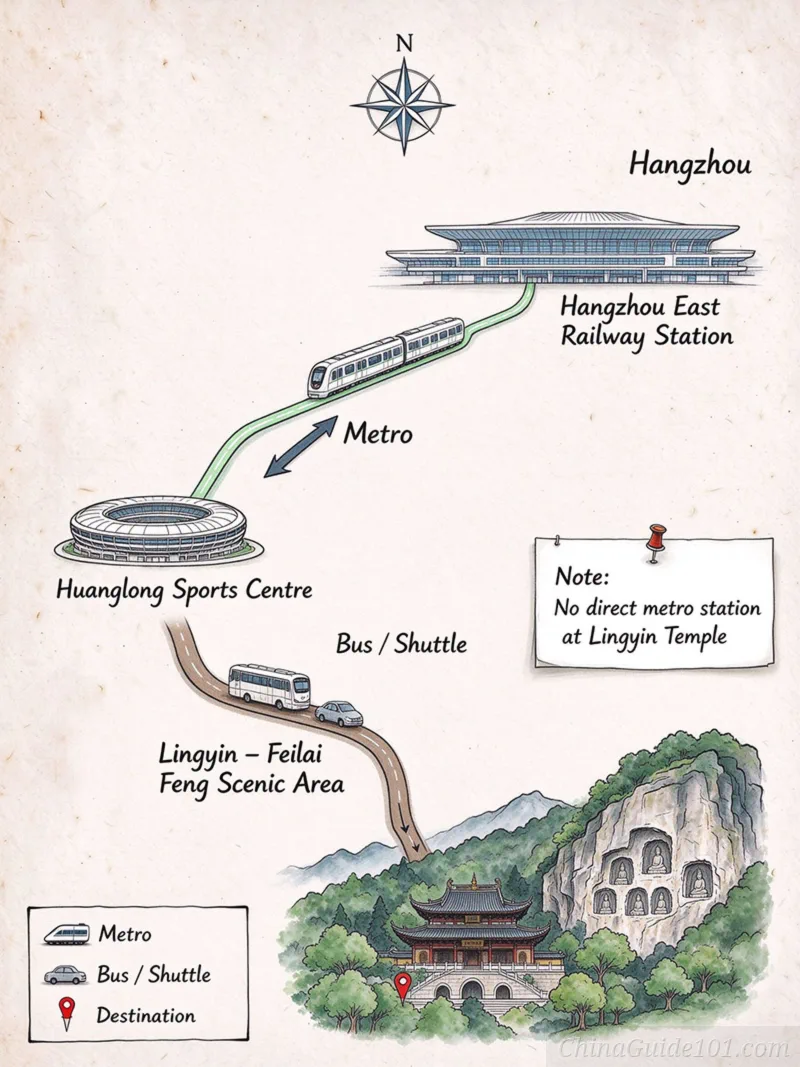
Board the metro system
Transfer from metro to local bus or dedicated scenic shuttle
Arrive at the main visitor gate
PRO TIP: WEEKEND & HOLIDAY TRANSPORT
On weekends and public holidays, traffic restrictions and shuttle adjustments are common, making public transport far more practical than direct taxi rides to the gate.
From West Lake
If you are coming after exploring West Lake , you have multiple transport choices:
- Public bus:Several regular bus routes run from lakeside stops to Lingyin bus station, with travel times fluctuating based on traffic.
- Ride‑hailing / taxi:Direct car transfers are available but prone to heavy congestion on weekends and holidays.
Can You Take the Metro to Lingyin Temple?
There is no metro station directly at Lingyin Temple.You need to transfer from the metro to a bus or shuttle for the final part of the journey. Huanglong Sports Centre is the most common and convenient metro transfer hub for visitors traveling to the scenic area.
Best Time to Visit Lingyin Temple
Best Season
Weather and natural scenery vary significantly across seasons, making timing an important consideration for your visit:
| Season | Highlights & Conditions |
|---|---|
| Spring (March‑May) | Hillsides turn bright green with fresh foliage, offering pleasant natural scenery, though weekend crowds are common. |
| Summer (June‑August) | Hot and humid in Hangzhou. The shaded Feilai Feng valley provides cool respite, so early morning visits are recommended. |
| Autumn (September‑November) | Autumn generally offers mild temperatures and comfortable conditions for walking, with soft foliage enhancing the valley's natural scenery. |
| Winter (December‑February) | Colder temperatures limit outdoor exploring, but light snowfall creates serene, atmospheric views of the temple and forested hills. |
Best Time of Day
Early morning visits shortly after opening deliver softer light and thinner crowds. Crowds generally increase later in the morning, especially on weekends and holidays.
- Plan weekday visits whenever possible to enjoy a far quieter, more relaxed experience.
- Avoid peak hours on weekends and Chinese public national holidays when visitor volumes spike sharply.
Lingyin Temple and West Lake
Can You Visit Lingyin Temple and West Lake on the Same Day?
Yes, you can combine these two sites in one single day, but you should not expect to see every corner of West Lake and Lingyin at a relaxed pace. West Lake itself covers a very wide area.
Lingyin in the Morning, West Lake Afternoon
- Start early for your fixed morning reservation at Lingyin Temple and complete your visit by midday.
- Enjoy lunch nearby, then spend the afternoon exploring a focused section of West Lake, such as Su Causeway or Leifeng Pagoda.
West Lake Morning, Lingyin Afternoon
- Spend the morning walking along West Lake before heading west for an afternoon Lingyin slot.
- Risk:Delays during morning lake sightseeing can easily cause you to miss your strict, pre‑booked Lingyin entry window.
PRO TIP: EXPECTATION SETTING
Whichever sequence you pick, accept that a one‑day combination means you will need to make choices about what you skip to avoid a rushed itinerary.
Lingyin Temple + Longjing Tea Village
This pairing forms another popular one‑day itinerary alternative, especially for visitors interested in local tea culture.
After you finish exploring Lingyin‑Feilai‑Feng, you can travel onward to either Longjing Tea Village or Meijiawu . Both sit on nearby mountain slopes famous as the original growing region for West Lake Longjing green tea. You can wander among the tiered tea plantations, stop at local family‑run tea houses for a tea‑tasting session and simple lunch.
PRO TIP: TRANSPORTATION ADVICE
Road connections between Lingyin and these mountain villages are short, though public bus services are not always very frequent. A short private taxi transfer between the sites makes the day‑trip flow more smoothly. This mountain‑valley‑plus‑tea‑village day gives you a nice contrast between ancient religious heritage and traditional local agricultural life.
Where to Stay for Visiting Lingyin Temple
| Area | Best For |
|---|---|
| West Lake | First‑time visitors |
| Wulin Square / city center | Transport convenience |
| Near Lingyin | Quiet surroundings, early‑morning site visits |
| Hangzhou East Station | Early‑departure high‑speed‑rail or very short overnight stays |
PRO TIP: LOCATION SELECTION
For most first‑time international visitors to Hangzhou, staying around West Lake or the central city area remains the most practical choice. Accommodation directly beside Lingyin is quiet and secluded, yet it puts you further away from Hangzhou's restaurants and other urban attractions. Unless you specifically want a quiet mountain‑side stay, central locations are generally the safer pick.
Practical Tips for International Visitors
Always carry your physical passport. Your reservation name must exactly match the name printed inside your passport document; you will show both reservation record and passport for entrance verification.
Mobile payment systems are heavily used locally for taxis and small shops in this area. Carry some cash as a simple backup, in case phone‑based payment applications do not work reliably for your foreign bank card.
Dress respectfully when entering the temple halls. Avoid overly revealing clothing, especially inside active worship areas, out of consideration for religious customs.
Wear sturdy, comfortable walking shoes for stone paths and staircases throughout the scenic zone.
English signage exists, but it is not universal across the whole site; having a downloaded offline map on your phone will help you navigate.
Expect longer walking queues on weekends and public holidays. Even with a confirmed reservation, you may wait in line before passing the main gate.
Some interior temple halls ban flash photography. Look for small posted notices, and when in doubt avoid taking photos inside worship spaces.
Do not feed wild monkeys or other small animals you might spot on the wooded slopes.
IMPORTANT: RESERVATION NO-SHOW POLICY
Do not make a reservation unless your travel plans are reasonably firm. Under the official rules, a first no‑show can result in a 30‑day suspension of reservation eligibility, with longer cumulative suspensions (60 days for the second, 90 days for the third) for repeated no‑shows. Cancel bookings before the deadline if your plans change.
Lingyin Temple FAQ
Q: Is Lingyin Temple worth visiting?
It is worth considering if you enjoy historic religious architecture, stone grotto art, and forested mountain‑valley scenery. If your Hangzhou itinerary is extremely tight, however, you could prioritize West Lake first.
Q: How much does Lingyin Temple entry cost?
Entry has been completely free for all visitors since December 1, 2025. No admission fee applies to Lingyin Temple, Feilai Feng, Yongfu Temple, or Taoguang Temple. A mandatory real‑name reservation is still required for most visitors for entry.
Q: Do you need a separate reservation for Lingyin Temple and Feilai Feng?
No. One valid real‑name reservation for the Lingyin‑Feilai Feng Scenic Area covers all core attractions in the zone. No additional booking is needed for individual temples.
Q: How long do you need at Lingyin Temple?
Most travelers spend between 2.5–3 hours for the core sights. Budget longer if you also plan to hike uphill to Yongfu Temple or explore extended grotto areas.
Q: Can foreigners visit Lingyin Temple?
Yes, international visitors are fully welcome. You can complete official reservations using your valid passport, and only your original physical passport is accepted for on‑site verification.
Q: Do I need my passport for entry?
Absolutely yes. Foreign visitors must present the original physical passport used for reservation.
Q: Is Lingyin Temple difficult to walk around?
The main lower‑valley paths through the grottoes are reasonably gentle. The upper parts of the temple and further uphill monasteries have numerous stone staircases. People with limited mobility can stick to the lower zones for a comfortable visit.
Q: Can you visit Lingyin Temple and West Lake on the same day?
Yes, it is possible, but you will not be able to see every West Lake landmark in addition to Lingyin. Plan carefully and select a small subset of lakeside sights to avoid a rushed itinerary.
Q: How far is Lingyin Temple from West Lake?
Lingyin Temple is several kilometers west of the main West Lake sightseeing areas. Travel time varies significantly with traffic, especially on weekends and holidays.
Q: Is there a metro station near Lingyin Temple?
There is no metro station directly at the site.You ride the metro to a nearby transfer station such as Huanglong Sports Centre, then complete the trip via local bus or shuttle vehicle.
Q: What is the best time to visit?
Weekday mornings in spring or autumn generally offer the most pleasant experience with fewer crowds. Avoid national holiday periods whenever possible.
Q: Is Lingyin Temple suitable for children?
Yes, children can visit, but stroller use is tricky due to widespread stone steps. Keep small children supervised beside the mountain stream, and every child needs an individual reserved entry slot.
Q: Is Lingyin Temple suitable for older travelers?
Older visitors can comfortably enjoy the lower grotto area and the first two main temple halls. Skip the steeper uphill sections to avoid excessive stair‑climbing, and wear non‑slip walking shoes.
Q: What is the difference between Lingyin Temple and Feilai Feng?
Feilai Feng is the limestone hill with ancient cliff‑side grotto sculptures in the outer part of the scenic zone. Lingyin Temple is the large working Buddhist monastery located further into the valley. They share one unified scenic area and require only one reservation for joint entry.
Q: Do I need to reserve Lingyin Temple in advance?
Yes, if you are a regular visitor.Reservations must be made at least one day in advance , and same‑day reservations are not available. You can reserve up to seven days ahead through the official "杭州灵隐飞来峰" mini‑program on WeChat or Alipay.