
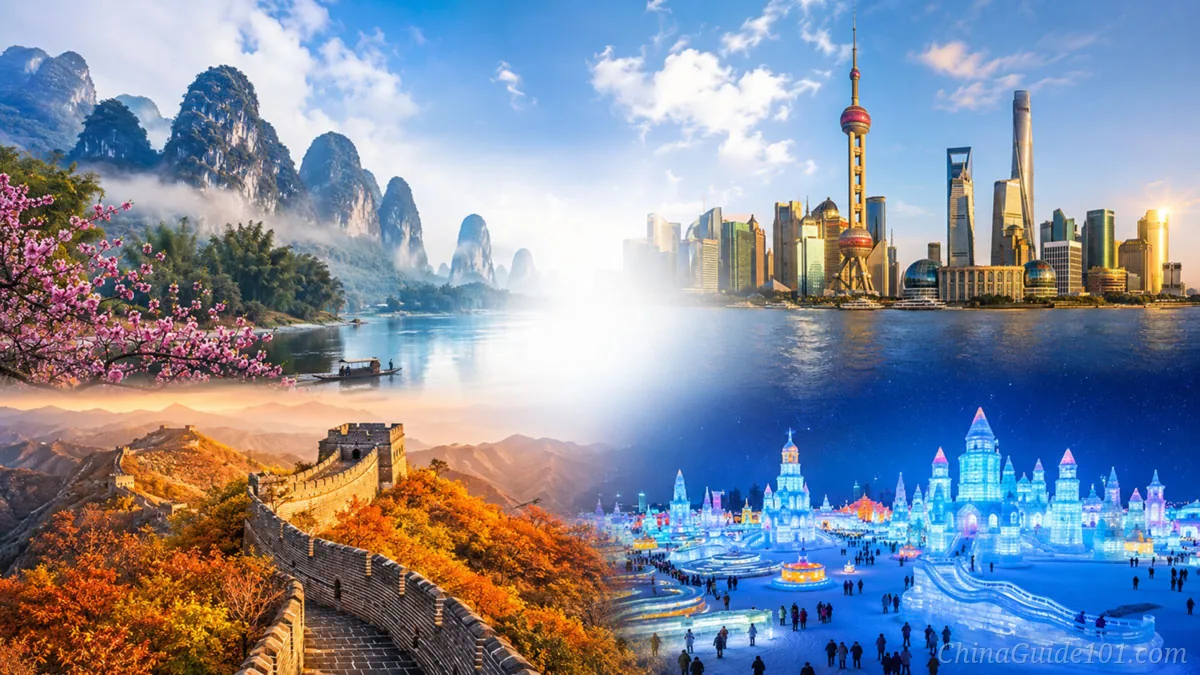
Quick Answer
Choosing when to visit China is one of the biggest decisions you'll make when planning your trip. Thanks to China's vast size, the best travel season can vary dramatically depending on where you're going. A spring day in Guangzhou can feel like early summer, while Harbin may still be covered in snow.
For most first-time visitors exploring China's classic highlights — including Beijing, Xi'an, Shanghai, Guilin and Zhangjiajie — the best time to visit is April to May and September to October . These two windows deliver pleasant temperatures, manageable humidity, and clear skies across the majority of the country.
| Travel Goal | Best Time |
|---|---|
| Best overall experience | April–May, September–October |
| Lowest prices and fewer tourists | November, early December |
| Avoiding crowds completely | March, November |
| Most reliably comfortable weather | April, May, September, October |
| Family vacations (school holidays) | July–August (but choose cooler regions) |
| Winter scenery and snow festivals | December–February |
Best Time to Visit China at a Glance
Scan the monthly rating below to see at a glance how each month performs for general travel across China. Deeper green indicates the most favourable months, while orange signals periods to approach with careful planning.
| Month | Jan | Feb | Mar | Apr | May | Jun | Jul | Aug | Sep | Oct | Nov | Dec |
|---|---|---|---|---|---|---|---|---|---|---|---|---|
| Rating | ⭐⭐⭐ | ⭐⭐⭐ | ⭐⭐⭐⭐ | ⭐⭐⭐⭐⭐ | ⭐⭐⭐⭐ | ⭐⭐⭐ | ⭐⭐ | ⭐⭐ | ⭐⭐⭐⭐⭐ | ⭐⭐⭐⭐⭐ | ⭐⭐⭐⭐ | ⭐⭐ |
| Vibe | ❄️ Winter | ❄️→🌸 | 🌸 Spring | 🌸 Spring | 🌸→☀️ | ☀️🌧️ | ☀️ Summer | ☀️ Summer | 🍁 Autumn | 🍁 Autumn | 🍂 Late Autumn | ❄️ Winter |
For a quick match between your travel goal and the ideal window, use the table below:
| If you want to... | Best Time | Where to Go |
|---|---|---|
| Comfortable sightseeing weather | April–May, September–October | Almost everywhere except high-altitude Tibet |
| Lowest prices and empty sites | November, early December | Focus on central and southern cities |
| Snow and ice festivals | January–February | Harbin, Jilin, northern Xinjiang |
| Iconic autumn colours | October | Beijing's Fragrant Hills, Jiuzhaigou, Yellow Mountain |
| Cherry and plum blossoms | March–April | Wuhan, Nanjing, Hangzhou, Kunming |
| Hiking without heatstroke | April, May, September, October | Great Wall, Tiger Leaping Gorge, Yellow Mountain |
| Tibet and high-altitude adventures | June–September | Lhasa, Everest Base Camp, Western Sichuan |
| Avoiding peak domestic crowds | March, November | All regions (except Sanya in winter) |
| Experiencing Chinese festivals | Jan/Feb (Spring Festival), June (Dragon Boat), Sept (Mid-Autumn) | Nationwide, but book transport far in advance |
Why There Isn't One Perfect Time to Visit China
It's tempting to think of China as a single destination, but the reality is very different. The distance from the frozen northeast to the subtropical south is roughly the same as from northern Scotland to the Sahara. In January, Beijing can be well below freezing while Hong Kong basks in comfortable 18°C (64°F). Meanwhile, the Tibetan Plateau has its own high-altitude weather logic, Xinjiang's deserts swing wildly between day and night, and Yunnan stays spring-like for much of the year.
There is no single "best month" for the whole of China — your ideal travel time depends on where you want to go and what kind of experience you're looking for. A week of persistent drizzle in Shanghai during June's plum rain season is a nuisance for sightseers but creates the perfect atmosphere for tea house afternoons and misty water town photographs. The Mid-Autumn Festival in September brings magical lantern displays but also a spike in domestic hotel bookings. The art of timing a China trip lies in understanding these trade-offs.
What Determines the Best Time to Visit China?
Before we walk through each month, you need to understand the five big forces that will shape your trip. Ignore them at your peril.
1. Weather — and China's Forgotten Climate Divide
China spans multiple climate zones, but there's one invisible line that foreign visitors rarely know about: the Qinling Mountains–Huai River Line . North of this line, buildings have government-mandated central heating in winter. South of it, they do not. In January, you'll be peeling off layers inside a Beijing hotel but shivering under a duvet in a Shanghai guesthouse. In summer, the south's "steam room" humidity is relentless — walking the Forbidden City at 2 p.m. in July can feel far more uncomfortable than the thermometer suggests because there is almost no shade across the vast stone courtyards. In cities like Shanghai, Nanjing, Wuhan, and Chongqing, daytime temperatures above 35°C (95°F) combined with very high humidity can make outdoor sightseeing genuinely exhausting. Locals adapt by starting their day before 8 a.m., and you should too.
The far west — Xinjiang and Tibet — brings extreme temperature swings and intense sun. A single day in Urumqi can span 15 degrees, and the high-altitude sun in Lhasa demands SPF 50 even when the air feels cool.
To give you a baseline, here are average daily highs and lows for three representative cities across the seasons:
| Season | Beijing (North) | Shanghai (Central) | Guangzhou (South) |
|---|---|---|---|
| Spring (Mar–May) | 5°C to 26°C | 8°C to 24°C | 17°C to 29°C |
| Summer (Jun–Aug) | 19°C to 31°C | 22°C to 32°C | 25°C to 33°C |
| Autumn (Sep–Nov) | 1°C to 26°C | 8°C to 28°C | 17°C to 32°C |
| Winter (Dec–Feb) | -9°C to 5°C | 0°C to 10°C | 10°C to 19°C |
This table is a snapshot. As you move west or into the mountains, conditions change dramatically.
2. Crowds — The Rhythm of 1.4 Billion Travellers
Domestic tourism in China is enormous, and during major public holidays it can feel as though the entire country is on the move. The three busiest travel periods are Chinese New Year ,the Labor Day holiday in early May , and the National Day Golden Week in early October . During these periods, popular attractions can reach capacity by mid-morning, high-speed train tickets often sell out within minutes of release, and major highways experience severe traffic congestion.
Summer vacation (July and August) sees a surge in family travel, especially at historical sites, theme parks, and mountain resorts. Even ordinary weekends make popular places like the Forbidden City or Zhangjiajie very busy. The smartest move? Shift your visit by just three days on either side of a holiday and you'll feel like you've arrived in a different country.
3. Travel Costs — The Price of Timing
Flight prices, hotel rates, and even high-speed train tickets spike during Chinese New Year, Labor Day, and National Day. A ¥400 hotel room can easily become ¥1,200. The weeks just after these holidays, by contrast, are some of the cheapest of the year. November and early December form a genuine sweet spot: autumn colours are fading but the weather remains manageable in many places, and prices dip noticeably. March, before the spring travel rush, is another budget-friendly window. If you're watching your wallet, avoiding the peak periods is the single most effective strategy — more than haggling, more than hostel-hopping.
4. Festivals — Cultural Immersion or Logistical Nightmare?
If you want to experience China's culture at its most vibrant, planning around a major festival can be incredibly rewarding — but you must go in with your eyes open. Chinese New Year immerses you in temple fairs, fireworks, and family feasts, yet many family-run restaurants close for several days, and intercity transport is chaotic. (A crucial tip: major shopping malls and tourist attractions in big cities like Beijing and Shanghai usually remain open throughout the holiday, so city stays are perfectly viable.) The Mid-Autumn Festival (usually September or early October) brings mooncakes and lantern displays. The Dragon Boat Festival (typically June) means lively boat races and zongzi (sticky rice dumplings). Experiencing these firsthand is unforgettable, but book everything — hotels, trains, attraction tickets — the moment they become available.
5. Regional Differences — The Most Common Planning Mistake
This cannot be overstated. Northern plains, southern rice terraces, southwestern highlands, northwestern deserts, and the Tibetan Plateau all have their own optimal seasons. When it's sweltering in Shanghai in July, the mountains of Yunnan are cool and pleasant, with wildflowers blooming. When Harbin is a wonderland of ice in January, hiking Tiger Leaping Gorge would be bone-chillingly cold and dangerously icy. Always treat China not as one monolithic weather map but as a collection of distinct travel regions, each with its own calendar. This principle applies to every month — China weather by month means nothing until you pin it to a specific province or city.
China Month by Month
Below is the heart of this guide. Each month includes a star rating (out of five), weather summary, pros, cons, best destinations, and a clear verdict.
January
Weather:Bitterly cold in the north (Beijing averages -9°C to 2°C), crisp but chilly in central areas, mild in the far south (Guangzhou around 10°C–18°C). Snow is common in the northeast and on high ground. Northern interiors are toasty thanks to district heating; southern guesthouses can be damp and cold.
Pros:Harbin's Ice and Snow Festival is at its spectacular peak. Ski resorts in Jilin and Xinjiang are world-class. Beijing's Forbidden City and Summer Palace, dusted in snow, offer a quiet, almost private atmosphere. Flight and hotel deals abound after the first week. This is genuinely the only time to see China transformed into a winter kingdom.
Cons:Many outdoor attractions in the north are bitterly cold. Great Wall sections like Jinshanling can be icy and slippery — trekking poles become essential, not optional. Chinese New Year travel rush (if it falls in late January) makes transport a nightmare.
Best for:❄️ Winter scenery, 📸 photography, ⛷️ skiing, 🏮 Chinese New Year atmosphere (if dates align).
Overall recommendation:A brilliant month for winter scenery lovers and photographers chasing snow-covered Great Wall shots. Not recommended for first-time visitors wanting comfortable sightseeing across multiple regions unless you stick to the south.
- Winter scenery
- Photography
- Skiing
- First-timer city tours
- Hiking
February
Weather:Still cold across most of the country, but with the first hints of spring in the south by late February. Northern China remains in deep winter, though the harshest cold usually eases after the first week.
Pros:Chinese New Year often falls in February (in 2027 it begins on February 6). Temple fairs — traditional performances, folk art, street food — and lantern displays transform cities. Plum blossoms start appearing in the Yangtze Delta, especially around Nanjing's Plum Blossom Hill. Prices are low before and after the holiday.
Cons:The Spring Festival travel season (chunyun) is the world's largest human migration. Trains, flights, and hotels are booked solid and expensive right around the holiday. Many small, family-run restaurants close for several days, though shopping malls, major chain restaurants, and key tourist sites in big cities usually remain open. Expect either eerie quiet (reunion days) or overwhelming crowds (the following days).
Best for:🏮 Cultural immersion, 🌸 early blossoms, 💰 budget travel (late Feb).
Overall recommendation:Only travel during Chinese New Year if you specifically want that cultural immersion and are prepared for the logistical challenges. The second half of February is a calmer, still low-cost window with emerging spring signs in the south.
- Cultural festivals
- Budget travel (late Feb)
- Plum blossoms
- Smooth intercity transport (holiday period)
March
Weather:A month of transition. Northern cities thaw but remain chilly (Beijing 0°C–12°C). Central and southern China become pleasantly mild, with occasional spring rain. Yunnan is already basking in warm, dry days.
Pros:Fewer crowds than almost any other month. Prices stay low. Spring blossoms — peach, cherry, rapeseed — begin in the warmer regions. Luoping's vast rapeseed fields in Yunnan become a sea of yellow. It's an excellent time for cultural sightseeing in cities like Xi'an and Nanjing without extreme temperatures. The cherry blossom forecast for Wuhan usually points to late March.
Cons:Northern China can still be brown and dusty, with occasional sandstorms in Beijing. The weather is unpredictable; you can get a week of drizzle in Shanghai. Many mountainous areas are still too cold for comfortable hiking. Central heating has typically been turned off in northern China by mid-March, making indoor spaces surprisingly chilly for a week or two.
Best for:🌸 Spring flowers, 💰 budget travel, 🚶♂️ avoiding crowds, 🏛️ cultural cities.
Overall recommendation:A very underrated month, especially for budget travelers and photographers chasing spring blooms in the south. Skip it if your itinerary is heavily focused on the Great Wall or northern outdoor activities.
- Budget travel
- Spring flowers
- Avoiding crowds
- Northern mountain hiking
- Great Wall (dust storms possible)
April
Weather:One of the most comfortable months of the year. Beijing sees 8°C–20°C, Shanghai 12°C–20°C, and the south is warm without the summer mugginess. Rainfall is moderate, and the famous "April showers" often clear by afternoon.
Pros:Perfect sightseeing weather. Trees and gardens are lush and green. The peony festivals in Luoyang are breathtaking — entire parks filled with blooms that the Chinese have revered for over a thousand years. The Li River and Zhangjiajie are at their most photogenic. Tourist numbers haven't yet peaked. Even the Great Wall feels manageable.
Cons:Occasional spring rain showers, especially in the Yangtze River basin. Popular destinations start getting busier toward the end of the month as Labor Day approaches. The far northwest (Xinjiang) might still be chilly, with some mountain passes remaining closed.
Best for:🌿 First-timers, 🥾 hiking, 📸 photography, 🏙️ city sightseeing, 🌸 flower festivals.
Overall recommendation:One of the two golden windows. If you only have one trip to China, April is a top contender. Book accommodations early if your dates overlap with the very end of the month.
- First-time visitors
- Hiking
- Photography
- City sightseeing
- Nature
May
Weather:Early May continues the pleasant spring before summer heat starts building mid-month. Beijing hits 15°C–26°C; the south becomes quite warm and humid. This is often the last truly comfortable month in southern China before the summer steam arrives.
Pros:From May 6 onward, crowds thin dramatically after the Labor Day exodus. Long daylight hours, vibrant greenery, and comfortable temperatures for the Great Wall, Li River cruises, and outdoor dining. Tibet starts becoming more accessible as the high passes thaw.
Cons:Labor Day (May 1–5) is one of China's three "Golden Weeks" — avoid these specific dates at all costs if you value your sanity. Late May can bring increasing humidity and the first hints of the plum rain season in the south.
Best for:🏞️ Outdoor adventures, 🏔️ Tibet overland, 🚲 cycling trips, 🌇 city breaks (after May 5).
Overall recommendation:Wonderful, but strictly avoid the first five days. From May 6 onward, it's an ideal time for almost any classic itinerary. Tibet overland tours start running reliably.
- First-time visitors (after May 5)
- Tibet
- Hiking
- Travel during Labor Day week
June
Weather:Hot and increasingly wet. The "plum rain" season (meiyu) typically arrives in the Yangtze River basin by mid-June and lasts into early July, bringing persistent drizzle or theatrical downpours. The south is steamy; the north is heating up but still manageable.
Pros:Lush green landscapes everywhere. Tourist sites are less crowded than July and August. Dragon Boat Festival (often June) adds cultural flavour with exhilarating boat races and zongzi. Prices are moderate. The grasslands of Inner Mongolia are coming alive.
Cons:The relentless humidity in Shanghai, Nanjing, and Hangzhou can make sightseeing feel like walking through warm soup. Mountain views — especially at Zhangjiajie and Yellow Mountain — are frequently obscured by thick fog and rain. Southern China can feel like a steam room. Hiking trails become slippery and leech-prone in Yunnan's lowland jungles.
Best for:🐉 Dragon Boat Festival, 🌿 Inner Mongolia grasslands, ☕ rainy-day teahouse culture, 🏞️ Yunnan highlands.
Overall recommendation:A tricky month for a classic first-timer's loop. It's best reserved for travellers heading to the southwest or northwest, or those who don't mind a bit of rain and want to experience the dramatic Dragon Boat Festival.
- Inner Mongolia
- Yunnan highlands
- Dragon Boat Festival
- Classic city itineraries
- Mountain scenery visibility
July
(⭐⭐⭐⭐☆ for high-altitude regions)
Weather:Peak summer heat across most of China. Beijing can easily reach 35°C (95°F), with high humidity. The Yangtze River Valley is sweltering — Wuhan, Nanjing, and Chongqing are known as China's "Three Furnaces" for good reason. Southern China, including Hong Kong, is very hot and wet, with typhoon risk starting. In many Chinese cities, sightseeing often starts before 8 a.m. during July because locals actively avoid the brutal afternoon heat. Parks become lively at sunrise with tai chi practitioners and bird walkers, while outdoor attractions are much quieter — and more bearable — before 10 a.m. Evenings, on the other hand, come alive: Xi'an's city walls, Chengdu's Kuanzhai Alley, and Nanjing's Fuzimiao are far more pleasant after sunset than during the day.
Pros:High-altitude destinations like Tibet, Shangri-La, and western Sichuan are at their most accessible and beautiful. The grasslands of Inner Mongolia and Xinjiang's Kanas Lake region are in full green splendour. Qingdao's International Beer Festival is a lively, sweaty celebration. Wildflowers carpet the Tibetan Plateau.
Cons:Oppressive heat and humidity in the major tourist cities makes sightseeing genuinely exhausting. Walking the Forbidden City at 2 p.m. in July can feel far worse than the temperature suggests — those vast stone courtyards offer almost no shade. Afternoon thunderstorms are common, and typhoons can disrupt flights and ferry services along the southeast coast. The Great Wall under the July sun is an endurance test.
Best for:🏔️ High-altitude escapes, 🌾 Grasslands, 🍺 Qingdao Beer Festival, 👨👩👧👦 Family summer vacations.
Overall recommendation:Not the best for Beijing–Xi'an–Shanghai trips, but genuinely excellent for high-altitude and grassland adventures. If you must travel this month, adopt the local habit: early morning exploration, a long lunch break, and evening walks when the city comes back to life.
- Tibet
- Grasslands
- High-altitude trekking
- City sightseeing
- Great Wall
- Lowland hiking
August
(⭐⭐⭐⭐☆ for high-altitude regions)
Weather:Similar to July — hot, humid, and with continued typhoon risk along the coast. Late August can still see sweltering days, though the last week often brings a subtle shift as summer begins its retreat.
Pros:Same high-altitude accessibility as July. The tail end of summer holidays in China (schools resume in early September) means domestic crowds start reducing in the last week. Waterfalls at Jiuzhaigou are thundering at full flow. The grasslands remain lush.
Cons:The heat in cities is relentless and unrelenting. Air quality can be poor in major urban centres. It's the peak month for typhoons hitting the south and east coasts, potentially disrupting flights, high-speed rail, and ferry services to places like Hong Kong and Hainan. Expect rain.
Best for:🏔️ Tibet & plateau treks, 💦 Jiuzhaigou waterfalls, 🌾 Inner Mongolia, 🧑🤝🧑 Late August family trips.
Overall recommendation:Choose your locations wisely. Stick to elevation or latitude if you want comfort; avoid the central cities and southern plains unless you genuinely love tropical heat. Late August can be a strategic window — children return to school, and the first hints of autumn appear.
- Tibet
- Grasslands
- Jiuzhaigou waterfalls
- Coastal cities (typhoon risk)
- City-heavy itineraries
September
Weather:A glorious shift. Early September can still be warm, but the crushing humidity retreats noticeably by the second week. By mid-month, Beijing sees 15°C–26°C and the south becomes genuinely pleasant. Rainfall decreases significantly. The autumn light in the north is famously crystal clear.
Pros:Possibly the single best month for weather across the broadest range of China. Tourist numbers are moderate — a lull after summer holidays and before October's Golden Week. Mid-Autumn Festival often falls in September, adding mooncakes, lantern displays, and family gatherings. The skies over the Great Wall are deep blue and perfect for photography.
Cons:The week leading up to National Day at the very end of September can see an uptick in domestic travellers getting a head start, especially at headline attractions. Some high-altitude areas in the west may see early frost, and the Tibetan Plateau starts getting cold at night.
Best for:🎑 Mid-Autumn Festival, 🌤️ Perfect weather, 🚶♂️ Hiking, 📷 Photography.
Overall recommendation:Book this month with absolute confidence. Just try to wrap up your trip before September 28th, or plan to stay through the Golden Week only if you've secured every booking in advance.
- First-time visitors
- Photography
- Hiking
- Festivals
- Almost everything
October (after the 7th)
Weather:Early October continues the autumn perfection. By late October, northern China becomes crisp and chilly, while the south stays beautifully mild. This is the driest time of year in many regions, and the autumn foliage peaks in different areas throughout the month. Beijing's Fragrant Hills (Xiangshan) erupt in crimson and gold, Jiuzhaigou's forests become a painter's palette, and the golden poplar forests of Ejina Banner in Inner Mongolia draw photographers from across the country. After Golden Week, the autumn colour relay begins: ginkgo trees in temple courtyards, red maples on Yellow Mountain, and vast golden poplar stands in the northwest.
Pros:After October 7, the crowds vanish almost overnight, and you get glorious weather in almost the entire country. Autumn colours in the mountains and along the Great Wall are genuinely unforgettable. This is, for many seasoned China travellers, the absolute best time of year.
Cons:Golden Week (October 1–7) is the single most crowded, expensive period to travel in China. Sites sell out, trains are packed with standing-room-only carriages, and hotel prices can triple or quadruple. Do not attempt intercity travel during this week without fully secured reservations. Western regions like Tibet may start imposing travel restrictions due to cold, and some high mountain passes can close.
Best for:🍁 Autumn foliage, 📸 Photography, 🥾 Hiking, 🏙️ City exploration (after Oct 7).
Overall recommendation:Absolutely wonderful — but only after October 7. If you can't avoid the holiday week, you must treat it as a military operation: book accommodations, train tickets, and entry tickets as far in advance as the systems allow. That said, if you're already in China during Golden Week, the festive urban atmosphere — flags, flower displays, and public celebrations — is something to witness.
- First-time visitors (after Oct 7)
- Autumn foliage
- Photography
- Hiking
- Spontaneous travel (Golden Week)
November
Weather:Late autumn sliding into early winter. Northern China gets cold (Beijing 0°C–10°C), with dry, crisp days and brilliant blue skies. The south remains mild and comfortable. Central heating starts in northern cities from mid-November, making indoors wonderfully cosy. This is a very comfortable month for travel if you dress appropriately.
Pros:Very low tourist numbers — you can have sections of the Great Wall almost to yourself. Accommodation and flights are genuinely cheap, often at their lowest point of the year. The autumn leaves persist well into the month in the south. Nanjing's ginkgo-lined avenues carpet the ground in gold. It's a great time for cultural city trips without weather extremes or queues. Hot pot restaurants feel especially welcoming.
Cons:The north can feel bleak and grey by late November, with bare trees and early sunsets. Outdoor attractions like the Great Wall are cold and windy — layers are non-negotiable. Some mountain scenic areas start closing high-altitude trails for the winter. Days are noticeably shorter, reducing sightseeing hours.
Best for:💰 Budget travel, 🏛️ Cultural deep dives, 🍂 Late autumn leaves, 🚶♂️ Avoiding crowds.
Overall recommendation:A very smart choice for budget-conscious travellers who don't mind wearing a coat and prefer empty sites to peak-season queues. Focus your itinerary on the central and southern regions, and you'll have a wonderful, unhurried trip.
- Budget travel
- Cultural sightseeing
- Avoiding crowds
- Northern mountain hiking (late Nov)
- Long daylight hours
December
(⭐⭐⭐⭐☆ for winter scenery)
Weather:Winter settles in firmly. Beijing drops well below freezing at night, often to -8°C. Shanghai is damp and chilly (2°C–10°C), and the lack of central heating in older southern buildings makes 5°C indoors feel far colder than -10°C in a heated Beijing hotel. The south is cool but tolerable. Harbin's ice sculptures are being frantically built, with the festival preview opening by late December.
Pros:Rock-bottom prices (except around Christmas and New Year's Eve at international hotels). Sites in the north are almost empty — the Forbidden City can feel like a private museum. It's the start of the winter sports season, and the Harbin Ice and Snow Festival begins welcoming visitors in the last week. Hot pot in Chengdu or Chongqing tastes especially satisfying in cold weather. This is when you see the China that summer visitors never experience.
Cons:Bitterly cold in the north. Southern interiors without heating can make for genuinely uncomfortable nights if you're staying in budget guesthouses — always confirm heating arrangements before booking. Many outdoor activities are limited, and some scenic areas operate on reduced winter schedules. Air pollution can be worse in northern cities during winter thermal inversions, though this varies year to year.
Best for:❄️ Harbin Ice Festival, ⛷️ Ski resorts, 🏯 Empty museums, 🍲 Winter food culture.
Overall recommendation:Only choose this month if winter scenery is your goal, or you're focusing on the deep south, Hong Kong, and tropical Hainan. For a standard multi-city itinerary, the cold and limited daylight will constrain your plans. But if you've always wanted to see the Great Wall under fresh snow or photograph Harbin's illuminated ice castles, this is your window.
- Winter scenery
- Harbin Ice Festival
- Budget travel
- Standard sightseeing
- Warm-weather outdoor activities
Best Time for Different Types of Travelers
First-Time Visitors
Aim for April, May (after the holiday), September, or October (after Golden Week). These months give you the classic hits — the Great Wall, Terracotta Warriors, Li River, Shanghai's skyline — in conditions that won't break your spirit. You'll understand why China's ancient poets wrote so many verses about spring mornings and autumn moons.
Budget Travelers
March and November are your best friends. You'll find low-season hotel rates (often 30–50% less than peak), discounted internal flights, and attractions that feel as though they're open just for you. Early December before the Christmas bump is another genuine sweet spot. The money you save on accommodation can fund an extra week of exploration or a splurge on a few memorable meals.
Families
Your travel window is often dictated by school holidays, so July and August become the default. To survive and actually enjoy the trip, build your itinerary around cooler regions: Yunnan's highlands, Tibet, Inner Mongolia's grasslands, or the mountains of Guizhou. Avoid lowland cities between noon and 3 p.m., follow the local rhythm of early starts and long lunch breaks, and choose hotels with swimming pools. If you can travel in late August, you'll catch slightly smaller crowds as Chinese schools resume in early September.
Nature Lovers
Spring (April–May) and autumn (September–October)are when China's landscapes are at their most vivid. Wildflowers in Yunnan, verdant karst peaks piercing the mist in Yangshuo, golden rice terraces cascading down the hills of Longji, and fiery autumn forests reflected in Jiuzhaigou's turquoise lakes. These windows offer the perfect balance of comfortable hiking and spectacular scenery.
Photography Enthusiasts
Autumn (October and November)delivers the iconic golden ginkgo leaves that carpet ancient temple courtyards, the red maples on Yellow Mountain, and the mirror-like rice terraces just before harvest. Winter (December–February) provides snow-covered Great Wall shots — when the crowds are gone and fresh snow transforms the battlements into something otherworldly — and Harbin's illuminated ice wonderland. Spring (March–April) paints Luoping's fields yellow with rapeseed flowers and brings peach blossoms to the valleys of Nyingchi in Tibet. China is a photographer's dream when you match the landscape to its perfect season.
Hiking and Trekking
April, May, September, and October are prime for the Great Wall's wilder sections, Tiger Leaping Gorge in Yunnan, and the alpine trails of western Sichuan. Summer hiking in high-altitude Tibet or around Heavenly Lake in the Tianshan Mountains is also excellent, with wildflowers at their peak. Avoid low-elevation treks in July and August unless you're prepared for heavy rain, slippery trails, and leeches in Yunnan's rainforest sections.
Best Time by Destination — At a Glance
Here is a quick-reference table for China's most popular destinations. Each entry gives the best months and a one-line summary. Detailed seasonal guides for each city are coming soon; this table will link to them as they're published.
| Destination | Best Months | Why |
|---|---|---|
| Beijing | April–May, September–October | Perfect Great Wall weather, clear skies, autumn foliage →Read our full Beijing guide |
| Shanghai | March–May, October–November | Pleasant temperatures; avoid summer humidity and winter damp →Read our full Shanghai guide |
| Xi'an | April–May, September–October | Comfortable for the city walls,Terracotta Warriors , and nearby Mount Hua |
| Chengdu | March–June, September–November | Mild for pandas, tea houses, and Sichuan opera; avoid summer humidity |
| Zhangjiajie | April–June, September–early November | Clearer views of the pillars; avoid summer crowds and winter ice |
| Jiuzhaigou | October, May–June | October foliage is legendary; spring offers lush waterfalls |
| Guilin & Yangshuo | April–May, September–November | Karst scenery in comfortable warmth; avoid summer heat and floods |
| Yunnan | March–May, September–November | Spring flowers or clear autumn skies; highlands are a cool summer escape |
| Xinjiang | May–October | Grasslands in summer, golden poplars in autumn; winter is extremely cold |
| Tibet | May–October | Accessible high passes, mild days; July–August can be rainy |
| Harbin | Mid-December–late February | Ice and snow festivals; otherwise, it's just an extremely cold city |
| Hong Kong | October–December | Most pleasant weather; summer is hot, humid, and typhoon-prone |
When You Should Avoid Visiting China
This section isn't about saying "don't go." It's about ensuring you go in with a plan. If you're an independent traveller with flexibility, you'll have a much smoother trip by avoiding these three major blockout periods:
- Base yourself in major cities and enjoy temple fairs if visiting during Chinese New Year
- Shift your May trip to arrive after May 5 for a completely transformed experience
- Reserve all hotels, train tickets, and attraction entries as early as systems allow
- Arrive at train stations at least an hour ahead during holiday periods
- Chinese New Year (late January or February) — transport at limit, small restaurants closed
- Labor Day (May 1–5) — scenic areas packed, hotel prices surge, trains sell out in minutes
- National Day Golden Week (October 1–7) — country-wide movement, solid rivers of people
- Attempt intercity travel during Golden Week without advance reservations for every segment
- Chinese New Year (late January or February).The exact dates change annually, but the week before and after the holiday see transport systems stretched to their absolute limit. Many family-run restaurants close for several days. However, major shopping malls, hotel restaurants, and tourist attractions in large cities usually remain operational. If this is your only window, base yourself in one or two major cities, book hotels and trains at least a month in advance, and enjoy the unforgettable temple fairs.
- Labor Day (May 1–5).The first major domestic travel spike of spring. Scenic areas are packed to capacity, hotel prices surge, and high-speed trains sell out within minutes of release. Shifting your trip by just a week — arriving after May 5 — transforms the experience completely.
- National Day Golden Week (October 1–7).The most intense travel period of the year. It's not just busy — it's a country-wide movement of hundreds of millions of people. The Great Wall at Badaling becomes a solid river of people. Do not attempt intercity travel without advance reservations for every single segment of your journey.
PRO TIP: SURVIVING PEAK TRAVEL HOLIDAYS
If your trip can only happen during these windows, you can absolutely still have a memorable visit. But you must treat it as a planned operation. Reserve all hotels, high-speed train tickets (which usually open for booking 15 days in advance), and entry tickets for major sites as early as the systems allow. Arrive at train stations at least an hour ahead of departure. Accept that you'll be sharing the view with many others, and you might even find that the uniquely Chinese festival atmosphere — the patriotic flags, the family excitement, the special holiday foods — becomes a highlight in itself.
Frequently Asked Questions
Q: What is the best month to visit China?
If you could pick only one,October (after the 7th)is arguably the best single month for weather, comfort, and scenery across the widest range of destinations. The autumn light is legendary, and the summer crowds have dispersed.
Q: Is July too hot to visit China?
In many classic destinations — Beijing, Xi'an, Shanghai, Wuhan — yes, it can be genuinely uncomfortable. Daytime temperatures combined with high humidity can make sightseeing exhausting. However, July is a great time for Tibet, Yunnan's mountains, and Inner Mongolia. You just need to choose your locations carefully and plan activities for early morning.
Q: Is August a good time to travel in China?
It has similar challenges to July, with the added typhoon risk on the southeast coast. It's a strong month for high-altitude and grassland regions but a poor choice for city-heavy itineraries in the east. Late August is a strategic window as Chinese school holidays end.
Q: Is China worth visiting in summer?
Yes, but only if you plan around the heat. Summer is the best time for Tibet, Xinjiang's grasslands, and high-elevation national parks. If you stick to lowland cities, you'll likely find the humidity draining. Many travellers find summer trips highly rewarding when they focus on the right regions and adopt the local rhythm of early starts and late evening outings.
Q: What's the worst month to visit China?
There is no single "worst" month, but for a classic sightseeing trip covering Beijing, Xi'an, and Shanghai,July and August are often the most challenging due to heat, humidity, and crowds. January and February can also be harsh if you're not prepared for cold, especially in unheated southern accommodations. The worst month depends entirely on your itinerary.
Q: When is the cheapest time to visit China?
November and early December , just before the Christmas and New Year season, offer the lowest prices and the fewest tourists across most of the country. March is another solid budget window before spring demand picks up.
Q: Should I avoid Golden Week?
If you can, yes — shifting your trip by one week will dramatically improve your experience. The first week of October sees the entire country on holiday simultaneously. If you must travel then, book everything as far in advance as possible and set realistic expectations about crowds.
Q: Is winter a good time to visit China?
For winter-specific experiences — Harbin's ice festival, ski resorts, snowy Great Wall photography — absolutely. For a standard sightseeing trip covering multiple regions, winter can be more challenging due to cold, early sunsets, and reduced access to some mountain areas. But the empty sites and low prices are compelling trade-offs.
Q: What's the rainy season in China?
The most well-known rainy period is the East Asian monsoon's "plum rain" season, which typically affects the Yangtze River basin (Shanghai, Nanjing, Hangzhou) from mid-June to early July. Southern China receives heavy rain from May through August, and typhoon season along the coast peaks from July to September, sometimes extending into October.
Q: Is spring or autumn better for sightseeing?
Both are excellent, and the choice often depends on your specific interests. Spring offers blossoming flowers, fresh green landscapes, and a sense of renewal. Autumn gives you crisp air, golden light, harvest colours, and is generally slightly drier and more predictable. You genuinely can't go wrong with either.
Q: What's the best time to visit Beijing?
April–May and mid-September to October.You'll enjoy clear blue skies, comfortable temperatures for climbing the Great Wall, and spectacular autumn leaves in October. Avoid January and February unless you're specifically seeking winter scenery.
Q: What's the best time to visit Zhangjiajie?
April–June and September–early November.You want to avoid the summer holiday crush and the icy winter pathways while dodging the heaviest fog and rain that can completely obscure the quartz-sandstone pillars. Even in good months, Zhangjiajie is moody — embrace the mist as part of the experience.
Q: When can I see cherry blossoms in China?
Cherry blossoms typically peak from mid-March to early April, depending on the specific location and the year's weather. Wuhan's East Lake Cherry Blossom Park and university campuses are the most famous spots, followed by Nanjing's Jiming Temple area and Beijing's Yuyuantan Park. Check the annual cherry blossom forecast for exact dates.
Q: When is the Mid-Autumn Festival?
The Mid-Autumn Festival follows the Chinese lunar calendar, so the date changes every year. It usually falls in September or early October . Mooncakes, lantern displays, and family gatherings are the highlights. It's a wonderful time to experience traditional Chinese culture, but book hotels and transportation early, as domestic travel demand often increases around the holiday.
Q: Is it worth visiting China during Chinese New Year?
Only if you specifically want the cultural experience of temple fairs, fireworks, and traditional celebrations. Be ready for transport chaos and restaurant closures, though major city attractions and malls stay open. It's vibrant and unforgettable but demanding.
Q: When does the Harbin Ice Festival take place?
It officially runs from early January to late February, with the ice sculptures usually at their most impressive from mid-January onward. February remains a great time to visit, but expect larger crowds and higher prices if your trip coincides with the Chinese New Year holiday.
Q: Can I combine Tibet with a standard China itinerary?
Yes, and the best months for that are May, June, September, and October . July and August are accessible but can be rainy, obscuring mountain views. Winter and early spring often see travel permit restrictions for foreigners. You'll need to join an organized tour for most Tibet travel, so plan this segment well in advance.
Q: How far in advance should I book domestic flights and trains?
For peak travel periods (Chinese New Year, Labor Day, National Day), book high-speed train tickets the moment they become available — typically 15 days in advance — as popular routes sell out in minutes. Flights are best booked 1–2 months ahead during peak seasons. For off-peak travel, a few days to a week of advance booking is usually sufficient.
Common Mistakes First-Time Visitors Make When Choosing Their Travel Dates
We've watched too many travellers walk into the same avoidable traps. These are the real, on-the-ground lessons that will save your trip.
- Check specific climates for every city on your itinerary
- Head for high elevation if traveling during summer
- Confirm heating arrangements before booking southern accommodations in winter
- Research rainfall patterns for outdoor spots and prepare rainy day backup plans
- Set calendar reminders for the 15-day train ticket release window
- Pack in layers to handle climate variations in a single trip
- Assume the weather is uniform across China's 5 climate zones
- Underestimate July and August heat/humidity in the Yangtze River Valley
- Book during National Day without planning for massive crowds and sold-out sites
- Choose southern cities in winter without verifying indoor heating
- Ignore altitude and season combinations that cause pass closures
Assuming the weather is the same across China.Arriving in Beijing with a summer wardrobe in January because "China is in Asia, so it must be warm" is a painful mistake. China spans five climate zones. Always check the specific climate of every city on your itinerary, not a national average.
Underestimating how hot and humid July and August can be.The combination of high temperature and humidity in the Yangtze River Valley can reach dangerous levels. Cities like Wuhan, Nanjing, and Chongqing are famously oppressive. Sightseeing becomes an endurance sport rather than a pleasure. If summer is your only option, head for elevation.
Booking during National Day without realizing how crowded it gets.The photograph of the Great Wall you've seen — a peaceful stone pathway winding through green hills — will not match your experience on October 3rd. The Forbidden City's 80,000 daily tickets sell out completely. Train travel without a reserved seat means standing in the carriage aisle for hours. This is not an exaggeration.
Choosing winter without checking regional temperatures and heating.A trip planned around Shanghai, Suzhou, and Hangzhou in January sounds romantic, but sleeping in a charming old guesthouse without proper heating when it's 3°C outside is genuinely miserable. Northern China has excellent central heating; the south, below the Qinling Mountains, traditionally does not. Always confirm heating arrangements before booking southern accommodations in winter.
Planning outdoor sightseeing during the rainy season in southern China.Hiking the Longji Rice Terraces in dense June fog or waiting for the Zhangjiajie pillars to emerge from a week of steady drizzle can erase the views entirely. Research the rainfall patterns for your must-see outdoor spots, and have a flexible "rainy day" backup plan — museums, tea houses, cooking classes — for each destination.
Not factoring in public holidays when booking internal travel.Even domestic travellers get caught out. Train tickets and hotel availability disappear rapidly during every public holiday, even the shorter ones like the Qingming Festival (early April) and the Dragon Boat Festival (June). If your dates coincide with any Chinese holiday, book earlier than you think you need to. Set calendar reminders for the 15-day train ticket release window.
Ignoring altitude and season combinations.Tibet's high passes can be blocked by snow from November to March, and some national parks in western Sichuan close entirely during the same period. Trying to hike Tiger Leaping Gorge in January is possible but involves dangerously icy sections and guesthouses that may be closed for the season. Match the activity to the season.
Packing for the wrong climate within a single trip.A common itinerary like "Beijing → Xi'an → Chengdu → Guilin → Shanghai" can span freezing northern mornings and subtropical southern afternoons in the same week during spring or autumn. Layering is everything. A packable down jacket, a waterproof shell, and comfortable walking shoes will serve you far better than any single-purpose coat.
PRO TIP: THE GOLDEN RULE OF CHINA TRAVEL
Remember: there is no bad season to visit China — only the wrong destination for that season.A little seasonal awareness transforms a trip to China from an exhausting ordeal into the adventure you're actually hoping for. Whether you're chasing the perfect golden hour on the Great Wall in October, wandering a misty morning in a Yangshuo rice paddy in April, or watching snow fall silently over a Beijing temple in January — picking the right window makes all the difference.