
The Yulong River winds through Yangshuo's karst countryside, widely known as the "Little Li River." Unlike motorised river cruises, its signature experience is quiet, pole-pushed bamboo rafts gliding past rice paddies, ancient stone bridges and scattered farmhouses. This guide is built around the practical choices every independent traveller faces: picking the right raft route, reaching the correct pier, booking tickets under real rules, sorting post-raft transfers, and understanding how rain or low water can disrupt your day. It skips redundant Yangshuo background and focuses only on planning decisions for your time on the river.
Is the Yulong River Worth Visiting?
The Yulong River rewards travellers who slow down. Its charm lies in intimate, up-close karst scenery: rafts drift just above the water, passing small weirs, shaded bamboo banks and quiet villages barely touched by mass tourism. It pairs naturally with Yangshuo's cycling routes, so many visitors weave rafting together with easy bike rides through the countryside.
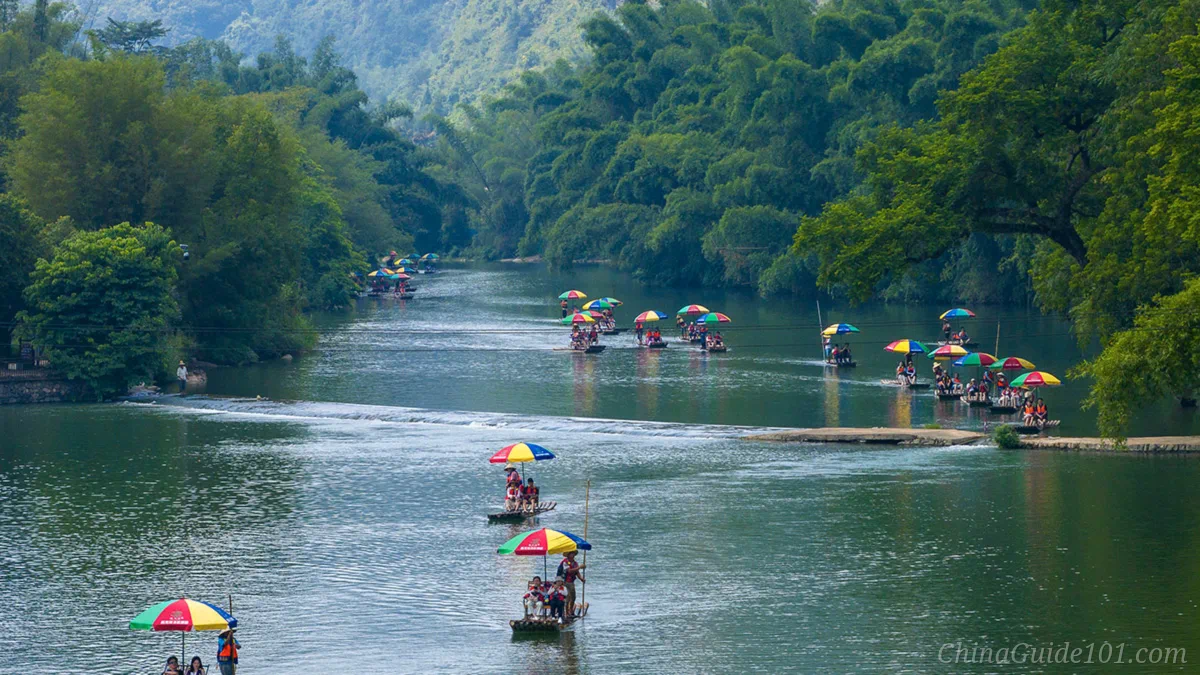
This experience works best for photographers, leisure travellers and anyone chasing a calm, pastoral version of Guangxi's famous mountain landscape. It is not a high-adrenaline white-water trip, though small weir drops can create gentle splashes and memorable photo moments. Be aware that popular routes fill quickly during peak seasons; waiting times, limited ticket releases and sudden river-level closures can easily reshape your plan.
One critical distinction to keep in mind: Yulong River rafting offers a completely different mood and layout from Li River cruises. Read the comparison below to decide which fits your itinerary, or whether you have time for both.
Yulong River vs. Li River: Which Should You Choose?
| Yulong River | Li River | |
|---|---|---|
| Core experience | Man-pushed bamboo rafts, quiet rural atmosphere | Wide river cruises; some Li sections also offer bamboo rafts, operated under separate rules |
| Landscape feel | Intimate, small-scale: rice fields, old bridges, village homesteads tucked between peaks | Grand, sweeping karst vistas, iconic landmarks such as the 20-yuan note view |
| Vessel details | Standard rafts carry 2 guests; no engine, steered by a local boatman with a long pole | Large passenger cruise ships for groups; some sections use electric bamboo rafts |
| Planning priority | Select your exact pier and route carefully; one ticket only covers one set start and finish | Pick your boarding pier and cruise segment; most cruises run one-way with fixed disembark points |
If you are squeezing Yangshuo into a single day and want countryside plus cycling, lean toward the Yulong. If your priority is the classic, wide-angle Guangxi mountain panorama, a Li River cruise is the stronger pick. You can dive deeper into scheduling, pier options and ticket rules in our dedicated Li River Cruise Guide .
Yulong River Bamboo Rafting Routes Compared
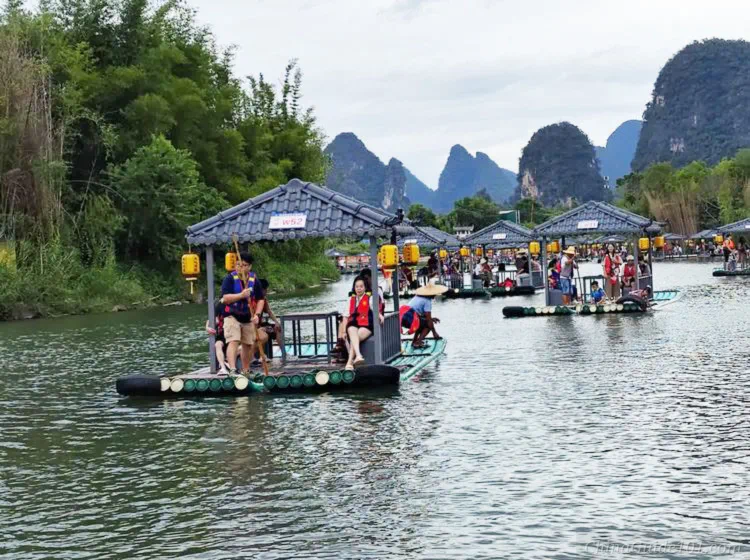
Yulong River bamboo rafts are grouped by capacity: 2-person, 3-person, 4-person and 8-person rafts. Many 2‑person and 3‑person routes run one-way, while 4‑person and 8‑person leisure routes are mostly return trips. Standard two-person rafts on popular one-way routes are generally priced per raft, not per person. One important detail for visitors to understand: a solo traveller buying a two-person raft ticket still pays the full raft rate. Most one-way routes do not loop back, so your disembarkation pier shapes all your onward transport.
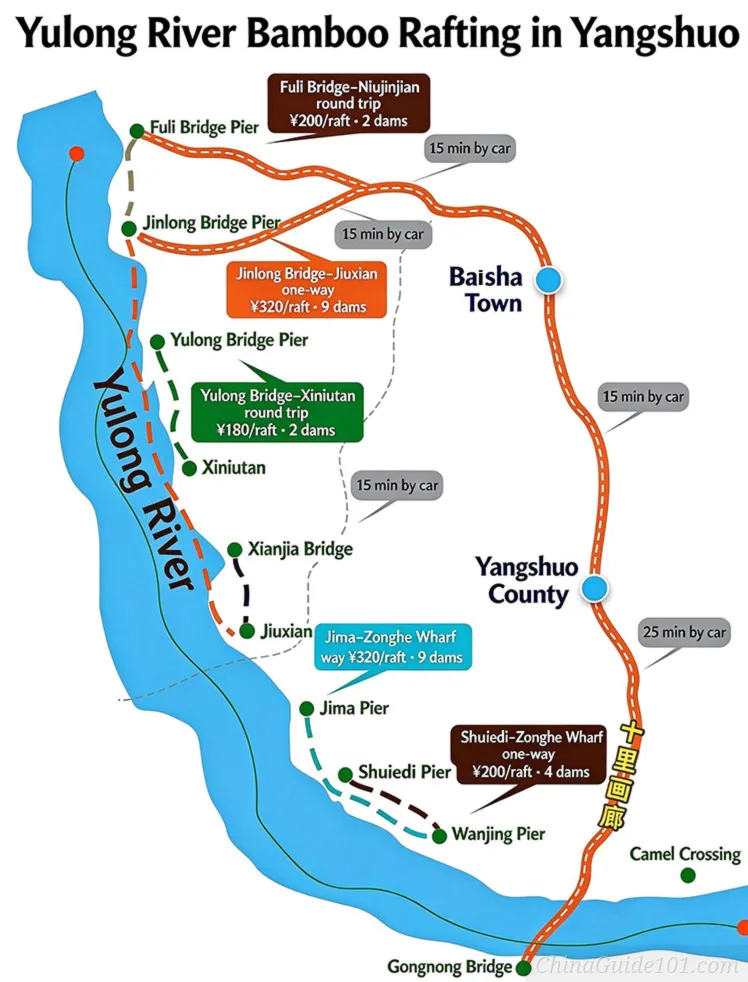
⚠️ Pier names: Some route listings use Wanjing Pier (万景码头 / Miaolingdong 妙灵洞码头), while others describe the landing point as the comprehensive pier beside Gongnong Bridge. Check the Chinese pier name, raft type (2/3/4/8-person) and exact finish point on your ticket before setting off.
| Route | Raft Type | Reference duration (voyage time can shift with river flow) | Weirs / small drops | Best for | Reference price |
|---|---|---|---|---|---|
| Jinlong Bridge (金龙桥) to Jiuxian Village Pier (旧县综合码头, ~6.18 km) | 2-person, one-way | ~70 minutes | 9 | Visitors with half a day, wanting a longer stretch of Yulong River's rural scenery | ¥320 per raft |
| Jima (骥马) to Zonghe Pier (综合码头 / Gongnong Bridge area, ~5.20 km) | 2-person, one-way | ~60 minutes | 9 | Visitors planning to cycle along the Ten-Mile Gallery | ¥320 per raft |
| Shui'edi (水厄底) to Zonghe Pier (综合码头, ~2.48 km) | 2-person, one-way | ~30 minutes | 4 | Visitors with limited time, golden-hour photography | ¥200 per raft |
| Qing'edu Pier (青厄渡) to Yangshuowan Pier (阳朔湾码头, ~2.78 km) | 2-person, one-way | ~35 minutes | 5 | Visitors wanting a short, calm one-way float, fewer heavy weir drops | ¥200 per raft |
| Miaolingdong (Wanjing) to Beitouba (碑头坝) | 3-person, one-way | ~50 minutes | 6 | Small groups of 3 who prefer the classic upper river view | ¥300 per raft |
| Fuliqiao (富里桥) ⇋ Shibi Tan (石壁滩, ~1.66 km) | 4-person, return | ~30 minutes | 0 | Family groups of 4 wanting a gentle loop without weir drops | ¥280 per raft |
| Wanjing / Longtan / Yangshuowan leisure loop | 8-person, return | ~30 minutes | 0 | Larger groups, families with young children or seniors. Priced per guest, minimum charge for 5 people. | ¥45 per person |
Jinlong Bridge to Jiuxian (2-person, one-way)
This is the most celebrated upstream stretch on the Yulong. Starting from Jinlong Bridge pier, the raft winds through the quieter valley, drifting past old stone arch bridges and wide rice flats. The nine small weirs create soft splashes without rough rapids.
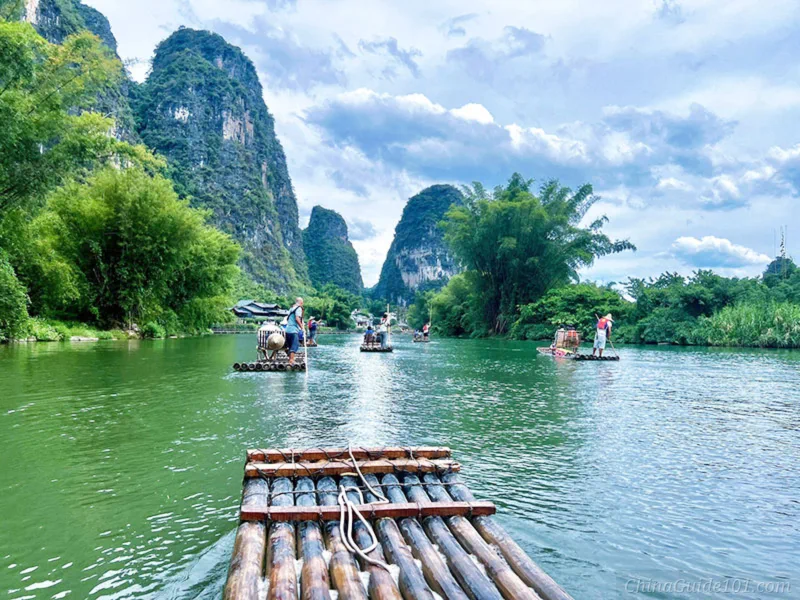
At roughly 70 minutes of reference voyage time, this segment takes up more of your day. When you land at Jiuxian Village, you will need to arrange onward transport back toward Yangshuo or your next stop. It suits travellers who are not rushing and want a longer rural float on the upper river.
Jima to Gongnong Bridge area (2-person, one-way)
This mid-section route works well for visitors planning to cycle along the Ten-Mile Gallery. The karst scenery stays lush, and the disembarkation point near Gongnong Bridge puts you directly beside bike lanes and food stalls, creating seamless cycling connections.
Its reference 60-minute runtime sits between the long upstream Jinlong Bridge route and the shorter Shui'edi run. It is a balanced middle ground: enough floating time to soak up the river without committing to the full upper-reach journey.
Shui'edi to Gongnong Bridge area (2-person, one-way)
This shorter route is a practical choice for visitors with limited time. At a reference 30 minutes, it delivers concentrated karst views and gentle weir splashes, and it lands near Ten-Mile Gallery cycling routes. The tradeoff is crowds: tickets can sell out quickly during peak periods, weekends and public holidays.
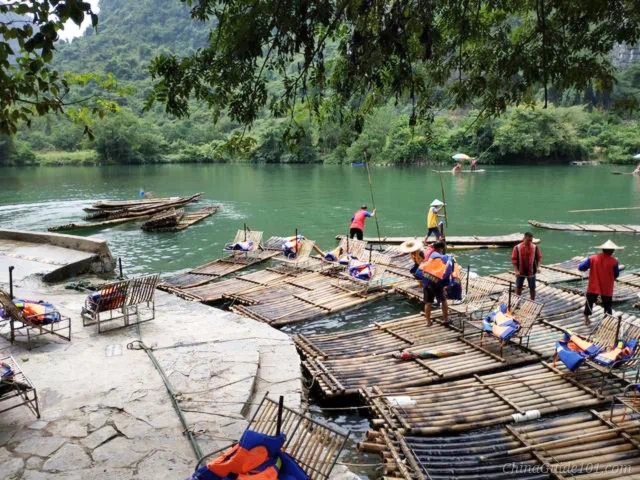
Many day-trippers pair this short raft segment with late-afternoon cycling, which works well for golden-hour light, provided you secure your time slot early.
Other Short or Round-Trip Rafting Options: 3-person, 4-person & 8-person Rafts
Beyond the popular 2-person one-way rafts, there are 3-person one-way rafts, plus 4-person and 8-person return leisure loops. 3-person one-way rafts follow similar scenic stretches as the 2-person versions, with the same weir drops, and are charged per raft. 4-person return rafts, such as the Fuliqiao to Shibi Tan loop, travel out and back along the same stretch with no weir descents, making them far calmer. 8-person leisure rafts are the most family-friendly shared option; they are charged per person with a 5-guest minimum. Passenger restrictions still apply and differ by raft size and pier. Visitors under 1 metre or aged 70+ are permitted on these multi-person rafts only when accompanied by a guardian.
Quick route selection summary
- If you have plenty of time and want a longer rural float: Jinlong Bridge to Jiuxian (2-person one-way)
- If you plan to cycle Ten-Mile Gallery right after rafting: Jima to Gongnong Bridge area (2-person one-way)
- If your day is packed and you want a concise scenic sample: Shui'edi to Gongnong Bridge area (2-person one-way)
- If you travel as a group of 3: look for 3-person one-way raft routes
- If you are a family of 4 wanting a calm loop: choose the 4-person return raft at Fuliqiao
- If you are travelling in a larger group or with young kids: look for the 8-person leisure return raft options.
How to Choose the Right Rafting Pier
Choosing the wrong pier can disrupt your onward travel plans. Your ticket is tied strictly to one start pier and one end pier. You cannot buy a generic "Yulong River raft ticket" and swap your launch point later.
Before paying, write down both the official Chinese and English names of your start and finish piers. Map navigation should target the exact pier, not simply "Yulong River." Piers sit scattered along the valley, with travel times from Yangshuo Town varying widely. Jinlong Bridge sits farther north and takes longer to reach; Shui'edi and Jima are closer to Ten-Mile Gallery.
If you plan to cycle along the Ten-Mile Gallery after rafting, choose a route that ends near Gongnong Bridge and confirm where you can collect a bicycle.
How to Get to the Yulong River
From Yangshuo Town
Your options are taxi, private car, electric scooter or bicycle. Scooters and bikes work well for piers near Ten-Mile Gallery, but keep distance in mind: riding all the way out to Jinlong Bridge and back adds substantial kilometres. Taxis are the most reliable choice for early-morning raft slots or upstream piers, and you can negotiate for the driver to wait or return to collect you after your float.
Leave generous buffer time. Security checks, queueing and locating the correct pier entrance can add 20–40 minutes, especially on busy days. Note: you must arrive at your pier at least 30 minutes before your scheduled boarding time for identity verification.
From Yangshuo Railway Station
Do not confuse Yangshuo Railway Station with Yangshuo Town. The station is outside Yangshuo Town, and the transfer can take around 40 minutes or longer, depending on traffic and transport. You will first take a shuttle bus or taxi from the station into Yangshuo Town, then transfer onward to your raft pier. If your raft slot is early, build this extra leg into your morning timeline.
Getting Back After Rafting
Many popular two-person rafting routes are one-way, but some piers offer round-trip experiences. Check your ticket's start and finish points before arranging transport.
If you rode a scooter or bike to your starting pier, you may need to make separate arrangements to retrieve your vehicle after rafting. Confirm vehicle relocation options and fees with your bike rental shop in advance, as services are not available at every pier.
If you plan to continue straight into Ten-Mile Gallery cycling, pick a route ending near Gongnong Bridge. If you need to return to Yangshuo West Street, pre-book a taxi or shuttle from your disembarkation point before you set off on the water.
Yulong River Bamboo Rafting Tickets and Booking
Ticket Prices and What's Included
The prices below are reference rates from the official Yulong River route schedule. Check the official booking page before your visit, as available routes, ticket types and prices may change.
| Route & Raft Type | Reference price |
|---|---|
| Jinlong Bridge – Jiuxian, 2-person one-way | ¥320 per raft |
| Jima – Gongnong Bridge area, 2-person one-way | ¥320 per raft |
| Shui'edi – Gongnong Bridge area, 2-person one-way | ¥200 per raft |
2-person, 3-person and 4-person rafts are all priced per raft , not per passenger. If you are travelling alone and want a 2-person or 3-person raft, you still pay the full raft rate. The 8-person leisure return rafts follow a different rule: priced per guest, with a minimum charge for 5 people.
The price covers only the raft trip itself. It does not include pier parking, bike relocation, onward taxi rides, snacks or optional photos taken by the boatman. The Yulong River corridor has no general entrance gate ticket; you can walk riverside paths and visit old bridges free of charge without boarding a raft. Note that separate fees may apply for parking, village attractions and other independent roadside facilities.
How to Book Tickets
Most tickets are released through the official WeChat mini-program:遇龙河景区竹筏漂游票(Yulong River Scenic Area Bamboo Raft Tickets). Double-check that you select the verified official mini-program, as many unofficial lookalike booking services exist. New tickets for the following day go on sale at 20:00 (8 PM) every evening. Slots for Shui'edi and Jinlong Bridge can sell out quickly during holidays, weekends and spring/autumn high season. Walk-up tickets are limited and cannot be guaranteed.
Third-party platforms including Trip.com also sell Yulong raft packages. When booking through a reseller, double-check that the listing clearly states your exact pier, route and scheduled time slot, and save your confirmation voucher and booking reference.
Rules for Foreign Visitors
Yulong River rafting requires real-name booking and identity verification.Original foreign passports are officially accepted for ticket purchase and boarding checks , alongside Mainland ID cards, Hong Kong / Macau / Taiwan travel permits.
Before paying, confirm whether your chosen booking channel supports passport entries online. Carry the physical passport you used for your reservation and arrive at the pier at least 30 minutes ahead of your scheduled slot for inspection.
Passenger Restrictions and Safety Requirements
The below rules apply only to two-person weir-crossing bamboo rafts on the main routes (Jinlong Bridge, Jima, Shui'edi), taken directly from the official scenic area notice. Multi-person leisure rafts follow separate rules:
- You must wear the provided life jacket for the entire raft trip and cannot remove it mid-journey.
- Children under 1 metre tall cannot board two-person rafts; children 1 m and above must ride with an adult.
- Pregnant visitors, guests with heart disease, coronary heart disease, severe hypertension, mobility impairments, and intoxicated travellers are prohibited from boarding.
- Travellers aged 70 and older may not take the two-person weir routes.
- Strict weight limits apply: any guest weighing over 100 kg must book a raft alone. The combined weight of two passengers cannot exceed 160 kg; groups exceeding this limit will be required to split into separate rafts, paying the full raft fee each time.
- Each raft holds exactly two passengers; no extra riders are permitted.
- Valuables, pets, phones, cameras, tablets and other electronic devices are forbidden on the two-person bamboo rafts.
- Do not wear shoe covers while riding the raft; the raft surface is slippery.
- No special discounts are available for this rafting experience.
If you travel with young children or older family members, ask pier staff for the specific safety rules of the round-trip shared raft you intend to book. Do not assume multi-person rafts carry fewer restrictions. If a boatman solicits tips or extra payments during your trip, report it immediately to the scenic hotline: 0773-8883299.
Best Time to Visit the Yulong River
Best Seasons for Scenery
Spring (March to May) often brings fresh green rice paddies and soft mist over the peaks, often regarded as one of the more photogenic windows. Rain showers are frequent, and sudden upstream rainfall can trigger temporary raft suspensions.
Summer (June to August) is hot and humid, with afternoon thunderstorms that can pause rafting without advance notice. River levels are high, and weir splashes feel refreshing, yet crowds and waiting times often peak during this period.
Autumn (September to November) usually brings milder temperatures and clearer light. Rice fields turn golden in patches, though rain risk remains present; short-notice closures can still happen after heavy upstream rainfall. For October, note the official pier hours: Jinlong Bridge and Jima piers run 8:00–17:00, while Shui'edi, Qing'edu and other piers operate 8:00–17:30.
Winter (December to February) has thinner crowds and cool weather. Water levels can drop, and some segments may operate on a reduced schedule or pause temporarily. Misty quiet mornings still offer lovely photo opportunities, but warm layers are necessary for the slow float.
Best Time of Day for Rafting
Early morning slots (roughly 8:00–10:00) often have softer light, lighter wind and fewer people before day-tour buses arrive. Midday light is bright and high-contrast, which can make photography more challenging. Late afternoon slots starting around 15:00 can deliver warm golden light, but these tickets are highly competitive. Always verify the last boarding time for your selected pier before locking in your schedule; closing times differ between upstream Jinlong/Jima piers and other piers along the river.
No time slot is guaranteed to be crowd-free; even early morning queues can grow long on national holidays.
How Weather and Water Levels Affect Rafting
Rafting is highly weather-dependent. Heavy upstream rain raises river levels rapidly, and operators will suspend service without advance notice for safety. Low water in dry winter months may shorten routes or cancel certain weir segments entirely.
Always check the official Yulong River notice board or your booking platform on the morning of your trip. Build a backup activity into your Yangshuo plan: if rafting cancels, nearby cycling, village walks or riverside café stops make natural alternatives.
What to Expect During the Rafting Experience
Your boatman will pole the raft slowly along the channel. You will glide close to the riverbanks, passing bamboo groves, small farmhouses and stone arch bridges. When you hit each weir, the raft drops a short distance and splashes water upward. It is gentle fun, not white water, but your lap, shoes and bags can get wet.
Boatmen sometimes offer to take photos for you. Tips are never mandatory, and extra photo fees should be agreed on openly before the service. Treat boatmen and local riverside residents with respect; keep voices low and avoid littering into the river.
Scenic area official guidance discourages bringing phones, cameras and other electronics onto two-person bamboo rafts, and visitors assume full liability if these items fall into the river. In practice, many travellers bring devices for photos,but always use a secure waterproof pouch . Never hold your phone or camera without protection when crossing weirs, as splashes and sudden tilting create a high risk of dropping your gear into the water. Wear quick-dry footwear that will not slide off in the splash zones. Sunscreen, a hat and insect repellent are essential for long stretches exposed to the sun.
Combining Yulong River with Other Yangshuo Attractions
Yulong River and Ten-Mile Gallery
This is a popular way to combine rafting with countryside cycling. If your raft finishes near Gongnong Bridge, you can immediately pick up a bicycle or scooter and follow the Ten-Mile Gallery route past Moon Hill and the Banyan Tree. Most travellers allocate 3–4 hours total for rafting plus relaxed cycling stops.
Confirm vehicle relocation service from your starting pier ahead of time if you rent a bike before your raft trip. You can learn more about route planning, bike rental and road etiquette in our separate Yangshuo Travel Guide .
Yulong River and Yangshuo West Street
Pair a daytime Yulong raft and cycling session with an evening in Yangshuo Town. West Street works well for dinner, local snacks and souvenirs after your outdoor day. Keep timing realistic: do not book a late-evening high-speed train immediately after rafting, as transport delays and queues can easily throw off your schedule.
Yulong River and the Li River
You can fit both experiences into a two-day Yangshuo stay, but trying to squeeze Li River cruising and Yulong rafting into one single day usually feels rushed. Save the Li River cruise for a separate morning if you want to properly enjoy both. If you only have one day in Yangshuo, choose one water experience rather than splitting your time thin.
Practical Tips for Visiting the Yulong River
- Double-check your start pier, end pier and route before paying. A ticket for one segment cannot be swapped to another stretch.
- Tickets for the next day release at 8 PM nightly; book popular routes at least one or two days ahead during peak travel periods.
- Arrive at your boarding pier at least 30 minutes before your scheduled rafting time for identity checks.
- Two-person rafts prohibit electronics and valuables on board; prepare accordingly.
- Do not stack a tight train or bus departure right after rafting; delays and transfer waits are common.
- Check river operation notices on the morning of your trip. Rain and rising water are common reasons for last-minute closures.
- Have a backup itinerary ready: nearby cycling and village walks are the easiest substitutes if rafting cancels.
- Confirm bike relocation options separately with your rental shop if you ride a scooter or bicycle to your launch pier.
Frequently Asked Questions
Q: Is the Yulong River bamboo rafting experience worth it?
Yes, if you are after slow, pastoral karst scenery and want to combine rafting with countryside cycling. It is less suited for travellers whose main goal is the sweeping, famous Li River landmarks.
Q: What is the difference between Yulong River and Li River rafting?
Yulong's standard two-person rafts are hand-pushed, quiet, and set within small-scale farmland and village scenery. The Li River offers broader mountain vistas; its water excursions include large passenger cruises and separate electric bamboo rafts on selected stretches.
Q: Which Yulong River bamboo rafting route is best?
Jinlong Bridge to Jiuxian is the classic long 2-person one-way route for travellers with ample time. Shui'edi to Gongnong Bridge area is ideal if you want a shorter, easily scheduled float that connects to Ten-Mile Gallery. Groups of 3, 4 or those travelling with young children can pick 3-person, 4-person or calm 8-person return leisure rafts instead.
Q: How long does Yulong River bamboo rafting take?
It ranges from a reference 30 minutes for the Shui'edi segment and leisure return loops up to around 70 minutes for Jinlong Bridge to Jiuxian. This does not include travel to the pier, waiting time or post-raft transfers; actual duration can shift with river flow.
Q: How are the raft tickets priced?
2-person, 3-person and 4-person rafts are charged per raft, regardless of how many guests you bring onboard. The 8-person leisure rafts are priced per person, with a minimum charge equivalent to 5 tickets even if your group is smaller.
Q: Do I need to book Yulong River rafting tickets in advance?
Strongly recommended. New tickets for the next day are released at 8 PM every evening. Popular one-way routes can sell out quickly, and walk-up availability is unreliable on weekends, holidays and autumn high season.
Q: Can foreign visitors book Yulong River rafting tickets with a passport?
Yes. The scenic area officially accepts original foreign passports for real-name ticket purchase and boarding verification. Confirm your booking platform supports passport information entry online, and bring the physical passport you used for booking, arriving at least 30 minutes before your raft slot.
Q: Where should I go for my booked rafting route?
Navigate directly to the pier printed on your ticket, not just "Yulong River." The same river has many separate launch points spread kilometres apart. Double-check your ticket details: pier name, raft capacity and whether it is one-way or return, as listings may use alternate names for landing points near Gongnong Bridge.
Q: How do I return to Yangshuo after rafting?
Arrange a pre-booked taxi, shared shuttle or bike relocation service before you start. Most 2-person and 3-person routes are one-way and do not return you to your original pier. 4-person and 8-person leisure routes are return loops and will bring you back to your starting pier.
Q: Does Yulong River rafting operate in rainy weather?
Not always. Heavy upstream rain can trigger rapid water-level rises, and operators suspend rafting for safety. Always verify the live status on the day you plan to go.
Q: Can I combine bamboo rafting with cycling in Yangshuo?
Absolutely, and this is a popular way to experience the Yulong. Pick a one-way route ending near Gongnong Bridge, and confirm bike transfer arrangements ahead of your trip.
For more Guangxi countryside inspiration, you may also enjoy our Longji Rice Terraces Guide . For broader trip planning context, start with the main Yangshuo Travel Guide .