
Sanxingdui Museum is one of China's most distinctive archaeological museums, known for monumental bronze figures, masks, a reconstructed bronze sacred tree, gold objects and other finds from the ancient Shu civilization. The museum sits in Guanghan, roughly 40 kilometres north of central Chengdu, and most international visitors plan this as a half-day trip from the city. Allow about 3–4 hours inside the museum itself, plus transportation time. Book your admission before leaving Chengdu .
PRO TIP: PLANNING YOUR TRIP
Allow about 3–4 hours inside the museum itself, plus transportation time. Book your admission before leaving Chengdu.
What Is Sanxingdui Museum?
Where Is Sanxingdui?
The Sanxingdui archaeological site and Sanxingdui Museum are two different visitor sites. The museum is the primary destination for travellers. This modern museum displays many of the most important artifacts recovered from the Sanxingdui site, including finds from the sacrificial pits. The excavation site offers a different experience and is covered later in this guide. The museum and excavation areas are separate, so visiting the museum does not mean walking through active excavation trenches.
PRO TIP: SITE VS. MUSEUM
The museum and excavation areas are separate, so visiting the museum does not mean walking through active excavation trenches.
What Is Sanxingdui Famous For?
Sanxingdui preserves material from the ancient Shu civilization, a Bronze Age society that flourished in Sichuan more than 3,000 years ago. Archaeologists uncovered a series of sacrificial pits filled with deliberately broken and buried ritual objects.
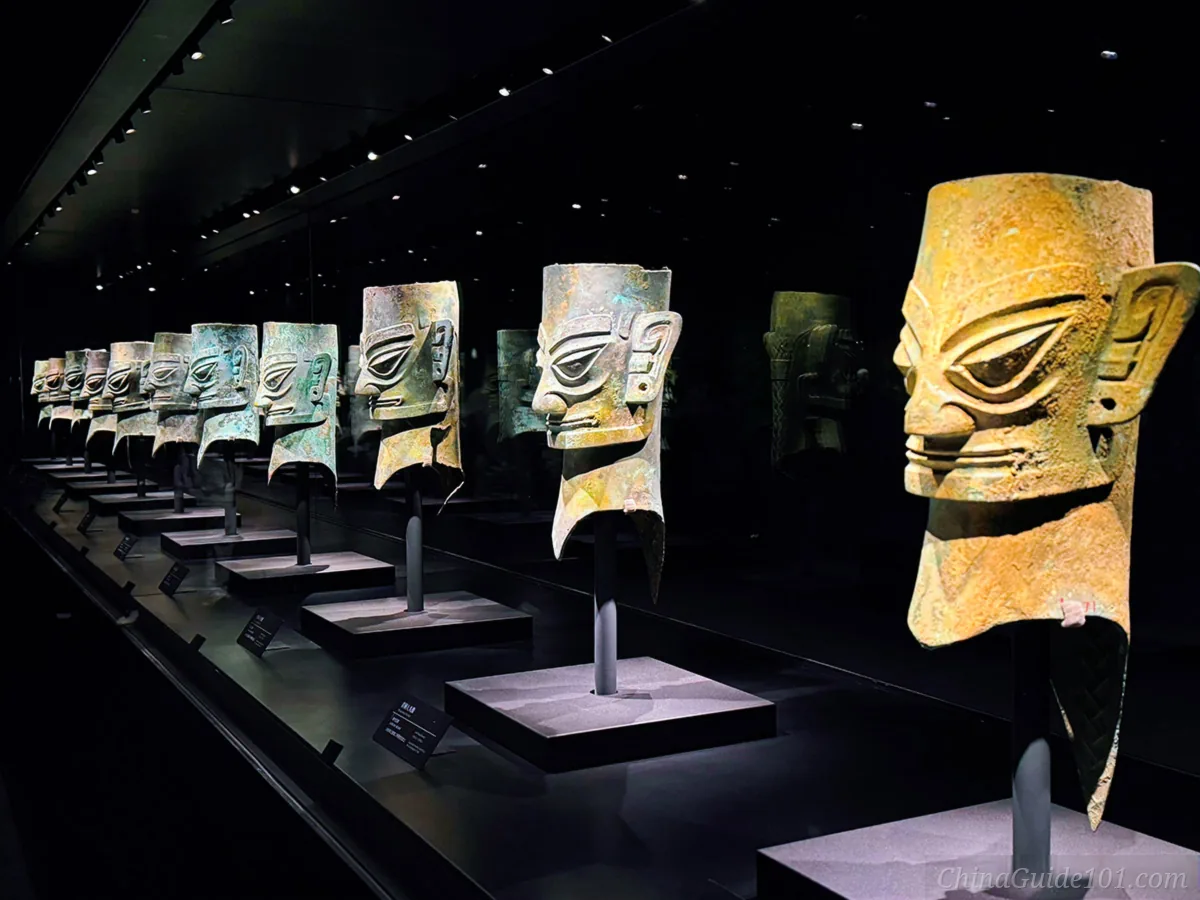
Its most celebrated finds include colossal bronze masks, towering bronze standing figures, fragments assembled into an ornate bronze sacred tree, thin gold masks and gold foil artifacts, plus finely worked jade ceremonial blades. Its distinctive bronze figures and masks make it one of the most unusual surviving artistic traditions of Bronze Age China. This collection offers visitors a rare window into a civilization that left no known written records.
Why Does Sanxingdui Look So Different?
Sanxingdui's exaggerated eyes, ears and facial features can look unfamiliar to visitors more familiar with the imperial art and architecture found elsewhere in China. These forms were part of a distinctive Bronze Age ritual tradition and should not be interpreted as realistic portraits.
- Current research points to a sophisticated local society with its own beliefs, ritual traditions and artistic style. Archaeological interpretation continues to evolve as new pits and artifacts are uncovered, especially discoveries made from 2020 onward. They are best understood in the context of ancient Shu beliefs and ritual practices.
- Their unusual appearance has also led to online speculation about extraterrestrial origins, but there is no archaeological evidence for such claims.
Sanxingdui Museum Tickets
Ticket Prices
Official 2026 pricing for the main exhibition halls and restoration hall is as follows:
- Adult full ticket:CNY 72
- Student discounted ticket:CNY 36 , available for full-time university undergraduates and younger students with valid physical student ID
- Free admission: Visitors aged 60 and above, children under 1.3 metres, active military personnel and people with disabilities. Free entry still requires advance reservation.
All ticket types grant entry to the main exhibition buildings, restoration hall and museum grounds. Separate fees apply for audio guides or English guided tours.
Do You Need to Book in Advance?
Advance online booking is required. No walk-up tickets are sold at the gate. You should not travel to Guanghan without a confirmed reservation.
PRO TIP: TICKET RELEASE TIMES
Tickets release online at 20:00 each day for entry up to 5 days ahead of your planned visit. During Golden Week, Spring Festival and other major holidays, holiday window tickets are released in bulk batches. Use the museum's official website, WeChat account or mini-program for bookings. For international visitors who prefer an English interface and passport-friendly booking flow,Trip.com is a widely used platform for reservation assistance. The museum states it has not authorised third-party resellers for admission tickets. Avoid unofficial sellers, as the validity of tickets purchased through unauthorised channels cannot be guaranteed.
Tickets sell out quickly on weekends and school holidays. Lock in your booking window before travelling from Chengdu.
Can Foreign Visitors Book With a Passport?
Yes, foreign visitors can book using a passport. Use the dedicated inbound visitor booking channel on the official platform. Enter passport information exactly as printed on your passport, matching names and numbers precisely. After completing reservation via the inbound visitor portal, visitors need to present their original passport at the ticket service counter for ticket exchange before entering.
What If Tickets Are Sold Out?
If your preferred date is fully booked, select another available date. Check the official booking page periodically; cancelled reservations are sometimes released back into the pool. Do not travel to Guanghan hoping to buy leftover tickets at the gate.
- Legitimate guided tour packages that include pre-reserved admission may be an alternative, but verify the provider works through official ticketing systems.
- Avoid scalpers or unofficial agents promising guaranteed entry.
Sanxingdui Museum Opening Hours
Regular Hours
Normal operating season (March to June, September to October):
- Main exhibition buildings: 08:30–18:00, last admission at 17:00
- Restoration Hall: 09:00–17:00
Extended Hours
During January–February (winter holiday) and July–August (summer vacation), plus major national holiday periods, the museum extends opening hours:
- Main exhibition buildings: 08:30–20:00, last admission 18:00. Evening entry tickets start check-in at 17:00.
- The restoration hall does not follow this extended schedule and closes earlier.
Restoration Hall Hours
Do not confuse the main exhibition hall closing time with the restoration/conservation area. The restoration hall keeps shorter hours and may close before the main buildings, even on days with evening extended opening. If watching conservators clean and reconstruct artifacts is a priority, arrive early enough to fit this stop before it shuts.
PRO TIP: MONDAY VISITS
Sanxingdui is generally open seven days per week. The only regular full closure each year is Chinese New Year's Eve. Temporary closures may be announced via official notices for maintenance or special events, so double-check opening status the morning before your trip. This makes Sanxingdui convenient for visitors whose Chengdu itinerary falls on a Monday.
How to Get to Sanxingdui Museum from Chengdu
This is the recommended route for most independent travellers. High-speed trains run frequently between Chengdu East Railway Station and Guanghan North Railway Station, with the ride taking roughly 18 minutes.
Book train tickets in advance via China Railway 12306. Foreign visitors can purchase tickets using passports. Aim for an early morning train to leave plenty of museum time before closing.
The museum sits approximately 7 kilometres from Guanghan North Station.
- Taxi / ride-hailing: 15 minutes, roughly CNY 20–30 . This is the easiest transfer option after arriving by train.
- Bus 13: public bus service from the station to the museum, around 20 minutes. Budget-friendly but less convenient with luggage or limited Chinese.
Direct Tourist Bus
Direct tourist shuttle buses depart from popular Chengdu locations including Chunxi Road, Kuanzhai Alley and the Panda Base . These include round-trip transport, with fixed morning departures and afternoon return times. This works well if you prefer no train transfers, but you will be locked into a rigid schedule. We do not recommend this as the primary option for travellers wanting flexibility.
Taxi or Private Car
Private cars or ride-hailing from Chengdu city centre to Sanxingdui take around one hour each way, depending on traffic. This suits families, small groups or visitors who want to set their own timetable without train station transfers. It costs significantly more than the train + taxi combination.
Which Option Is Best?
| Situation | Best option |
|---|---|
| Most independent travelers | Train + taxi |
| Family/group | Private car / ride-hailing |
| Travellers who prefer a simple transfer-free trip | Direct tourist bus |
| Tight schedule | Private transfer |
How Long Do You Need at Sanxingdui?
Two hours leaves only enough time for a rushed visit. You can view the museum's best-known exhibits, but you will skip supporting galleries and contextual background. This only works if your schedule is extremely constrained.
Recommended for most visitors.This window gives time to walk the full exhibit sequence, pause at iconic bronze and gold objects, visit the restoration hall, and listen to an audio guide or read exhibit labels.
Plan your full excursion as a half-day outing. Add travel time on top of your 3–4 hours inside the museum. Total round trip from central Chengdu, including transit and museum visit, will usually occupy 6 to 7 hours.
Sanxingdui + Chengdu Panda Base?Not recommended. Both attractions can be busy, and travelling between them leaves little room for delays. If possible, visit them on separate days.
What to See at Sanxingdui Museum
Bronze Masks
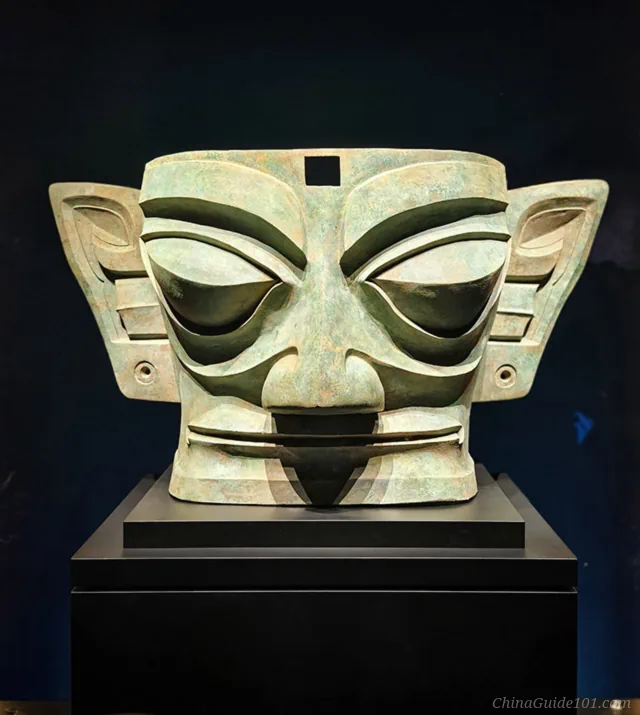
The bronze masks are Sanxingdui's signature artifacts. Many feature dramatically protruding eyes and oversized ears, crafted on a scale rarely seen in Bronze Age art. Archaeologists believe they represented spiritual beings or ancestral figures within ancient Shu ritual practices.
KEY HIGHLIGHT: BRONZE MASKS
Focus on the craftsmanship and scale while viewing these pieces. The masks were not portraits of individual rulers, but ritual objects created for communal ceremonies.
Bronze Standing Figure
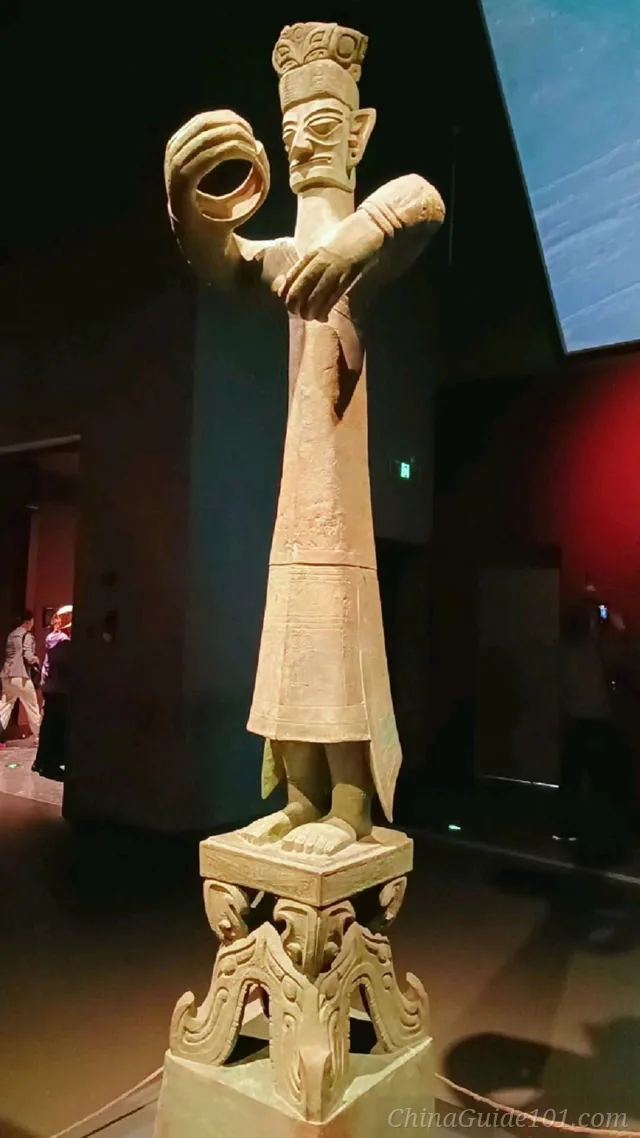
The towering bronze standing figure stands over two metres tall and wears layered, finely patterned robes. Its hands are positioned as if holding a large ceremonial object, though whatever it gripped did not survive. The figure is often interpreted as a high-ranking ritual figure, although its exact identity and function remain uncertain.
Bronze Sacred Tree
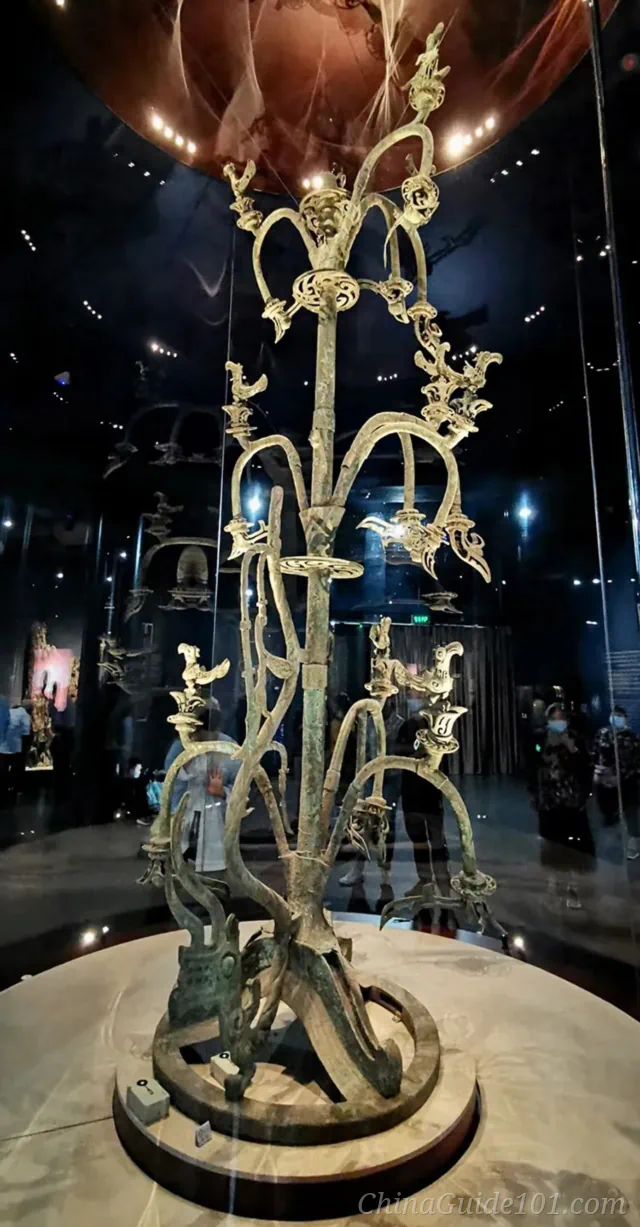
Reconstructed from hundreds of broken fragments recovered in the sacrificial pits, the bronze sacred tree reaches nearly four metres high, complete with birds and decorative branches. It is generally interpreted as a sacred or cosmological tree, possibly representing a connection between the human world and the heavens. The reconstructed tree is one of the museum's most impressive displays.
Gold Objects
The gold artifacts are surprisingly thin, hammered into sheets rather than cast. Gold mask fragments and gold foil-covered ceremonial items carry huge symbolic value. Its use suggests that gold held considerable status and symbolic value in ancient Shu society. These finds also point to sophisticated craft production and access to valuable materials.
Jade and Other Artifacts
Do not overlook the jade pieces. The museum displays jade zhang blades and ritual ornaments, many intentionally broken before burial alongside bronze and gold treasures. Pottery, ivory fragments and bone objects add further context to the ritual deposits.
The Sacrificial Pits and Archaeological Story
Ancient objects were first discovered at the site in the late 1920s. Large-scale archaeological excavations began decades later. New excavation work starting in 2020 uncovered six additional sacrificial pits, yielding thousands more artifacts. The pits were not tombs. Communities deliberately smashed and buried these sacred objects as part of large-scale ritual events.
ARCHAEOLOGICAL CONTEXT
Without this context, the objects can seem like a collection of unusual statues rather than part of a larger ritual tradition.
Recommended Visitor Route
Where to Start
The main exhibition building houses the permanent galleries, organised chronologically and thematically. This is where nearly all headline artifacts are displayed. The restoration hall sits as a separate space, where visitors can watch conservators stabilise and reconstruct broken relics during working hours.
The easiest approach is to follow the museum's exhibition sequence: discovery and archaeology → ancient Shu society → major bronze and gold objects → sacred tree and masks → restoration hall. Start with archaeological context first, then view the spectacular objects. This order lets you understand what you are seeing, rather than just photographing striking pieces without background.
Entrance → introductory archaeology galleries → ancient Shu society → bronze masks and standing figure → bronze sacred tree → gold and jade artifacts → restoration hall → museum grounds and exit. This route follows the museum's intended flow and covers all core highlights at a relaxed pace.
Entrance → skip early introductory rooms → bronze mask gallery → bronze standing figure → sacred tree → gold artifacts → quick stop at restoration hall. This covers the museum's best-known exhibits but leaves out much of the archaeological context.
Restoration Hall
Allow some extra time if you want to watch conservation work. It closes earlier than the main galleries, so schedule it before the end of your visit.
PRO TIP: RESTORATION HALL TIMING
Allow some extra time if you want to watch conservation work. It closes earlier than the main galleries, so schedule it before the end of your visit.
Audio Guides and English Tours
Why Some Context Helps
The exhibits are much easier to appreciate with some explanation of the ancient Shu culture, ritual practices and archaeological discoveries behind them. Basic exhibit labels provide facts, but they rarely explain the ritual system, the meaning of broken artifacts or the sequence of excavations. Without context, the collection may remain visually impressive but difficult to understand.
Audio Guide
The official audio guide can be rented at the visitor service desk for CNY 30 . It covers the main exhibition building and gives context for key artifacts. For a self-guided visit, this is usually enough.
English Guided Tour
In-person English guided tours can be booked on-site in advance, subject to guide availability. These cost more than the audio guide, with fixed pricing per group. Availability cannot be guaranteed on arrival.
Which Should You Choose?
- Archaeology enthusiasts: an English guided tour adds significant value.
- Casual visitor: the audio guide is enough.
- Travelling with children: guided explanation helps make the culture easier to follow.
Sanxingdui Museum vs. Archaeological Site
Can You See the Excavation Site?
The archaeological site zone sits adjacent to the museum, but it is not the same experience. Some excavation areas are covered protective shelters. You will not walk through active dig trenches or handle artifacts.
Museum vs. Archaeological Site
The museum holds the recovered artifacts: masks, bronze statues and gold treasures. The archaeological site marks the ground location of the sacrificial pits. Most first-time visitors prioritise the museum. If you only have one half-day, spend your time inside the exhibition buildings rather than splitting time between museum and site grounds.
- Spend your time inside the main exhibition buildings to see the recovered artifacts, bronze statues, and gold treasures if you have a half-day.
- Do not expect to walk through active dig trenches or handle artifacts when visiting the archaeological site zone.
Sanxingdui vs. Jinsha Site Museum
Sanxingdui and Jinsha both tell chapters of ancient Shu civilization, but they serve different travel purposes.
| Sanxingdui | Jinsha Site Museum | |
|---|---|---|
| Location | Guanghan | Chengdu |
| Period | Earlier Shu culture | Later Shu period |
| Main appeal | Large bronze ritual objects | Archaeological site + Shu culture |
| 2026 status | Open | Closed for renovation, expected to reopen 1 May 2027 |
IMPORTANT ITINERARY NOTE
Jinsha is expected to reopen on 1 May 2027 after renovation ending on April 30, 2027. This closure detail matters, as many older travel blogs recommend pairing Sanxingdui with Jinsha. Do not build your itinerary around Jinsha if travelling this year.
Practical Tips for Visiting
- Bring the same passport used for your reservation for entry verification.
- Book admission online before leaving Chengdu; no on-site walk-up tickets are available.
- Budget 3–4 hours inside the museum, plus travel time to and from Guanghan.
- Wear comfortable walking shoes; there is a lot of standing and walking between galleries.
- Build extra buffer time for your return transport back to Chengdu to avoid missed trains.
- Double-check opening hours and temporary official notices on the museum's website before your trip.
- Flash photography is not permitted in the exhibition halls. Follow the museum's current photography rules, especially around fragile artifacts.
Frequently Asked Questions
Is Sanxingdui Museum in Chengdu?
No. It sits in Guanghan, roughly 40 km north of central Chengdu, and most travellers visit as a half-day excursion.
Is Sanxingdui Museum worth visiting from Chengdu?
Yes, if ancient art and archaeology interest you. It makes a strong half-day excursion, though it requires careful ticket planning and travel time to Guanghan.
How much is Sanxingdui Museum in 2026?
Adult tickets cost CNY 72 , student discounted tickets CNY 36 . Eligible visitors qualify for free entry, but all visitors must reserve tickets online ahead of time.
Do I need to book Sanxingdui Museum in advance?
Advance online booking is required. There are no walk-up tickets sold at the gate. Tickets release each evening at 20:00 for dates up to 5 days ahead.
Can foreigners buy Sanxingdui tickets with a passport?
Yes. Use the inbound visitor booking channel, input passport details exactly as printed, and bring your physical passport for entry verification.
How do I get to Sanxingdui Museum from Chengdu?
The best route is high-speed train from Chengdu East to Guanghan North (18 minutes), then taxi or bus the final 7 kilometres to the museum. Tourist shuttles and private cars are alternatives.
How long do you need at Sanxingdui Museum?
Most visitors need 3–4 hours inside the museum. Add travel time for the trip from Chengdu. A rushed snapshot visit can be done in two hours, but you will miss much of the archaeological context.
Can you visit Sanxingdui without a tour?
Absolutely. Independent travel is straightforward once you secure tickets and arrange transport. An audio guide provides enough context for self-guided exploration.
If you have three or more days in Chengdu, Sanxingdui is one of the best half-day excursions outside the city. The museum combines spectacular Bronze Age artifacts with a fascinating archaeological story, but it requires more planning than a typical Chengdu attraction. Book your admission in advance, allow 3–4 hours inside the museum, and leave enough time for the journey to and from Guanghan.