
Leshan Giant Buddha at a Glance
| Item | Details |
|---|---|
| Location | Leshan, Sichuan |
| Best known for | Giant stone Buddha carved directly into a river‑facing cliff |
| Main experience | Walking descent down the cliff path to the Buddha's feet |
| Alternative | Sightseeing river boat tour across the confluence of three rivers |
| Recommended visiting time | 3‑4 hours for the core scenic area |
| From Chengdu | Roughly 1.5‑2 hours total by high‑speed train plus local ground transport |
| Tickets | Separate fees for mountain scenic‑area admission and river boat tours |
| Best for | Cultural heritage visitors, landscape lovers, anyone exploring Sichuan's UNESCO sites |
PRO TIP: CHOOSING YOUR EXPERIENCE
If your schedule only allows a half‑day here, you will need to decide early: do you prioritise a close‑up ground‑level view by hiking the cliff trail, or a full panoramic perspective from the river boat? Many travellers with limited time choose the boat only, while visitors with more available hours try both experiences.
What Is the Leshan Giant Buddha?
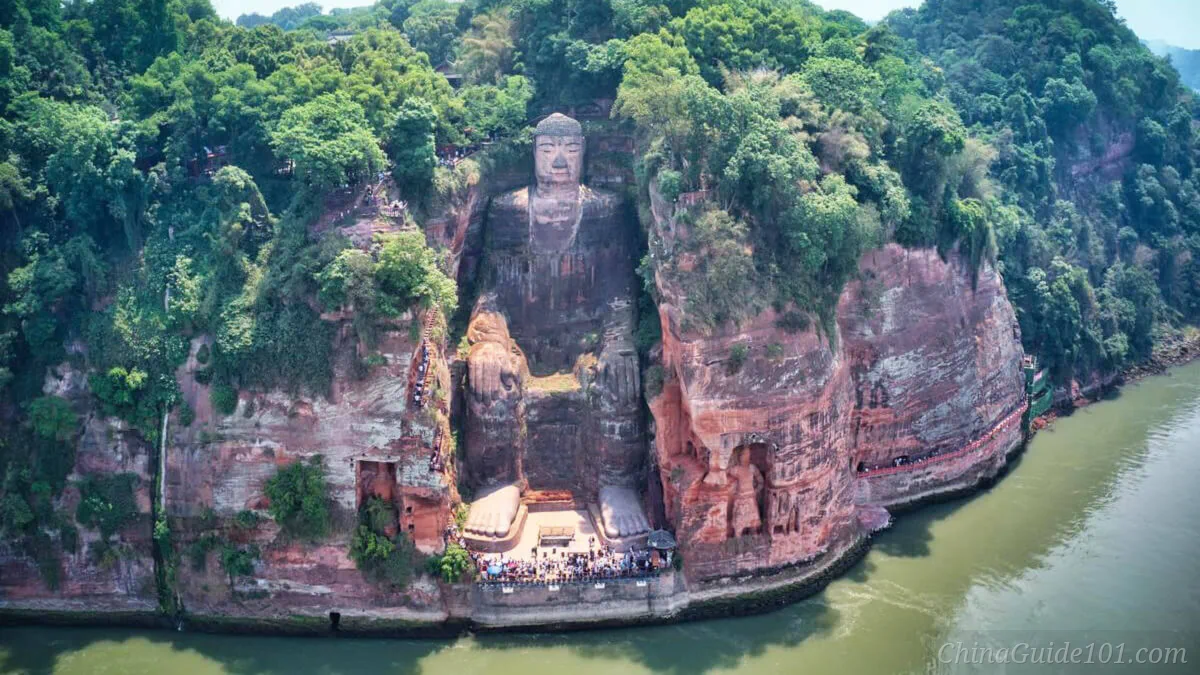
The massive seated Buddha sits right at the point where three rivers converge in southern Sichuan. Carved straight out of the steep cliff face, this monument has shaped the local landscape for more than 1,200 years. It forms one half of the combined Mount Emei‑Leshan Giant Buddha UNESCO World Heritage property.
Who Built the Leshan Giant Buddha?
Work on the statue first began in 713 AD, during China's Tang Dynasty, under the leadership of a monk named Haitong. The fast‑moving, turbulent river waters below regularly capsized wooden boats, and Haitong initiated the carving project in the hope that the giant Buddha figure would calm the destructive river currents and protect river travellers.
Haitong died before the sculpture could be finished. Construction continued over subsequent decades with financial backing from regional officials, and the carving work was completed nearly 90 years after it had first started.
How Big Is the Leshan Giant Buddha?
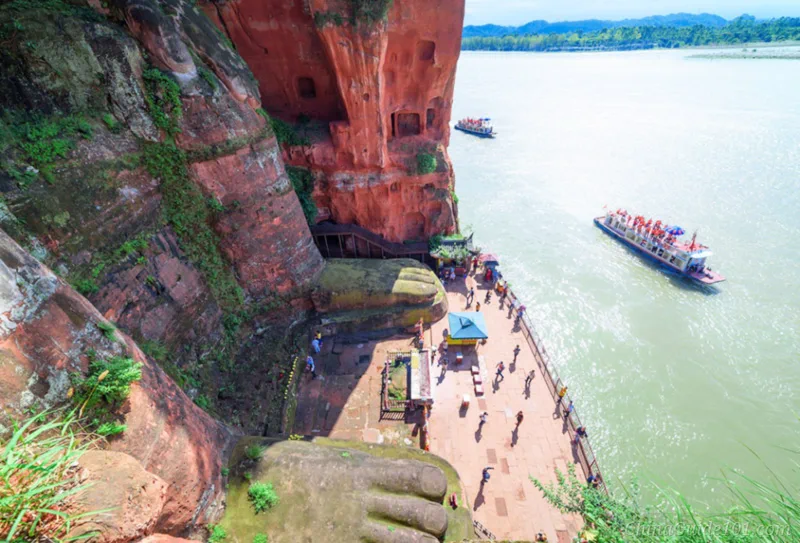
Standing at 71 metres in total height, this is the largest surviving ancient stone‑carved seated Buddha in China. Its head alone stretches more than 14 metres high, with ears reaching almost 7 metres in length. The enormous stone feet at the base are wide enough that dozens of adult visitors can stand across them at one time. Standing on the viewing platform near the feet, you get a clear physical sense of just how impressive this man‑made cliff carving really is.
Why Is the Leshan Giant Buddha Famous?
Its reputation comes not only from its sheer physical scale. The project represents ambitious Tang‑era cliff‑side stone‑carving engineering. Placed exactly at the three‑river junction, the statue forms a dramatic integration of human‑made sculpture and rugged natural riverside terrain. Along with nearby Mount Emei, the whole landscape was listed as a UNESCO World Heritage Site, drawing cultural travellers from every part of the world.
How to Visit the Leshan Giant Buddha
You have two fundamentally different ways to experience the Giant Buddha. Many first‑time visitors do not realise these are separate experiences, with separate tickets.
Walk Down to the Buddha
Buying the main scenic‑area ticket allows you to enter the mountain‑side site. You start at the upper level, near the top of the Buddha's head. From there you follow the narrow one‑way cliff‑hugging plank path downhill toward the statue's feet.
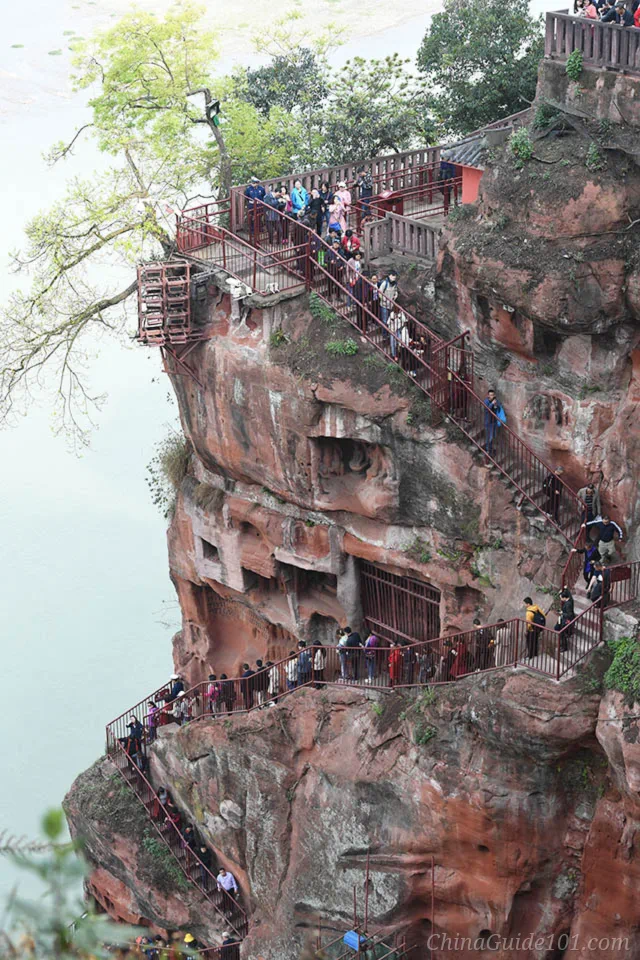
This route takes you past old grottoes and small temple buildings on the mountainside before you arrive at the lower viewing platform. Here you stand directly below the massive seated Buddha and gaze steeply upward.
It is important to note that this is not a flat, easy sightseeing trail. The descent consists of many steep stone steps, and once you reach the bottom you must climb all the way back uphill to exit the mountain section. During peak travel dates and holiday seasons, queues on this one‑way descending path can become very long.
Take a River Boat
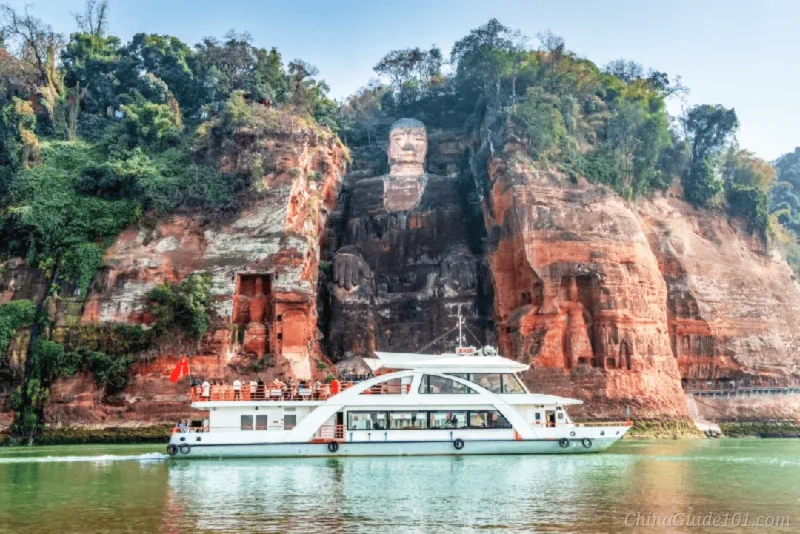
The river‑based boat tour keeps you entirely on the water. From the boat you drift across the river to face the cliff, giving you an unbroken horizontal view across the full height of the giant seated statue.
Since you stay on the vessel, there is almost no walking or stair‑climbing required. This makes the boat a practical alternative for older visitors, people with knee trouble, or travellers on a tight schedule. The boat also lets you observe the wider landscape of the three‑river confluence.
| Walking Route | Boat | |
|---|---|---|
| View | Close‑up view from the Buddha's feet | Complete full‑statue panoramic view |
| Walking effort | Moderate, many steep stairs downhill plus uphill return | Minimal walking |
| Time needed | Longer visit within the mountain park | Shorter excursion on the water |
| Photography | Details of the lower Buddha carving | Full‑frame photos of the complete giant statue against the cliff |
| Best suited for | First‑time visitors with reasonable mobility and sufficient time | Visitors with limited mobility, travellers short on available hours |
Leshan Giant Buddha Tickets and Opening Hours
How Much Is the Leshan Giant Buddha Ticket?
The standard 2026 rates are currently:
‑ Mountain scenic‑area admission (to walk inside the park and down the cliff path):CNY 80 for adults; discounted CNY 40 for eligible students and seniors. Children under 1.2 metres tall may enter Free of charge.
‑ River sightseeing boat ticket (separate, does not grant entry to the mountain park):CNY 70 per adult. Children under 1.2 metres may qualify for Free admission with valid documentation, with no other general discounts available.
These two tickets are sold independently. Buying one does not automatically include access to the other experience.
PRO TIP: SEASONAL DISCOUNTS & NIGHT TOURS
Some seasonal temporary student‑focused discount programmes run through parts of the year; these limited offers are announced locally by the scenic‑site administration, so you should not rely on discounted rates unless you verify them shortly before arrival. Night river cruise and night mountain tour experiences operate separately from daytime sightseeing with distinct pricing and schedules.
How to Book Leshan Giant Buddha Tickets
There are two practical ways for international visitors to book Leshan Giant Buddha tickets: through the scenic area's official booking channels or through an international travel platform such as Trip.com.
Official booking channels
The scenic area currently offers online booking through the "大佛旅游" (Dafo Tourism) WeChat Mini Program and the Leshan Giant Buddha Scenic Area official WeChat account . The official account provides access to the "智游大佛" service and ticket booking.
Official booking is a good option if you are comfortable using Chinese-language services and WeChat.
Trip.com
For many international visitors,Trip.com is a more convenient alternative. Its English-language booking page currently offers Leshan Giant Buddha admission tickets, including a ticket category specifically for non-Chinese mainland visitors . You can select your visit date, enter your traveler details and complete payment through the platform. Trip.com also supports international-language interfaces and provides booking support for overseas travelers.
Check Leshan Giant Buddha tickets on Trip.com
Prices and available ticket types on Trip.com can change according to the date and package selected, so compare the current price with the standard scenic-area price before booking.
Booking Tickets as an International Visitor
Whichever booking channel you use, carry your original physical passport when visiting the scenic area. Make sure the name and passport details in your reservation match the document you will present.
For the daytime river boat, international visitors booking with a passport need to take the original passport to the designated ticket window to exchange the booking confirmation for a paper ticket before boarding.
If an online booking cannot be completed with your passport, the North and South Visitor Centres provide on-site ticketing assistance. Their ticket windows have translation equipment for international visitors.
Do You Need to Book in Advance?
Advance booking is recommended, particularly for weekends, summer holidays and major Chinese public holidays. Daytime mountain visits use real-name, time-slot reservations, and popular periods can fill up.
For peak travel dates, check ticket availability as soon as your travel date is fixed.
Even with a confirmed reservation, allow extra time for queues on the one-way cliff path down to the Buddha's feet during busy periods.
Do You Need to Book in Advance?
The scenic area uses real‑name, time‑slot reservations for daytime visits. Check the available entry slots when booking, especially during weekends and Chinese public holidays.
- Foreign visitors should carry their passport. If the online booking system does not support your passport details smoothly, use the designated ticket counter and follow the scenic area's current ticketing instructions.
- Passport holders taking river boat tours need to exchange their booking confirmation for a physical paper ticket at on‑site windows before boarding.
- Book at least one or two days ahead during weekends, summer school holidays, and major Chinese national holiday weeks when reservations fill up quickly.
- Don't expect zero wait time even with a pre‑purchased ticket; you may still face substantial waiting times for the one‑way descending cliff plank walk during busier periods.
Opening Hours
Operating times shift between the warmer high‑season months and the cooler low‑season winter period, per 2026 official scenic area rules.
‑ Mountain scenic area: 07:30 – 18:30
‑ Day‑time river boat departures: 08:00 – 18:30, rolling departures every 30 minutes or once boats reach full capacity
‑ Mountain scenic area: 08:00 – 17:30
‑ Day‑time river boat departures: 08:00 – 17:00
PRO TIP: TIME SLOTS & WEATHER DELAYS
Daytime visits are assigned to fixed time slots: 07:30–10:30, 10:30–14:30, 14:30–16:30, and 16:30–18:30. Check your booking confirmation for the permitted entry period rather than treating the closing time as the latest arrival time. Boat services can be suspended temporarily when river water levels rise or during heavy rain; keep this potential disruption in mind when planning your itinerary. Always cross‑check official opening announcements shortly before your travel day.
Leshan Giant Buddha Walking Route
Where Does the Walking Route Start?
Most visitors enter the scenic site via the North Gate. After passing through the main entrance gates, you will follow paved trails uphill and through the grounds of Lingyun Temple until you reach the viewing platform at the top level, beside the Buddha's head. This upper platform gives you your first close‑range sight of the giant carving.
PRO TIP: ONE-WAY ROUTE & UPHILL RETURN
The route down to the Buddha's feet is one-way: you descend along the cliff path on one side. Once you've finished viewing at the feet, you cannot go back the same way — you must climb up a different path on the other side to exit the site.
How Long Does the Walking Route Take?
Times will vary heavily depending on how long you wait in queues for the descending cliff path:
- Quick visit (with short waiting):roughly 2 hours total inside the mountain scenic zone
- Standard unrushed sightseeing:3‑4 hours
- Relaxed pace including stops at Lingyun Temple and surrounding historic buildings:4‑5 hours
PRO TIP: PEAK QUEUE DELAYS
On peak‑season weekends or national holidays, waiting time for the descent path alone can stretch to one, two or even three extra hours, and you need to build this potential delay into your day's schedule.
Is the Stairway Difficult?
The descending plank path includes many steep stone steps, and the trail itself is narrow in several sections. It runs one‑way only down the cliff face.
- Wear closed‑toed, non‑slip walking shoes; the stone steps can become slippery after rainfall.
- Evaluate carefully whether this walking route is suitable for you if you have bad knees, struggle with steep stairs, or are travelling with a stroller, as the return climb back uphill after reaching the feet poses a physical challenge.
- Don't expect a continuous downhill stroll—the physical challenge comes on the return climb back uphill after you have reached the Buddha's feet.
Can You See the Buddha Without Walking Down?
Yes. If you prefer to avoid the steep stair descent and the associated long queue, the primary alternative is the river boat tour. The boat will not bring you to the statue's feet, but it delivers that famous full horizontal view of the complete Buddha carved on the cliff.
Leshan Giant Buddha Boat Tour
What Does the Boat Tour Show?
Boats travel out onto the broad river, stopping for a short interval directly opposite the cliff. From the water you look back toward the giant seated Buddha, with the surrounding mountain ridges and the confluence point of the three rivers filling out the background landscape. This perspective makes it much easier to photograph the Buddha's full height in a single frame. Depending on the route, the boat ride can also provide views of the Giant Sleeping Buddha, a natural formation created by the surrounding mountain ridges, an iconic natural‑landscape feature unique to Leshan's riverfront scenery.
How Long Is the Boat Ride?
A typical daytime sightseeing boat trip takes around 30–40 minutes, although operating times can vary with river conditions and weather. Boats depart on a rolling schedule rather than running strictly to fixed timetables, with services pausing entirely in heavy rain or flood‑level conditions.
Is the Boat Better Than Walking?
There is no universal better option; your choice depends entirely on your constraints.
| Priority / Constraint | Recommended Choice |
|---|---|
| If your available time is very limited | The boat tour is faster. |
| If you hope to stand right underneath the massive sculpture for a close‑up experience | Choose the mountain walking route. |
| If you have limited mobility or joint concerns | The river boat will generally be more comfortable. |
| If you want the classic full‑statue photograph | The river boat perspective works best. |
| If you have ample time for your visit | Some travellers choose to do both the mountain walk and the boat tour, seeing the monument from two distinct viewpoints. |
How Much Time Do You Need at the Leshan Giant Buddha?
| Visit Type | Time Required |
|---|---|
| Quick visit | 2 hours |
| Standard visit | 3‑4 hours |
| Relaxed visit including temple stops | 4‑5 hours |
| Giant Buddha plus nearby local sites in Leshan | Half‑day or longer |
Is 3 Hours Enough for the Leshan Giant Buddha?
PRO TIP: PLANNING FOR CROWDS
Three hours can work for a standard visit on a quieter weekday, provided you do not face very long queues on the descending cliff path. If you are travelling on a busy weekend or a national holiday, add extra buffer time for waiting. On crowded dates, three hours may only barely cover the walking route, leaving you no spare time to explore surrounding temple grounds.
How to Get to the Leshan Giant Buddha
From Chengdu to Leshan
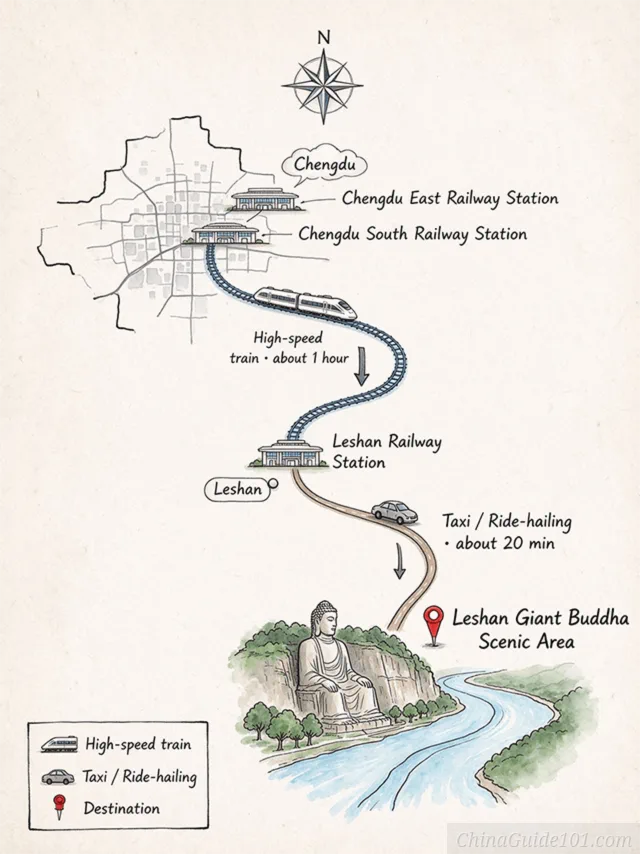
High‑speed rail is a convenient way to travel from Chengdu to Leshan. Trains run regularly from Chengdu East Railway Station or Chengdu South Railway Station to Leshan Railway Station. The train journey itself takes between 45 minutes and one hour.
PRO TIP: STATION SELECTION
Do take care to book tickets to Leshan Railway Station , not Leshan North station, which sits further away from the scenic zone and adds significant extra travel time.
From Leshan Railway Station to the Giant Buddha
Once you arrive at Leshan railway station you still need local transport to the attraction:
- Taxi or ride‑hailing vehicle:around a 20‑minute ride to the scenic‑area North Gate, the most convenient option for international visitors
- Local city buses:also connect the railway station with the Giant Buddha area, but routes and operating arrangements can change frequently. Check the latest local transit information after arrival if you plan to take public buses.
Most visitors aim to arrive at the main North Gate entrance of the Giant Buddha scenic area.
Can You Visit the Leshan Giant Buddha as a Day Trip from Chengdu?
Yes. Leshan Giant Buddha is one of the more straightforward major cultural attractions for a day‑trip out of Chengdu . Even so, a successful one‑day outing requires careful scheduling of your train times and accounting for potential queues at the site.
Leshan Giant Buddha One‑Day Trip from Chengdu
This sample timeline offers a practical framework for planning your day‑trip. Actual train departures will shift seasonally, so adjust timings around your confirmed rail schedule.
Take a high‑speed train from Chengdu to Leshan
Arrive in Leshan and travel onward to the Giant Buddha scenic site
Sightseeing inside the Giant Buddha mountain scenic zone
Lunch in Leshan; local Sichuan dishes are easy to find close to the scenic zone
Optional short walk through Leshan Old Town for casual sightseeing
Make your way back to Leshan railway station
Take the high‑speed train back to Chengdu
PRO TIP: ADDING THE BOAT TOUR
If you also intend to add the river boat tour to your day, allow extra 40‑60 minutes for that activity and shift your whole schedule slightly earlier.
Best Time to Visit the Leshan Giant Buddha
Best Season
Spring (March‑May):Temperatures are generally mild. Rain showers can happen from time to time, and visibility across the river varies after rainfall. This can be a pleasant visiting window outside peak crowds.
Summer (June‑August):Hot and humid. Summer school holidays also bring large visitor numbers and very long queues on the cliff descent path. An early arrival is especially useful during these months because queues can become much longer. Heavy summer rain occasionally disrupts boat trips.
Autumn (September‑November):Many travellers regard autumn as a favourable visiting season. Humidity falls, river visibility is often good, though the early‑October national holiday week brings extreme crowds.
Winter (December‑February):Cooler weather, far fewer visitors on weekdays. Days are shorter, so note the earlier closing hours for both the mountain park and river boats. Mornings can sometimes bring river mist that temporarily obscures the Buddha statue.
Best Time of Day
PRO TIP: AVOIDING PEAK QUEUES
Early morning, right after opening:This is the most reliable window for shorter queues on the steep descending plank trail. Larger tour groups generally arrive later in the morning.
Mid‑day (roughly 10 AM‑2 PM):This is when visitor numbers peak, and waiting times for the downhill path are at their longest. If you can avoid arriving during this mid‑day block, you will save significant waiting time.
Late afternoon:Crowds gradually start to thin in the later afternoon hours, and soft late sunlight can be nice for photography. Keep the published closing hours firmly in mind; do not arrive too late in the afternoon, or you may miss your chance to descend the cliff path.
Leshan Giant Buddha + Mount Emei
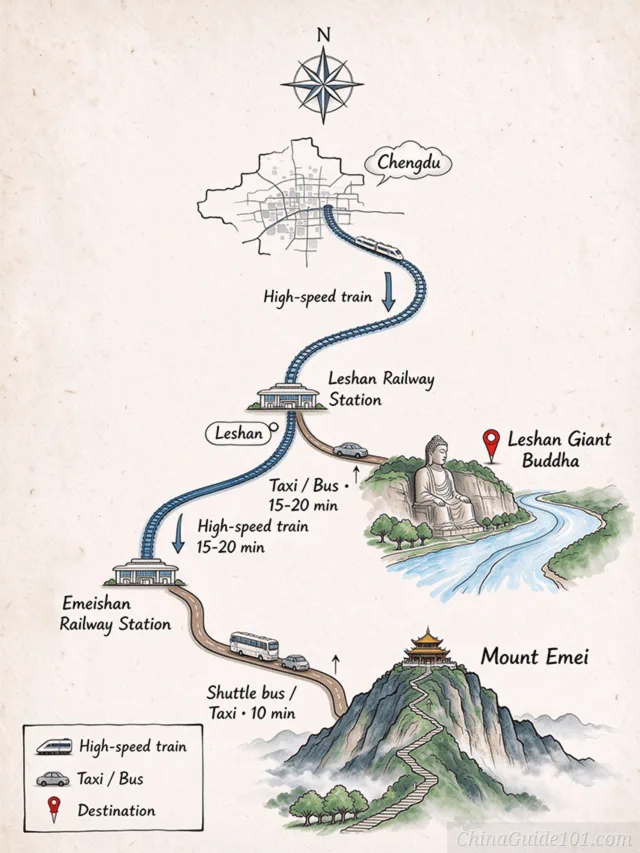
As two parts of the same UNESCO World Heritage listing, Leshan Giant Buddha and Mount Emei are very frequently grouped together on Sichuan travel itineraries. The two cities are connected by a short train journey.
Can You Visit Leshan and Mount Emei on the Same Day?
Technically, it can be done, though this tight one‑day schedule is not ideal for most visitors. Leshan alone requires a minimum of three hours of sightseeing. Mount Emei is a huge mountain‑based scenic site; to reach the famous Golden Summit on the mountain's high plateau you will spend multiple hours just on mountain shuttle buses and cable cars.
PRO TIP: ITINERARY PACING
Trying to cover both in one day leaves very little time at either site and usually requires a very early start.
Leshan and Emei: One Day or Two Days?
| Plan | Best for |
|---|---|
| One‑day trip only to Leshan Giant Buddha | Travellers with limited overall Sichuan itinerary time |
| One‑day trip only to Mount Emei | Itinerary focused primarily on mountain scenery and sacred mountain temples |
| Two‑day itinerary covering both Leshan Giant Buddha and Mount Emei | Most visitors wanting a more relaxed, complete experience of this UNESCO heritage area |
Other Things to See in Leshan
Lingyun Temple
Lingyun Temple sits within the Giant Buddha mountain scenic area itself. Most walking itineraries through the park pass through the temple grounds on the way toward the Buddha‑head viewing platform. This ancient Buddhist monastery existed before the giant Buddha carving was begun, and you will walk through its courtyards as part of your standard mountain‑site route.
Wuyou Temple / Wuyou Mountain
Across a small water channel from the main Lingyun mountain site lies quieter Wuyou Mountain, home to Wuyou Temple. If you have extra time after seeing the Giant Buddha, you can extend your walking visit here for a quieter temple experience with fewer tourist crowds.
Leshan Old Town
After finishing your visit to the Giant Buddha site, the old town area nearby works well as a casual stop for lunch or an evening meal. This is a good spot to sample local Sichuan‑style food, before you head back toward the railway station. It is not a major standalone sightseeing destination.
Where to Stay for the Leshan Giant Buddha
| Area | Best for |
|---|---|
| Leshan city centre | Visitors prioritising local restaurants and convenient city transport links |
| Accommodation near Giant Buddha scenic zone | Travellers who want to arrive early for a relaxed morning visit |
| Near Leshan railway station | Guests planning quick onward rail travel after their sightseeing |
| Lodging on or near Mount Emei | For multi‑day itineraries combining Leshan Giant Buddha and Mount Emei |
Should You Stay in Leshan or Chengdu?
PRO TIP: OVERNIGHT VS. DAY TRIP
If you are only planning a quick one‑day outing, you can comfortably travel out and back on the same day from Chengdu without overnight accommodation in Leshan. If you want to avoid a very early morning train out of Chengdu, or if your itinerary continues onward to Mount Emei the following day, spending one overnight in Leshan or Emeishan makes sense.
Practical Tips for Foreign Visitors
- Always carry your physical passport. It is your primary identity document when booking, verifying entry, and exchanging boat tour tickets at the scenic area.
- Follow real‑name, time‑slot booking rules. Where online reservation systems do not easily support foreign passports, on‑site ticket windows are your reliable backup option for purchasing and exchanging tickets.
- Carry a backup payment method, especially if you are relying on mobile payment for transport, food or small purchases.
- Wear sturdy, non‑slip walking shoes if you intend to descend the cliff‑side stairway. The stone steps can be slippery after rain.
- Manage your expectations for waiting times. The narrow one‑way descent path creates unavoidable queues on busy travel days.
- Bring drinking water and sun protection for summer visits; shade is limited along sections of the mountain walking trail.
- Use lockers available near the main visitor centre to leave larger bags before starting your walking tour if you have luggage.
- Take advantage of translation devices at scenic area service windows designed to assist international visitors with ticket purchases and inquiries.
- Do not trust street‑side scalpers selling unofficial "fast‑track" or shortcut tickets for the Giant Buddha scenic area; these offers are not legitimate.
Leshan Giant Buddha FAQ
Is the Leshan Giant Buddha worth visiting?
For visitors interested in Chinese Buddhist heritage and dramatic cliff‑side historic sculpture, the site delivers a distinctive experience. Whether it is worth a dedicated trip depends on your Sichuan travel schedule. If you are already travelling through this region of Sichuan, many travellers find the stop rewarding.
How long do you need at the Leshan Giant Buddha?
Plan for a minimum of 3‑4 hours for the main mountain‑scenic‑area visit, plus extra time if you also want to complete the river boat tour or wait in long queues on the cliff descent.
Can you see the Giant Buddha without taking the stairs?
Yes, the river sightseeing boat tour offers the main alternative, giving you a panoramic river‑level view without descending the cliff‑side stone stairway. You will not get the close‑up ground‑level perspective at the Buddha's feet when choosing the boat only.
Is the Leshan Giant Buddha difficult to walk?
The core challenge comes from the uphill return climb after you reach the Buddha's feet at river level. The trail is narrow with many uneven, steep stone steps. Visitors with knee concerns may prefer to stick with the boat sightseeing option.
Can I buy tickets with a passport?
Foreign visitors should bring their passport. If the online system does not support your passport details, follow the scenic area's current instructions and use the designated ticket counter if required. Some boat‑tour bookings for passport holders also require an on‑site paper ticket exchange.
Is a day‑trip from Chengdu feasible?
Yes, it is absolutely feasible for reasonably early risers. Keep in mind you will still need to factor in local transfers and potential long queues on the cliff descent path during weekends and holidays.
Should I combine Leshan Giant Buddha with Mount Emei?
You can pair them on your Sichuan itinerary, but trying to squeeze both sites into one single day creates a rushed experience for most travellers. A two‑day schedule will deliver a much more relaxed visit to both heritage locations.
What is the best time of year to visit Leshan Giant Buddha?
Autumn generally offers pleasant temperatures and good river visibility. If you hope to avoid crowds, visit on a weekday outside Chinese public holiday periods. Winter weekday visits see far fewer tourists, though early‑morning river mist can occasionally obscure the statue.
Can I bring my luggage inside the scenic area?
Large rolling suitcases are not practical on the narrow cliff descent trail. Free‑to‑use visitor‑centre lockers are available near the main North Gate, so you may store big bags before entering. Small backpacks are fine to carry while sightseeing.
Are there restaurants or food stalls within the site?
Only a very small number of simple snack stalls can be found inside the mountain scenic grounds. Do not count on a full‑scale meal inside. Most visitors plan their proper lunch either before entering or after exiting the park, in nearby parts of Leshan.
Are there restrooms along the cliff walking trail?
Restroom facilities exist at the upper zone near Lingyun Temple. Once you start going down the one‑way cliff descent path, toilet options become extremely limited. If needed, use facilities on the upper plateau before you start heading downhill.
Can I buy boat tickets separately without buying mountain admission?
Yes. River boat sightseeing tickets are sold completely independently. You may book the boat only if you merely want the river‑side panoramic view, with no requirement to purchase entry to the mountain scenic area.
Is the boat tour better than walking?
There is no straightforward answer. The boat gives you a complete panoramic shot from across the water, while the walking route lets you stand directly beneath the giant statue. Your final choice depends on your available time, mobility, and what kind of viewpoint you hope to prioritise.
How long does the boat tour take?
A typical daytime sightseeing boat trip runs roughly 30‑40 minutes. Sailing duration is not fixed; it can shorten or lengthen depending on river water levels, weather, and how many vessels are operating that day.
What should I bring to the Leshan Giant Buddha?
Pack sturdy non‑slip walking shoes, sun protection and drinking water. Always carry your physical passport for ticketing purposes. If you visit on rainy days, a lightweight rain jacket is recommended, as parts of the cliff trail offer very little shelter.